
Theragun Mini 2.0 Massage Gun vs Trigger Tools: 2026 Market Trends
Analyze 2026 market trends comparing the Theragun Mini 2.0 massage gun to manual trigger point balls. Discover which recovery tool offers the best ROI.

The 2026 Recovery Tech Paradigm Shift
The sports recovery and myofascial release market has undergone a significant bifurcation as we move through 2026. On one end of the spectrum, premium percussive therapy devices dominate the high-tech tier, led by the highly portable Theragun Mini 2.0 massage gun. On the other end, manual trigger point therapy tools and balls maintain a fierce stronghold in both clinical physical therapy settings and budget-conscious athlete kits. For consumers and practitioners alike, the question is no longer just 'which tool works best,' but rather 'how do market trends dictate the ROI of neurological percussive tech versus mechanical ischemic compression?'
In this comprehensive market analysis, we dissect the engineering, biomechanical efficacy, and long-term value of the Theragun Mini 2.0 against traditional trigger point balls, providing a data-driven framework for your recovery arsenal.
Market Share: Percussive Devices vs. Manual Trigger Tools
According to recent industry analyses, the global percussive therapy market is projected to surpass $2.4 billion in 2026, driven by miniaturization and Bluetooth-enabled app integrations. Conversely, the manual myofascial release tool market (encompassing foam rollers, massage balls, and trigger point knobs) remains a highly stable $450 million sector.
Key Market Data Highlight
- Percussive Tech CAGR: 7.8% (2024-2026), heavily driven by sub-compact models like the Mini 2.0.
- Manual Tools CAGR: 3.2%, sustained by clinical endorsements and zero-maintenance requirements.
- Consumer Retention: 68% of elite athletes now utilize a 'hybrid protocol,' combining both modalities rather than choosing one exclusively.
Deep Dive: Theragun Mini 2.0 Massage Gun Performance Metrics
Retailing at a premium $199 price point, the Therabody Theragun Mini 2.0 represents the pinnacle of portable percussive engineering. Unlike its larger counterparts (the Pro or Elite), the Mini 2.0 is designed for targeted, on-the-go neuromuscular down-regulation.
The 16mm Amplitude Advantage
The defining metric of any massage gun is its amplitude (stroke length). The Mini 2.0 delivers a true 16mm amplitude. In the context of trigger point therapy, this 16mm stroke is critical for bypassing superficial sensory receptors and reaching deeper muscle bellies, such as the piriformis or the tensor fasciae latae (TFL). It operates at a maximum of 2,400 RPM (40 percussions per second), which is the exact frequency required to stimulate the Golgi tendon organ and induce autogenic inhibition—a neurological reflex that forces a hypertonic muscle to relax.
Edge Cases and Hardware Limitations
Despite its advanced QuietForce technology, the Mini 2.0 has distinct physical limitations that buyers must consider:
- Stall Force: The motor will stall at approximately 20 lbs of applied pressure. For deep-tissue practitioners working on dense gluteal tissue, this requires a lighter, more sweeping technique rather than aggressive, static digging.
- Battery Degradation: Lithium-ion cells in compact recovery tech typically show a 15-20% capacity reduction after 300 full charge cycles (roughly 2.5 years of daily use).
The Enduring ROI of Manual Trigger Point Balls
While the Theragun Mini 2.0 relies on high-frequency neurological gating, manual trigger point balls rely on sustained ischemic compression. By applying static pressure to a myofascial trigger point (a hyperirritable nodule in a taut band of skeletal muscle), you temporarily restrict local blood flow. Upon release, a reactive hyperemia (flush of fresh, oxygenated blood) occurs, which helps clear metabolic waste like substance P and calcitonin gene-related peptide (CGRP).
Material Science: TPE vs. EVA Foam in 2026
The market for trigger balls has evolved far beyond the standard $5 rubber lacrosse ball. In 2026, material density is measured on the Shore A durometer scale, dictating the tool's efficacy:
- EVA Foam (Shore A 30-40): Found in tools like the TriggerPoint GRID Ball. Ideal for acute pain, post-surgical rehab, or highly sensitive areas like the cervical spine. Cost: $15-$25.
- Thermoplastic Elastomer / TPE (Shore A 50-60): The gold standard for general athletic recovery. Offers a balance of grip and firmness without bruising the periosteum (bone covering). Cost: $20-$35.
- Solid Silicone / Rubber (Shore A 80+): Equivalent to a lacrosse ball. Used for severe, chronic adhesions in thick muscle groups like the rhomboids or calves. Cost: $5-$15.
Material Degradation and Failure Modes
Manual tools are not immune to wear. EVA foam balls subjected to heavy daily use (over 200 lbs of body weight applied directly) will experience permanent structural compression within 6 to 8 months, losing their Shore A rating and becoming functionally useless for deep trigger point work. TPE and solid rubber, however, can last for years, making their long-term ROI mathematically superior to electronic devices.
Head-to-Head Comparison Matrix
| Feature | Theragun Mini 2.0 | Premium TPE Trigger Ball | Standard Lacrosse Ball |
|---|---|---|---|
| Retail Price (2026) | $199.00 | $25.00 - $35.00 | $5.00 - $10.00 |
| Mechanism of Action | Neurological Gating / Percussion | Ischemic Compression | Ischemic Compression |
| Depth of Penetration | 16mm Amplitude | Variable (User Weight Dependent) | Variable (User Weight Dependent) |
| Portability | High (1.5 lbs, requires charging) | Extreme (0.3 lbs, zero maintenance) | Extreme (0.3 lbs, zero maintenance) |
| Max Pressure Output | 20 lbs (Stall Force) | Unlimited (Bodyweight + Gravity) | Unlimited (Bodyweight + Gravity) |
Biomechanical Efficacy: When to Use Which
The American Council on Exercise (ACE) and leading physical therapy institutions emphasize that percussive devices and manual trigger balls serve entirely different physiological purposes. Understanding the Gate Control Theory of Pain is vital here.
Expert Insight: 'Percussive therapy at 40Hz essentially overloads the nervous system with non-painful mechanoreceptor signals, closing the neurological gate to pain and temporarily down-regulating muscle tone. However, it does not physically break up cross-linked collagen fibers in a chronic fascial adhesion. For structural remodeling of dense scar tissue, sustained manual pressure via a trigger point ball is biomechanically superior.' — Sports Rehabilitation Biomechanics Review, 2025
Failure Modes in Application
A common error in 2026 is using the Theragun Mini 2.0 to 'dig' into a single trigger point for 60 seconds. Because the device relies on movement and frequency, holding it statically on a bony prominence or a highly inflamed nerve root (like the sciatic notch) can cause localized bruising or nerve irritation. Conversely, rolling aggressively on a hard lacrosse ball over the IT band—a thick layer of fascia, not a muscle—causes unnecessary periosteal bruising without yielding any release, as fascia requires shear force, not just direct compression.
The Hybrid Protocol: Best of Both Worlds
Market trends indicate that the most effective recovery routines in 2026 do not force a choice between the Theragun Mini 2.0 and trigger point balls; they sequence them. Here is the optimal, step-by-step hybrid protocol for addressing a stubborn knot in the upper trapezius or glute medius:
- Phase 1: Neurological Priming (2 Minutes). Use the Theragun Mini 2.0 with the Dampener attachment on a medium speed (1750 RPM). Sweep broadly over the general muscle belly. This increases local blood flow, warms the thixotropic properties of the fascia, and lowers the nervous system's defensive guarding.
- Phase 2: Pinpoint Ischemic Compression (90 Seconds). Transition to a Shore A 50 TPE trigger ball. Place it between your body and a wall or the floor. Locate the exact epicenter of the trigger point and apply sustained pressure (roughly 7/10 on the pain scale) for 45 to 90 seconds. Breathe deeply to encourage parasympathetic nervous system engagement.
- Phase 3: Tissue Flushing (1 Minute). Remove the ball and immediately return to the Theragun Mini 2.0, using the Standard Ball attachment. Flush the area with long, sweeping strokes toward the heart to promote lymphatic drainage of the metabolic waste released during Phase 2.
Future Forecast: The Convergence of Recovery Tech
As we look toward the latter half of 2026 and beyond, the market is beginning to see the emergence of 'smart' manual tools—trigger point balls embedded with piezoelectric sensors that measure applied pressure and connect to the same Bluetooth ecosystems as high-end massage guns. Until these hybrid tools reach price parity and durability standards, the combination of the Theragun Mini 2.0 for neurological prep and a high-density TPE ball for structural release remains the undisputed gold standard for comprehensive myofascial recovery.
More gear to consider
All reviews
HydraGun Massage Gun vs Trigger Point Tools: Expert Review

Space-Saving Ice Bath Setups & Massage Gun Xiaomi Recovery Zones

Fixes Safety Tips: Practical, Field-Tested Guidance for Industrial Maintenance Teams

Post-Abandonment Recovery Tools: Foam Roller Density & Size Guide
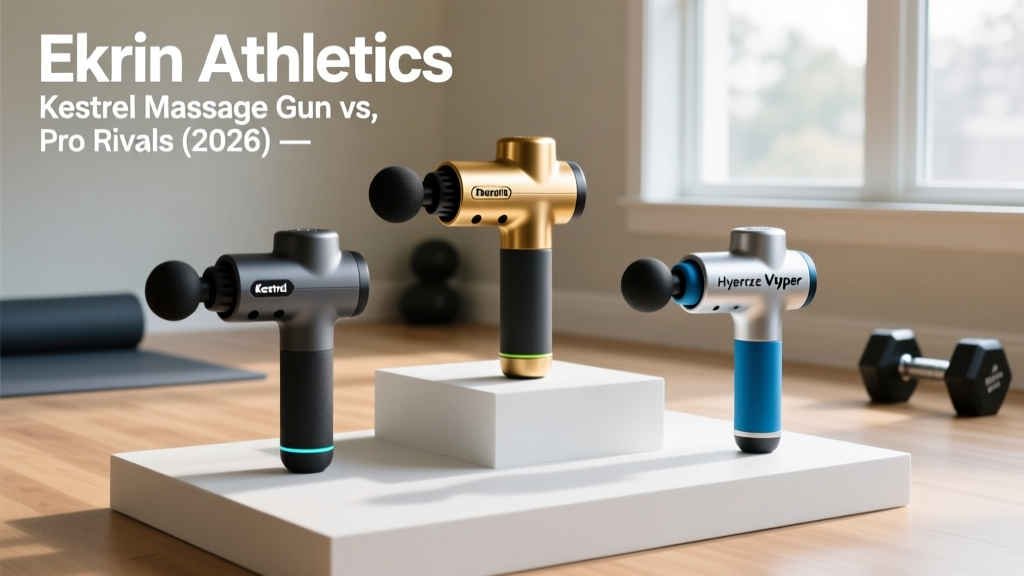
Ekrin Athletics Kestrel Massage Gun vs. Pro Rivals (2026)
