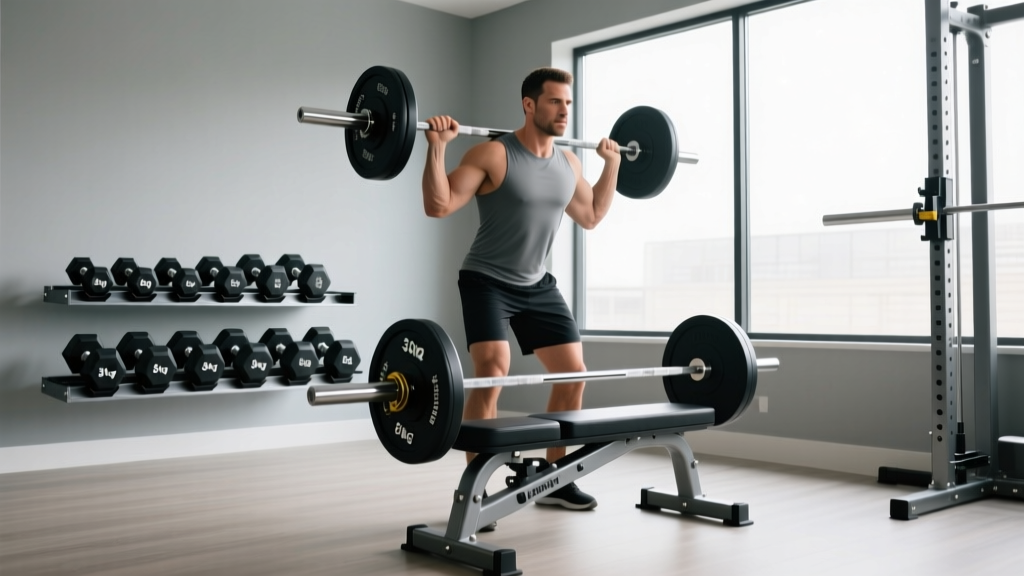
Standing Shoulder Press With Dumbbells: Form & 2026 Adjustable Picks
Learn proper form for the standing shoulder press with dumbbells and compare the best 2026 adjustable models to build your home gym safely.

Why the Standing Shoulder Press With Dumbbells is a Beginner Essential
If you are building a home gym or starting a new fitness journey in 2026, mastering the standing shoulder press with dumbbells should be a top priority. Unlike the seated variation, performing this movement while standing demands full-body integration. Your core, glutes, and stabilizers must work overtime to transfer force from the floor through your torso and into your arms. According to the American Council on Exercise (ACE), standing overhead pressing significantly increases core muscle activation compared to seated exercises, making it a highly functional movement for everyday strength.
However, beginners often struggle with two things: proper pressing mechanics and having the right equipment. Fixed-weight dumbbell racks are expensive and space-consuming, making adjustable dumbbells the undisputed champions of the home gym. In this step-by-step guide, we will break down the exact biomechanics of a safe overhead press and review the top adjustable dumbbells on the market to help you press pain-free.
Step-by-Step Form Guide for Beginners
Before we discuss gear, we must establish a safe movement pattern. Shoulder impingement is a common failure mode for beginners, usually caused by flaring the elbows out to 90 degrees. Follow this exact sequence:
- The Stance & Brace: Stand with feet shoulder-width apart. Squeeze your glutes and brace your core as if preparing for a stomach punch. This prevents 'rib flaring' and protects your lumbar spine. The Mayo Clinic emphasizes that a neutral pelvis is critical for any overhead lifting to avoid lower back compression.
- The Grip & Rack Position: Bring the dumbbells to shoulder height. Instead of pointing your elbows directly out to the sides (which grinds the rotator cuff), tuck your elbows slightly forward—about 30 degrees. This is known as the scapular plane. As noted by ExRx.net, pressing in the scapular plane aligns the humerus with the natural angle of the shoulder blade, drastically reducing impingement risk.
- The Drive: Exhale sharply as you press the weights up and slightly back. The bar path is not a straight vertical line; the weights should travel in a slight arc to finish directly over your mid-foot.
- The Lockout: Stop when your biceps are roughly in line with your ears. Do not hyperextend your lower back to push your head through the 'window' of your arms. Keep your ribs tucked down.
- The Descent: Inhale and lower the weights under control, taking 2-3 seconds to return to the rack position. Stop when the handles are roughly at chin/collarbone level to maintain tension on the anterior deltoids.
If you feel a pinch in your lower back or notice your ribs popping up toward the ceiling as you press, you have run out of shoulder mobility. Do not compensate by arching your spine. Lower the weight, work on your thoracic extension, and stick to a neutral-grip press until your mobility improves.
The Adjustable Dumbbell Dilemma: Overhead Clearance
When transitioning to adjustable dumbbells for the standing shoulder press with dumbbells, beginners quickly discover a unique mechanical hurdle: bell clearance. Standard hex dumbbells have compact heads. Adjustable dumbbells, however, house weight trays and dials, making them significantly longer. If you press with a standard pronated (palms-forward) grip, the bulky ends of most adjustable dumbbells will violently clang together at the top of the movement, forcing your wrists into awkward ulnar deviation.
The Fix: Always use a neutral grip (palms facing each other) or press strictly in the scapular plane with a semi-neutral grip when using adjustable models. This keeps the bulky weight blocks out of each other's way.
2026 Adjustable Dumbbell Comparison for Shoulder Pressing
Not all adjustable dumbbells are created equal, especially when taken overhead. Handle length, weight distribution, and the physical footprint of the weight blocks dictate how comfortable your shoulder press will be. Below is a comparison of the top three models dominating home gyms in 2026.
| Model | Max Weight | Overall Length | Overhead Clearance Rating | 2026 Est. Price (Pair) |
|---|---|---|---|---|
| Nuobell 80lb | 80 lbs | ~14.5 inches | ⭐⭐⭐⭐ (Excellent) | $349 |
| Bowflex SelectTech 552 | 52.5 lbs | ~14.5 inches | ⭐⭐ (Poor) | $399 |
| PowerBlock Elite USA | 50-90 lbs | ~12 inches | ⭐⭐⭐⭐⭐ (Superior) | $389 |
Deep Dive: Which Model Should You Choose?
1. PowerBlock Elite USA (Best for Strict Pressing)
The PowerBlock's unique caged, rectangular design makes it the most compact adjustable dumbbell on the market. At just 12 inches long regardless of the weight selected, it mimics the center of gravity of a traditional fixed dumbbell better than any competitor. For the standing shoulder press with dumbbells, this compact footprint means zero clanking at the top of the movement, even with a pronated grip. The downside? The caged handle can feel restrictive for users with very large hands or thick wrists during deep rack positions.
2. Nuobell 80lb (Best Overall Feel & Heavy Progression)
The Nuobell utilizes a twisting handle mechanism that drops weight plates seamlessly. It feels the most like a traditional dumbbell because the handle is fully exposed and knurled. However, because the steel plates extend outward, you must use a neutral or scapular-plane grip overhead to avoid the plates colliding at the lockout. It is the premier choice for beginners who plan to get strong quickly and need 5 lb micro-loading increments up to a heavy 80 lbs.
3. Bowflex SelectTech 552 (Budget/Beginner Friendly but Bulky)
The Bowflex 552 remains a massive seller due to its accessible dial system and widespread availability. However, for overhead pressing, it is the least ergonomic. The plastic housing is exceptionally long and bulky near the handle. When pressing overhead, the ends will almost certainly collide unless you have very wide shoulders and use a strict neutral grip. It is a fine tool for lateral raises and goblet squats, but a frustrating one for heavy standing shoulder presses.
Programming Your First Overhead Press Block
As a beginner, your tendons and ligaments need time to adapt to overhead loading. Do not jump into max-effort singles. Use this foundational 4-week block:
- Frequency: 2 times per week (e.g., Tuesday and Friday).
- Sets & Reps: 3 sets of 8-12 repetitions.
- RIR (Reps in Reserve): Stop 2 reps shy of failure. If you hit 12 reps easily, increase the weight by 5 lbs the next session.
- Rest Periods: 90 to 120 seconds. The standing shoulder press with dumbbells taxes the central nervous system and core stabilizers heavily; rushing your rest will lead to form breakdown on subsequent sets.
Frequently Asked Questions
Why do my wrists hurt at the top of the press?
Wrist pain during the standing shoulder press with dumbbells is almost always caused by 'grip width' issues on adjustable dumbbells. If the bulky weight blocks force your hands wider than your shoulders, your wrists bend outward (ulnar deviation) at the lockout. Switch to a neutral grip (palms facing each other) to stack the weight directly over your forearm bones, eliminating joint shear.
Should I use a weight belt for standing dumbbell presses?
For 95% of beginners, the answer is no. A belt can artificially increase intra-abdominal pressure, but it often masks poor core bracing mechanics. Learn to brace your core and squeeze your glutes naturally first. Belts are generally reserved for near-maximal barbell overhead presses, not moderate-rep dumbbell hypertrophy work.
Can I do this exercise if I have mild shoulder impingement?
If you experience sharp pain, stop immediately and consult a physical therapist. However, if you have mild, chronic stiffness, switching exclusively to a neutral-grip standing shoulder press in the scapular plane (elbows tucked 30 degrees forward) opens up the subacromial space and is often much better tolerated than a palms-forward barbell or dumbbell press.
The Bottom Line: The standing shoulder press with dumbbells is a cornerstone of functional upper-body strength. By mastering your core brace, respecting the scapular plane, and investing in a compact adjustable dumbbell set like the PowerBlock or Nuobell, you can build boulder shoulders safely in your home gym for years to come.
More gear to consider
All reviews
Beyond the Dumbbell Kickbacks GIF: Adjustable Dumbbell Reviews & Setup

RDL Exercise with Dumbbells vs. Barbell: 2026 Knurling Guide
Beginner Guide to Dumbbell Scoops Using Neoprene Weights

Beyond the Dumbbell Meme: Olympic Barbell Knurl & Weight Compared
EZ Bar vs Straight Bar: Space Optimization & Dumbbell Radial Deviation Tactics