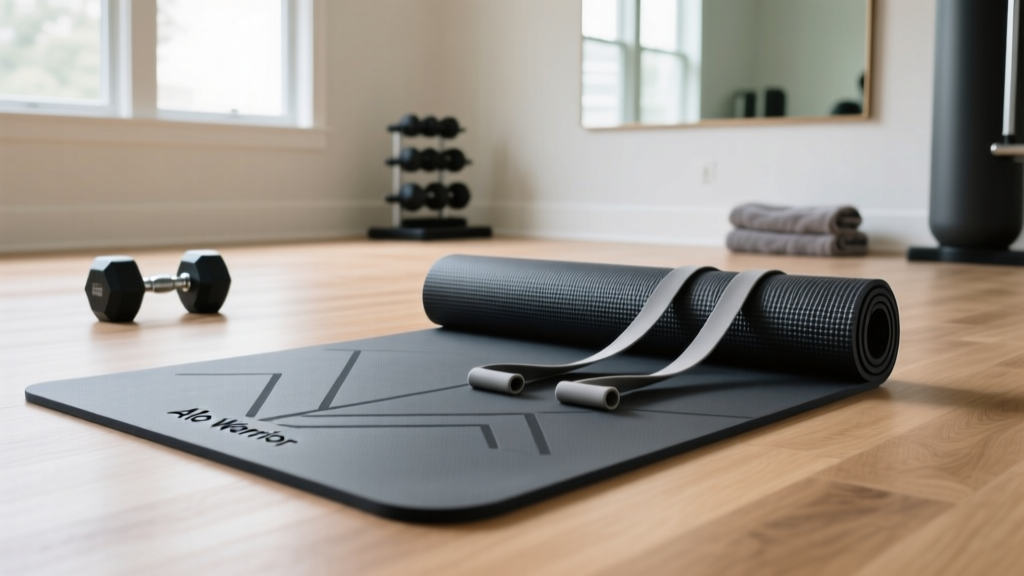
Medicine Ball Weight Selection: Setup With Jade Harmony Yoga Mat 74
Master your home gym setup with our medicine ball weight selection guide, storage installation steps, and Jade Harmony Yoga Mat 74 floor integration.

Phase 1: Foundation Setup & The Jade Harmony Yoga Mat 74
Building a functional home gym in 2026 requires more than just purchasing equipment; it demands a strategic approach to spatial planning, floor protection, and load management. When establishing a dedicated medicine ball training zone, the floor surface is your primary point of contact and force transfer. Standard closed-cell PVC or TPE fitness mats often fail under the dynamic lateral shuffles and rotational pivots required for medicine ball work, creating a dangerous "ice rink" effect when sweat is introduced.
This is where integrating the Jade Harmony Yoga Mat 74 into your setup becomes a critical installation step. Measuring exactly 74 inches long, 24 inches wide, and 3/16-inch thick, the Jade Harmony Yoga Mat 74 is constructed from vulcanized, open-cell natural rubber. Unlike synthetic alternatives, this material provides a high coefficient of friction that grips athletic shoes during explosive movements. At approximately $85, it serves as an elite, cost-effective foundation for your training zone, absorbing micro-impacts while preventing the foot slippage that frequently leads to lumbar strain during rotational throws.
⚠ Installation Warning: Mat Curing & Off-Gassing
Because the Jade Harmony mat uses natural rubber tapped from rubber trees, it requires a 48-to-72-hour off-gassing period in a well-ventilated space before heavy use. Do not place it in direct sunlight, as UV exposure degrades the open-cell matrix and causes the edges to curl, creating a tripping hazard during ball slams.
Phase 2: Storage Hardware & Wall-Mount Setup
Medicine balls are notoriously difficult to store, and leaving them on the floor creates a rolling hazard. Installing a wall-mounted storage rack is the safest and most space-efficient solution. For a standard 3-ball to 5-ball hoop rack (such as those from Rogue Fitness or Titan Fitness), follow these precise installation steps to ensure structural integrity:
- Locate the Studs: Use a magnetic stud finder to locate 16-inch on-center wooden studs. Never use drywall anchors for medicine ball storage.
- Calculate Dynamic Load: A 30-lb medicine ball dropped into a hoop from a height of 6 feet generates over 90 lbs of dynamic pull-out force.
- Hardware Selection: Pre-drill 1/4-inch pilot holes and secure the rack using 3/8-inch x 3-inch structural lag screws.
- Height Placement: Install the bottom hoop at least 18 inches off the ground to prevent accidental toe strikes when the balls are not in use.
Phase 3: Medicine Ball Weight Selection Guide
Selecting the correct medicine ball weight is not about maxing out; it is about optimizing the force-velocity curve for your specific training goal. According to guidelines established by the National Strength and Conditioning Association (NSCA), the load must be light enough to maintain maximum acceleration throughout the entire range of motion, but heavy enough to elicit a neuromuscular adaptation. Using a ball that is too heavy compromises your kinetic chain, forcing you to "muscle" the throw using your lower back rather than generating power from the hips and core.
Weight Selection by Training Modality
| Exercise Type | Primary Goal | Men (Beginner / Adv) | Women (Beginner / Adv) | Recommended Ball Type |
|---|---|---|---|---|
| Overhead Slams | Explosive Power | 15 lbs / 25 lbs | 10 lbs / 15 lbs | Dead Bounce (Sand/Rubber) |
| Wall Balls | Muscular Endurance | 20 lbs / 30 lbs | 14 lbs / 20 lbs | Soft Shell (PVC/Gel) |
| Rotational Throws | Core / Transverse Power | 6 lbs / 10 lbs | 4 lbs / 8 lbs | Hard Rubber (Grip Textured) |
| Russian Twists | Hypertrophy / Stability | 10 lbs / 20 lbs | 8 lbs / 15 lbs | Any standard medicine ball |
Failure Modes: Avoiding the "Rebound Effect"
A common setup mistake in 2026 is purchasing cheap, air-filled rubber balls for overhead slams. These balls exhibit a high elastic rebound. When slammed at maximum velocity into a concrete subfloor (even with a mat), they bounce back unpredictably, leading to severe facial and dental injuries. Always invest in "dead bounce" slam balls filled with a sand and iron-sand composite, which dissipates kinetic energy upon impact.
Phase 4: The 10-Rep Velocity Calibration Test
To finalize your weight selection, you must perform a baseline calibration test on your newly installed Jade Harmony Yoga Mat 74. This ensures the load matches your current power output without degrading your biomechanics.
- Warm-Up: Perform 5 minutes of dynamic mobility (hip openers, thoracic rotations).
- Execute 10 Reps: Perform 10 continuous overhead slams or wall balls with your target weight.
- Measure Velocity Degradation: Record the set on your smartphone. Compare the height and speed of Rep 1 to Rep 10.
- The 15% Rule: If the height or speed of Rep 10 drops by more than 15% compared to Rep 1, the ball is too heavy for power development. Drop down to the next weight increment (usually 2 to 4 lbs lighter).
- Form Breakdown Check: If you find yourself hyperextending your lumbar spine to compensate for the load, immediately halt the set. Power must originate from the hip hinge, not the lower back.
"The goal of medicine ball training is velocity, not just load. If the ball is so heavy that it turns an explosive plyometric movement into a slow, grinding strength movement, you have selected the wrong weight for the stimulus you are trying to achieve."
— Functional Conditioning Principles, American Council on Exercise (ACE)
Phase 5: Ongoing Maintenance & Mat Care
Proper maintenance of your setup ensures longevity and safety. The open-cell nature of the Jade Harmony Yoga Mat 74 means it will absorb sweat, chalk, and dust over time.
- Cleaning the Mat: Never use harsh chemical degreasers, bleach, or essential oils on natural rubber, as these break down the vulcanization bonds. Use a dedicated natural rubber mat wash or a mild solution of water and white vinegar (3:1 ratio) after heavy slam sessions.
- Ball Inspection: Every 90 days, inspect your slam balls for micro-tears in the outer rubber shell. If you notice sand leaking or an uneven weight distribution (the sand has shifted to one hemisphere), retire the ball immediately. An unbalanced medicine ball can cause severe wrist sprains during rotational catches.
- Hardware Check: Bi-annually, use a socket wrench to tighten the 3/8-inch lag screws on your wall-mounted storage rack, as the repeated vibration of heavy balls being loaded and unloaded can slowly back the screws out of the wooden studs.
By meticulously setting up your floor space, securing your storage, and rigorously applying this medicine ball weight selection guide, you create a professional-grade functional training environment right in your home gym.
More gear to consider
All reviews
Space-Saving Yoga Block & Strap Guide For Pendelton Yoga Mat

Therabody Yoga Mat & Stability Ball vs BOSU Ball 2026 Trends

Exercise Ball Size Guide & Budget: Pendleton Stylish Yoga Mat Value
Yoga Mat Sizes & Space: Stability Ball vs BOSU Ball 2026 Trends
Loop Band vs Tube Band: 2026 Budget Breakdown & R Yolo Yoga Mats