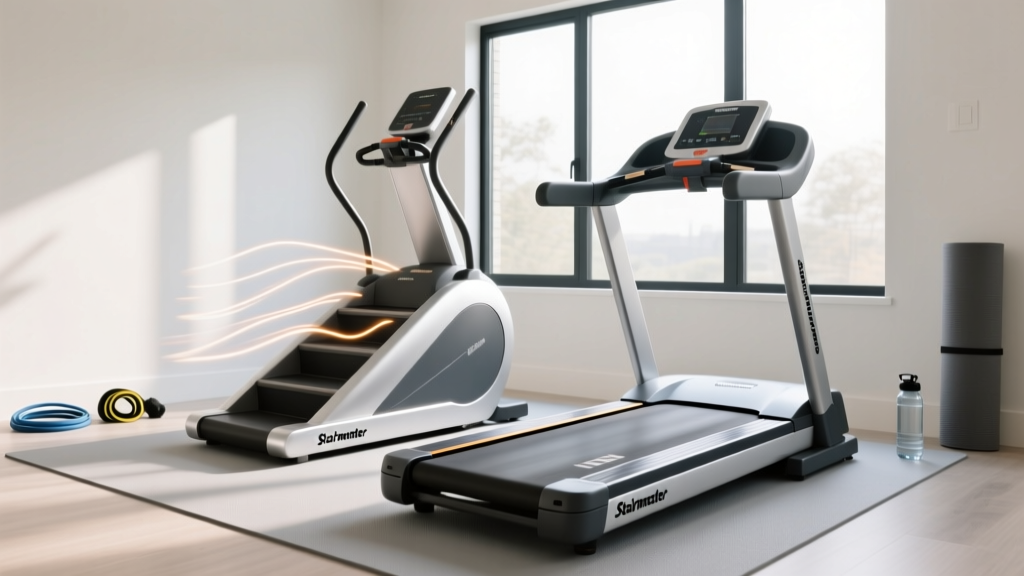
What Burns More Fat: StairMaster or Treadmill? Compact Budget Guide
Discover what burns more fat: StairMaster or treadmill. We analyze compact portable cardio options, budget breakdowns, and cost-per-calorie value.

When optimizing a home gym for fat loss, space and budget are usually the primary bottlenecks. If you have ever asked yourself what burns more fat, StairMaster or treadmill, you are likely trying to maximize your metabolic return on investment. However, commercial-grade StairMaster StepMills and full-size treadmills are neither portable nor budget-friendly. In 2026, the fitness industry has pivoted heavily toward compact, portable cardio equipment options that allow apartment dwellers and home-office workers to achieve similar physiological adaptations without sacrificing square footage or draining their savings.
This guide breaks down the biomechanics of stair climbing versus treadmill walking, translates those metrics into the compact gear market, and provides a rigorous budget breakdown to help you determine which portable machine offers the best long-term value for fat loss.
The Biomechanics of Fat Burn: Stairs vs. Treadmill
To understand which machine burns more fat, we must look at Metabolic Equivalent of Task (MET) values. The MET system measures the energy cost of physical activities, where 1 MET is the energy expended while sitting quietly.
- Stair Climbing (StairMaster equivalent): According to the Compendium of Physical Activities, continuous stair climbing registers between 8.0 and 9.0 METs. This high metabolic demand occurs because you are repeatedly lifting your entire center of mass against gravity, heavily recruiting the gluteus maximus, quadriceps, and hamstrings.
- Treadmill Walking (Flat, 3.5 mph): Registers at approximately 4.3 METs. The body utilizes elastic energy return in the Achilles tendon and relies on momentum, significantly lowering the oxygen cost.
- Treadmill Incline Walking (15% grade, 3.0 mph): Jumps to roughly 8.0 to 9.0 METs, effectively matching the metabolic output of stair climbing.
As noted by Harvard Health Publishing, a 155-pound individual will burn approximately 216 calories in 30 minutes of general stair climbing, compared to 133 calories walking at a moderate 3.5 mph pace on a flat treadmill. Therefore, in a pure gym setting, the StairMaster wins the fat-burn race per minute of exercise, unless you are utilizing maximum incline on the treadmill.
Translating Gym Giants to Compact Home Gear
You cannot fit a 280-pound, $3,500 StairMaster StepMill into a studio apartment, nor can you easily store a 6-foot-long commercial treadmill. The 2026 market for compact portable cardio equipment offers two primary alternatives:
- Hydraulic Mini-Steppers: The compact, budget-friendly answer to the StairMaster. These use hydraulic resistance cylinders to simulate the vertical stepping motion.
- Folding Walking Pads: The ultra-compact answer to the treadmill. These feature low-profile decks, no upright handrails (or folding ones), and are designed to slide under a bed or desk.
2026 Budget Breakdown: Compact Cardio Matrix
When evaluating budget portable cardio equipment, upfront cost is only one variable. We must also consider weight capacity, footprint, and the hidden costs of maintenance. Below is a comparative analysis of the top-selling compact steppers and walking pads currently dominating the market.
| Equipment Model | Type | Upfront Cost | Max User Weight | Footprint (L x W) | Est. MET Output |
|---|---|---|---|---|---|
| Sunny Health SF-S090017 | Mini-Stepper | $75.00 | 220 lbs | 16' x 12' | 7.5 - 8.5 |
| Sunny Health SF-E3911 | Heavy-Duty Stepper | $135.00 | 330 lbs | 19' x 15' | 8.0 - 9.0 |
| KingSmith WalkingPad C2 | Walking Pad | $299.00 | 220 lbs | 57' x 22' (Stored: 32') | 3.5 - 4.5 |
| WalkingPad R2 | Folding Treadmill | $499.00 | 240 lbs | 60' x 23' (Stored: 38') | 4.0 - 8.0 (Run) |
Hidden Costs and Edge Case Failure Modes
Budget breakdowns are incomplete without addressing equipment failure modes. Compact cardio machines are notorious for specific mechanical weaknesses that can ruin their long-term value.
Hydraulic Cylinder Overheating (Mini-Steppers): The primary failure point on sub-$150 steppers is the hydraulic piston. These cylinders rely on internal fluid viscosity. If you use the machine continuously for more than 45 minutes, the friction generates heat, thinning the fluid. This causes the pistons to bottom out, eventually blowing the internal O-ring seals and rendering the machine useless. Mitigation: Limit stepper sessions to 30 minutes and allow the cylinders to cool.
Motor Thermal Overload (Walking Pads): Most compact walking pads utilize 1.0 to 1.25 Continuous Horsepower (CHP) motors. If a user weighing over 180 lbs attempts to jog at 4.5 mph, the motor draws excessive amperage. Over time, this trips the thermal overload switch or burns out the motor controller board. Furthermore, cheap walking pads lack rear-roller adjustment bolts, meaning belt drift is a constant, frustrating maintenance issue.
Value Analysis: The Cost-Per-Calorie Framework
To truly answer what burns more fat from a financial perspective, we apply a Cost-Per-10,000-Calories framework. This metric divides the total lifespan cost of the machine by its total caloric burn potential.
'The cheapest machine is often the most expensive per calorie burned if its mechanical lifespan cannot support your weight loss timeline.' - FitGearPulse Engineering Team
Scenario A: The $75 Mini-Stepper
Assuming a conservative lifespan of 150 hours before hydraulic degradation (based on a 180 lb user).
Calories burned per hour: ~400.
Total lifetime calorie burn: 60,000 calories.
Cost per 10,000 calories burned: $12.50
Scenario B: The $499 WalkingPad R2
Assuming a lifespan of 1,500 hours (brushless motor, properly lubricated belt).
Calories burned per hour: ~280 (mix of walking and light jogging).
Total lifetime calorie burn: 420,000 calories.
Cost per 10,000 calories burned: $11.88
While the mini-stepper offers a higher MET output and burns fat faster per minute, the WalkingPad R2 actually provides slightly better long-term financial value due to its vastly superior mechanical lifespan and lower impact on the joints, which encourages higher weekly adherence. The Mayo Clinic emphasizes that consistency and adherence are the ultimate drivers of fat loss, not just acute metabolic spikes.
Expert Verdict: Which Compact Machine Wins Your Budget?
If your primary question remains what burns more fat, StairMaster or treadmill, the physiological answer is the StairMaster (or its stepping equivalent). However, when constrained by a budget and the need for portable, compact equipment, the decision requires nuance.
- Choose a Heavy-Duty Mini-Stepper (e.g., Sunny SF-E3911 at $135) if you have less than 2 square feet of space, a strict sub-$150 budget, and want to maximize your heart rate and glute engagement in short, 20-to-30-minute high-intensity windows.
- Choose a Folding Walking Pad (e.g., WalkingPad R2 at $499) if you work from home, want to integrate cardio into your workday (NEAT), have a higher budget, and prefer low-impact, steady-state fat oxidation over high-intensity interval training.
Ultimately, aligning your equipment with your daily lifestyle ensures you actually use it. According to the CDC Physical Activity Guidelines, achieving 150 minutes of moderate-intensity activity weekly is the baseline for health and weight management. Both compact steppers and portable walking pads can help you hit this mark, provided you respect their mechanical limits and maintain them properly.
More gear to consider
All reviews
Elliptical vs Treadmill: WalkingPad R3 Hybrid Foldable Treadmill

Garmin Watch Treadmill Run vs Upright, Recumbent & Spin Bikes
Walking Pad vs Treadmill: Finding a Good Speed for Treadmill Run

Folding Treadmill Engine Care: Small Space Longevity Guide

Rowing vs Precision Run Treadmill: Beginner's Guide
