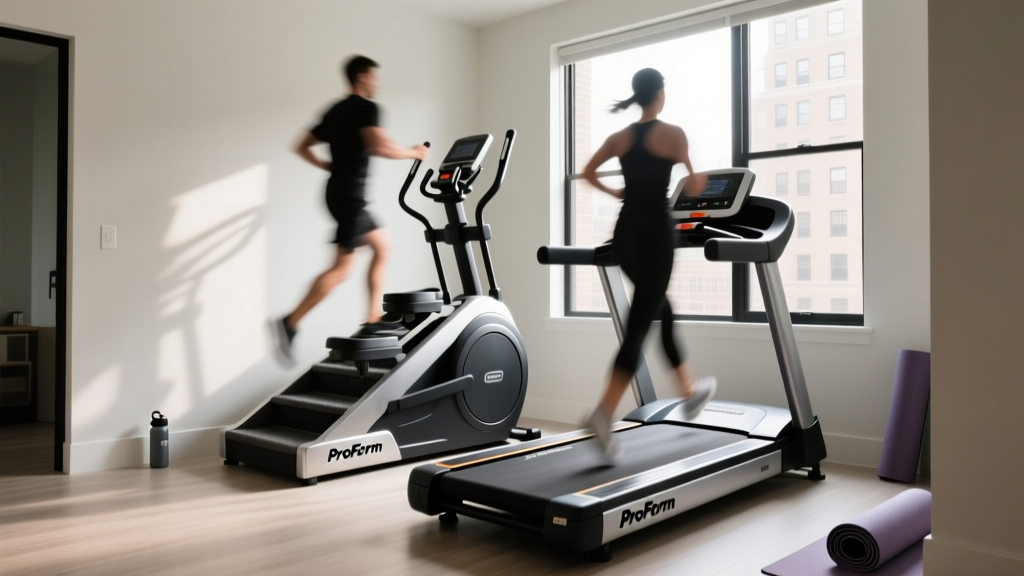
Home Stair Climber Setup vs ProForm 705 CST Treadmill
Compare home stair climber installation with the ProForm 705 CST treadmill. Get space, electrical, and assembly tips for your 2026 cardio setup.

Designing a dedicated home cardio zone in 2026 requires precise spatial planning and electrical foresight. When outfitting a home gym, buyers frequently cross-shop the vertical intensity of a stair climber machine against the steady-state reliability of traditional runners like the ProForm 705 CST treadmill. While the ProForm 705 CST remains a benchmark for flat-deck LISS (Low-Intensity Steady State) training, stair climbers deliver superior glute and hamstring activation in a significantly smaller footprint. However, their installation and clearance requirements differ drastically.
This comprehensive stair climber machine for home use guide walks you through the complete setup and installation walkthrough. We will use the popular ProForm 705 CST treadmill as our baseline comparison for space, electrical, and assembly metrics, ensuring you choose and install the right machine for your specific room dimensions.
Spatial Mapping: Stair Climbers vs. the ProForm 705 CST Treadmill
The most common installation failure in home gyms is ignoring the three-dimensional footprint. A treadmill requires a long, horizontal runway, while a stair climber demands vertical clearance and lateral stabilization space. Below is a direct comparison of standard home stair climbers against the ProForm 705 CST treadmill baseline.
| Machine Model | Base Footprint (L x W) | Machine Height | Min. Ceiling Clearance | Weight |
|---|---|---|---|---|
| Bowflex Max Trainer M9 | 49' x 30.5' | 65.3' | User Height + 15' | 148 lbs |
| Sunny Health SF-S902 (Mini) | 16' x 12.5' | 53' (with bands) | Standard 8' Ceiling | 22 lbs |
| NordicTrack FS14i Freestrider | 58.5' x 29.5' | 70.2' | User Height + 18' | 265 lbs |
| ProForm 705 CST Treadmill | 70' x 29' | 55' | Standard 8' Ceiling | 130 lbs |
The Ceiling Clearance Formula (Critical Step)
⚠️ The Step-Up Headroom Rule
Unlike the ProForm 705 CST treadmill, where your head remains at a static elevation, a stair climber elevates your entire body mass by 10 to 14 inches at the peak of the pedal stroke. The Golden Formula: Measure your exact height, add 15 inches for pedal elevation and arm reach, and ensure your ceiling is at least 2 inches higher than that total. If you are 6'0' (72 inches), your absolute minimum ceiling height must be 89 inches (7'5'). Installing a tall-mast climber under a standard 8-foot ceiling with a tall user will result in immediate head-strike injuries and machine abandonment.
Electrical & Subfloor Preparation
Cardio machines with magnetic resistance and digital consoles require stable power delivery. According to the Electrical Safety Foundation International (ESFI), high-draw fitness equipment should never share a circuit with high-wattage appliances like space heaters or air conditioners.
- Circuit Requirements: Both full-size stair climbers and the ProForm 705 CST treadmill require a dedicated 15-amp, 120-volt grounded outlet. Avoid using extension cords or power strips, which can cause voltage drops that corrupt the console's EEPROM memory or damage the magnetic brake servo.
- Subfloor Protection: Stair climbers generate intense vertical downward force (up to 3x your body weight per step). Standard 1/4-inch EVA foam puzzle mats will compress and cause the machine's leveling feet to punch through to the hardwood. Use a 3/4-inch thick vulcanized rubber horse stall mat or a high-density PVC treadmill mat to distribute the load and dampen acoustic vibrations.
Step-by-Step Stair Climber Assembly Walkthrough
While assembling the ProForm 705 CST treadmill primarily involves unfolding the deck and torquing the hood shroud, a stair climber requires precise alignment of the central crank and data cables. Follow this sequence to avoid catastrophic misalignment.
- Base Stabilization & Leveling: Before attaching the upright mast, position the base frame on your rubber mat. Thread the adjustable leveling feet into the bottom of the base tubes. Use a 24-inch carpenter's level across the main crossbar. If the floor is uneven, adjust the feet until the bubble is dead center. Failure to do this will cause the internal chain drive to wear unevenly.
- Mast Insertion & Cable Routing (The Danger Zone): Stand the upright mast tube vertical. Feed the console data cable down through the center of the tube. Critical: Ensure the cable is not pinched between the mast and the base bracket when you insert the M8 x 40mm carriage bolts. A pinched cable will result in a dead console or erratic resistance stepping.
- Crank Arm & Pedal Attachment: Slide the pedal arms onto the central crank shaft. Secure them using the provided split pins and cotter keys. Apply a drop of blue Loctite (threadlocker) to the pedal spindle threads before screwing the foot platforms in. This prevents the pedals from backing out during high-cadence intervals.
- Console Wiring & Reed Switch Alignment: Connect the color-coded wiring harnesses. Locate the reed switch (a small black sensor near the magnetic flywheel). Ensure there is exactly a 2mm to 3mm gap between the sensor and the flywheel magnet. If the gap is too wide, the console will not read your RPMs; if it touches, it will snap off during the first workout.
Calibration and Common Failure Modes
Once assembled, plug the machine directly into the wall and run the factory calibration mode (usually accessed by holding the 'Enter' and 'Incline/Resistance Up' buttons simultaneously for 5 seconds). This cycles the magnetic brake from level 1 to maximum, establishing the baseline tension.
Troubleshooting Installation Errors
| Symptom | Likely Cause | Corrective Action |
|---|---|---|
| Console powers on, but resistance stays at max | Servo motor cable disconnected or pinched | Remove mast shroud, verify servo cable is seated fully in the J2 port on the PCB. |
| Loud clicking noise during downstroke | Base not leveled; frame torsion | Re-level the base feet. Ensure all M8 frame bolts are torqued to 25 Nm. |
| RPM display reads '0' or flickers | Reed switch gap is too wide | Loosen sensor bracket, adjust to 2mm gap from magnet, retighten. |
By contrast, the most common setup failure on the ProForm 705 CST treadmill is improper walking belt tension. If the belt slips underfoot, you must use the included 3/16' Allen wrench to turn both rear roller adjustment bolts clockwise by exactly one-quarter turn, testing the belt after each adjustment until the slipping ceases.
Expert Verdict: Which Machine Fits Your Space?
Choosing between a stair climber and a traditional treadmill ultimately comes down to your room's geometry and your joint health. According to the Centers for Disease Control and Prevention (CDC), adults need at least 150 minutes of moderate-intensity aerobic activity weekly. Both machines fulfill this requirement brilliantly, but their spatial demands dictate the purchase.
Choose the Stair Climber if you have a compact room (under 60 square feet), low-impact joint requirements, and a ceiling height exceeding 8 feet. The vertical vector of a stair climber builds immense posterior chain strength without the repetitive heel-strike impact of running.
Choose the ProForm 705 CST Treadmill if you have a long, narrow hallway or spare bedroom with standard 8-foot ceilings, and your primary goal is steady-state endurance or walking-pad style multitasking. The ProForm 705 CST's 55-inch deck length is perfectly suited for brisk walking and light jogging, and its folding mechanism allows you to reclaim 40% of your floor space when not in use.
Whichever machine you select, respect the subfloor requirements, dedicate a clean 15-amp circuit, and meticulously follow the cable routing steps. A properly installed cardio machine will deliver a decade of reliable performance; a rushed assembly will lead to chronic sensor errors and premature drivetrain wear.
More gear to consider
All reviews
Curved vs Motorized: Running 2 Miles on Treadmill Compared

NYRR Run Center Gait Analysis: Replicate It on a Budget

Curved Treadmill vs Normal Treadmill: 2026 Buyer's Guide

Why No Caffeine Before Treadmill Stress Test? Office Layout Review

LifeSmart TM6500 PowerTouch Review: Best Compact Cardio Options 2026
