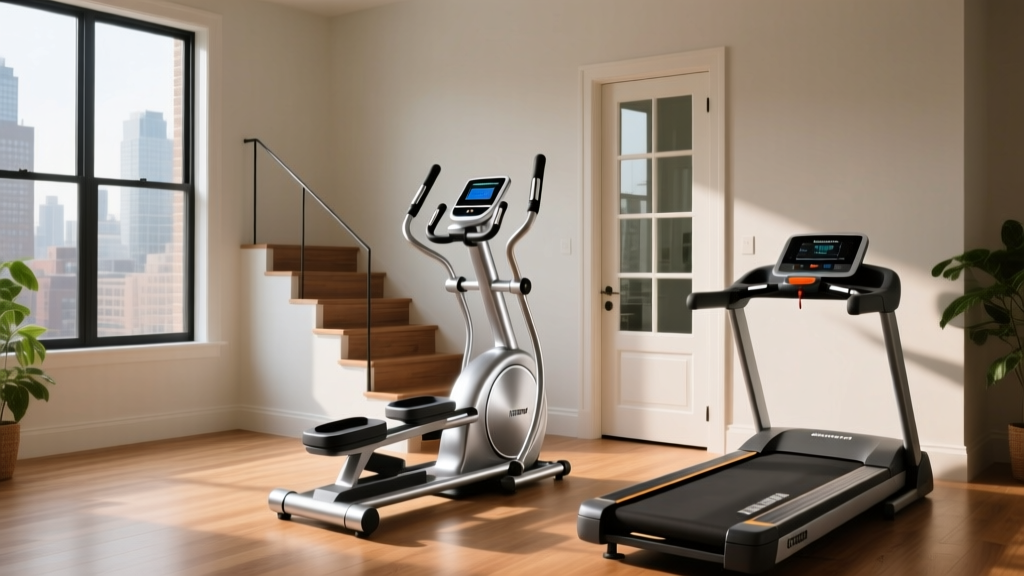
Stair Climber Setup: Beating Treadmill French Door Clearance Issues
Master your home stair climber setup. We compare spatial footprints, solve treadmill French door clearance issues, and provide a 2026 assembly guide.

When designing a home gym in 2026, spatial geometry is just as critical as cardiovascular output. Many homeowners face the notorious treadmill French door dilemma: attempting to fit a massive motorized treadmill into a spare bedroom or sunroom, only to realize the machine blocks the swing arc of exterior French patio doors, violates safety egress codes, or traps the user against a glass pane. If you have ever searched for 'treadmill french door placement' out of sheer frustration, you are not alone.
The architectural solution? Pivoting to a vertical cardio machine. A stair climber machine for home use delivers superior glute and quad engagement while occupying a fraction of the floor space. This complete setup and installation walkthrough will guide you through preparing your subfloor, assembling a modern stair climber, and permanently bypassing the spatial headaches of traditional treadmills.
The Spatial Dilemma: Stair Climbers vs. Treadmill French Door Clearance
To understand why stair climbers are dominating compact home gyms, we must look at the raw mathematics of equipment clearance. According to the U.S. Consumer Product Safety Commission (CPSC), motorized treadmills require a minimum of 36 inches of unobstructed clearance behind the machine to prevent severe friction-burn injuries in the event of a fall.
When you place a standard treadmill (like the Sole F80, which measures 82 inches long) near a set of French doors, the 36-inch rear safety buffer collides directly with the 36-to-72-inch swing arc of the doors. You are left with two choices: permanently pin your French doors shut, or risk a catastrophic safety hazard. Stair climbers eliminate this conflict entirely by utilizing vertical space rather than horizontal footprint.
Pre-Installation: Subfloor Mapping and Vibration Dampening
Before unboxing your machine, you must prepare the installation zone. Unlike a treadmill that distributes weight across a long deck, a stair climber concentrates dynamic load onto four small stabilizer feet. When a 200 lb user steps at 100 steps-per-minute (SPM), the machine generates localized downward sheer forces exceeding 350 lbs per impact.
Selecting the Right Equipment Mat
Do not use cheap, low-density puzzle mats. For a stair climber, you need a high-density PVC or 1.5 lb/ft³ EVA foam mat that is at least 3/4-inch thick. This prevents the machine's leveling feet from punching through the mat and denting your hardwood or laminate subfloor over time.
- Measure the Zone: Ensure a 4x4 foot clear area.
- Check the Egress: Verify that no doors, drawers, or furniture impede the 20-inch side-clearance required for handlebar mounting.
- Locate the Outlet: Stair climbers like the Bowflex Max M9 require a dedicated 120V, 15-amp circuit. Avoid using extension cords, which can cause voltage drops and trigger 'Error 1' console codes during high-resistance intervals.
Step-by-Step Stair Climber Assembly Walkthrough
For this guide, we are using the assembly architecture common to premium 2026 home stair climbers and stepper-climber hybrids (such as the Bowflex Max series and the Sunny Health & Fitness SF-S9021). You will need a 14mm socket wrench, a 17mm open-end wrench, and the included hex keys.
Phase 1: Base and Drive Train Stabilization
- Position the Base Frame: Lay the main drive base onto your high-density mat. Do not attempt to stand the machine up yet.
- Attach the Pedal Arms: Insert the pedal crank arms into the central drive axle. Expert Tip: Thread the bolts by hand for the first three rotations to avoid cross-threading the axle housing. Tighten to 45 Nm of torque using your socket wrench.
- Install the Leveling Feet: Screw the adjustable leveling feet into the base tubes. Leave them extended by about 1/2 inch to allow for final micro-adjustments once the machine is upright.
Phase 2: Upright Mast and Data Cable Routing
This is the most critical phase where 90% of DIY assembly failures occur. The upright mast houses the internal data cable that connects the lower drive computer to the upper display console.
⚠️ WARNING: The Pinch-Point Failure Mode
When tilting the mast upward to bolt it to the base bracket, the internal wire can easily slip between the steel bracket and the bolt plate. If the wire is pinched, the console will not power on, and you will have to completely disassemble the mast to replace the harness. Always have a second person guide the wire through the central channel while you tilt the mast.
- Align the Mast: Slide the mast onto the base bracket pins.
- Connect the Harness: Plug the color-coded data cable (usually a 9-pin D-sub or proprietary quick-connect) together until you hear a definitive click.
- Secure the Hardware: Insert the four 17mm carriage bolts and tighten them in a star pattern to ensure even tension on the steel bracket.
Phase 3: Console and Handlebar Calibration
Mount the console bracket, attach the multi-grip handlebars, and plug in the machine. Before stepping on the pedals, power on the console and run the factory calibration mode (usually accessed by holding the 'Program' and 'Up' buttons simultaneously for 5 seconds). This allows the magnetic resistance brake to sweep from Level 1 to Level 20, ensuring the stepper belt is tracking correctly.
Footprint & Clearance Comparison Matrix
Let us look at the exact spatial data comparing a stair climber to a treadmill, specifically highlighting how the stair climber resolves the treadmill French door clearance issue.
| Metric | Stair Climber (e.g., Bowflex Max M9) | Standard Treadmill (e.g., Sole F80) | French Door Interference Risk |
|---|---|---|---|
| Machine Length | 30.5 inches | 82.0 inches | Treadmill blocks door swing |
| Machine Width | 30.0 inches | 37.0 inches | Treadmill limits lateral egress |
| Rear Safety Buffer | 12 inches (Vertical step-off) | 36 inches (Mandatory fall zone) | Treadmill buffer hits patio glass |
| Door Swing Arc | Unobstructed | High Collision Probability | Stair climber allows full 180° opening |
| Estimated Price (2026) | $1,999 | $999 - $2,499 | N/A |
As the matrix demonstrates, the stair climber's 30.5-inch length leaves ample room for French doors to swing open a full 180 degrees, preserving your room's natural light, ventilation, and architectural flow.
Post-Installation Maintenance & Troubleshooting
Once your machine is assembled and positioned, maintaining the drive system is vital for longevity. Unlike treadmills that require frequent silicone deck lubrication, modern home stair climbers utilize sealed magnetic resistance and internal stepper belts.
- Monthly: Wipe down the optical sensors on the handlebars with isopropyl alcohol to prevent erratic heart-rate readings.
- Quarterly: Check the 14mm pedal arm bolts. The rhythmic stepping motion can cause micro-vibrations that loosen hardware over 90 days. Re-torque to 45 Nm if necessary.
- Annually: Inspect the lower drive belt tension. If you experience 'slipping' at high resistance levels, consult your manual for the specific tensioner bolt adjustment (usually a 3mm hex key turn clockwise).
By following the American Heart Association's guidelines for vigorous aerobic activity, your stair climber will become a cornerstone of your cardiovascular health, all while keeping your home's architectural integrity intact.
Frequently Asked Questions
Can I place a stair climber directly on carpet?
Yes, but you must use a rigid PVC equipment mat. Thick carpet padding absorbs the downward force of your steps, causing the machine to rock laterally. This rocking will eventually strip the threads on the leveling feet and void your warranty.
How much ceiling height do I need for a stair climber?
You must add 12 to 15 inches to your total height to account for the step-up elevation at the highest pedal stroke. For a 6-foot user, a minimum ceiling height of 8 feet is required to prevent head strikes during high-intensity intervals.
Is a stair climber safer than a treadmill for seniors?
According to Mayo Clinic fitness experts, low-impact aerobic exercise is excellent for joint health. Stair climbers eliminate the high-impact heel strike of treadmills and remove the risk of being ejected off the back of a moving belt, making them a highly stable, low-impact alternative for older adults focusing on leg strength and balance.
More gear to consider
All reviews
Stationary Bike Types vs. NordicTrack T 6.5 S Treadmill-NTL17915: 2026 Trends

Treadmill Motor Guide for 10000 Steps on Treadmill Calculator Targets

Treadmill Controller Noise: Cardio Machine Sound Comparison

Curved vs Motorized Treadmill: How Long to Walk 10000 Steps?
Air Bike vs Assault Bike Maintenance: Longevity Tips & HiFast Treadmill Care
