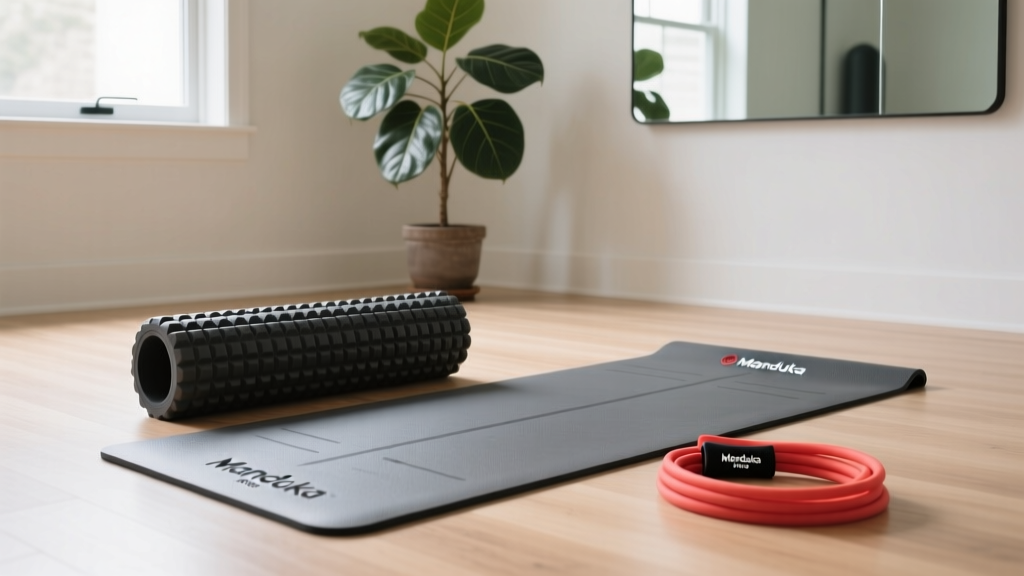
Mobility Setup: Foam Roller Sizing & Manduka PRO Lite Yoga Mat
Master your home mobility station setup. Learn foam roller density and size selection, plus how to anchor your routine with the Manduka PRO Lite yoga mat.

Architecting the 2026 Home Mobility Station
Building a dedicated home mobility and recovery station in 2026 requires more than just tossing a piece of foam onto the living room floor. True myofascial release demands a deliberate setup: a stable, high-traction base paired with the correct roller geometry for your specific biomechanical needs. According to the National Academy of Sports Medicine (NASM), effective self-myofascial release (SMR) relies on sustained pressure and precise positioning, both of which are compromised if your foundation slips or your roller lacks the appropriate density.
This complete setup and installation walkthrough will guide you through establishing a professional-grade mobility zone. We will focus heavily on the often-misunderstood science of foam roller density and size selection, and demonstrate how to anchor your entire setup using the industry-standard Manduka PRO Lite yoga mat as your primary recovery platform.
Phase 1: Base Installation & The Manduka PRO Lite Break-In
Before selecting your roller, you must install your foundation. The Manduka PRO Lite yoga mat (71 inches by 24 inches, 4.7mm thick, retailing around $132) is our recommended base for aggressive rolling. Unlike cheap TPE mats that bottom out when you apply 40+ pounds of localized pressure from a roller, the PRO Lite’s dense, closed-cell PVC construction absorbs impact while protecting your hardwood floors and joints.
⚠️ CRITICAL INSTALLATION STEP: The Salt Scrub Break-InOut of the box, the Manduka PRO series features a microscopic manufacturing film that makes the surface notoriously slippery. If you attempt aggressive IT band rolling on day one, the mat will slide across your floor, risking injury. According to Manduka's official PRO mat care guide, you must 'install' the mat's grip via a sea salt scrub before its first use.
- Prepare the Solution: Mix 1 cup of coarse sea salt with a small amount of warm water to create a gritty paste.
- Apply and Scrub: Spread the paste evenly over the top surface of the mat. Use a stiff-bristled brush or a coarse washcloth to scrub the surface in circular motions for 5 to 10 minutes. This physically exfoliates the manufacturing film.
- Cure and Wipe: Let the salt sit on the mat for 24 hours in a dry, room-temperature environment. Afterward, wipe it down thoroughly with a damp cloth and allow it to air dry completely.
Once this break-in process is complete, the closed-cell surface transforms into a high-traction anchor, ensuring your mat stays locked in place during dynamic rolling movements.
Phase 2: Decoding Foam Roller Density (Material Science)
The most common failure mode in home mobility setups is purchasing a roller with the wrong density. Density is measured in pounds per cubic foot (lb/ft³) and dictates how deeply the roller can penetrate the fascia without deforming. The Cleveland Clinic's research on myofascial release highlights that applying adequate pressure to trigger points is essential for increasing blood flow and reducing muscle stiffness, but excessive hardness can cause the nervous system to guard the muscle, defeating the purpose.
EVA (Ethylene-Vinyl Acetate): The Soft Option (1.5 - 2.0 lb/ft³)
Standard EVA rollers (often solid black or brightly colored, priced between $10 and $20) are highly forgiving. They are ideal for beginners, acute injury recovery, or highly sensitive areas like the neck and upper traps. Failure Mode: EVA foam suffers from permanent compression set. If used daily by an adult weighing over 150 lbs, a standard EVA roller will develop flat spots and lose its cylindrical integrity within 90 to 120 days.
EPP (Expanded Polypropylene): The Medium-Firm Standard (2.5 - 3.0 lb/ft³)
EPP rollers (recognizable by their slightly porous, bead-like texture, typically $20 to $30) represent the best balance of tissue penetration and longevity. EPP resists permanent deformation and maintains its density even under heavy, repetitive loads. This is the go-to material for general quad, hamstring, and latissimus dorsi release.
ABS Core with EVA/EPP Wrap: The Targeted Firm Option
Rollers like the TriggerPoint GRID (13-inch, ~$45) feature a rigid ABS plastic hollow core wrapped in a multi-density EVA exterior. This design prevents the roller from ever flattening out while allowing the exterior grid patterns to target specific fascial adhesions. These are mandatory for deep tissue work on thick muscle bellies like the gluteus maximus and the TFL (tensor fasciae latae).
Phase 3: Size and Geometry Selection Matrix
Selecting the correct length and diameter is just as critical as density. Your choice must align with the dimensions of your Manduka PRO Lite yoga mat (24 inches wide) and your specific anatomical targets.
| Dimension | Best Use Case | Mat Integration Notes |
|---|---|---|
| 36" x 6" (Standard) | Thoracic spine extension, full back rolling, bilateral quad release. | Extends 6 inches past each side of the 24" PRO Lite mat. Ensure your floor zone is clear of baseboards. |
| 24" x 5" (Mid-Size) | Lats, glutes, and general lower body work. Excellent for travel. | Fits perfectly within the 24" width of the mat. Ideal for smaller home gym footprints. |
| 12" x 5" (Travel/Target) | Unilateral work, calves, neck, and pinpoint trigger point isolation. | Highly maneuverable on the mat. Easily stored in a bin or shelf when the mobility station is not in use. |
| 3" Diameter (Slim) | Deep spinal erector targeting, localized foot/arch release. | Provides less surface area, requiring greater balance and core stability on the mat. |
Phase 4: Spatial Setup and Clearance Walkthrough
To properly install your mobility station, you must account for the kinetic envelope of your movements. When performing a thoracic extension over a 36-inch roller, your hips and head will extend beyond the roller's edges.
- Zone Dimensions: Clear a minimum floor space of 4 feet by 8 feet. This allows the 71-inch Manduka mat to lay flat with enough buffer space for your limbs during supine and prone rolling.
- Storage Integration: Install a vertical wall-mounted rack or a simple heavy-duty hook system 18 inches off the ground. Store your rollers vertically to prevent long-term gravitational warping, a common issue with cheaper EVA foam left resting on uneven surfaces.
- Environmental Factors: Keep the station out of direct UV sunlight. Prolonged UV exposure degrades both the PVC structure of the Manduka mat and the cellular integrity of EPP foam rollers, causing them to become brittle and flake over time.
Troubleshooting & Edge Cases
Edge Case 1: Mat Creeping on Hardwood During Aggressive Rolling
Even after the salt scrub break-in, highly dynamic movements (like cross-friction IT band rolling) can generate enough lateral force to creep the mat across smooth hardwood. Solution: Place a microfiber yoga towel (like the Manduka Yogitoes, ~$74) over the PRO Lite during high-friction rolling sessions, or apply a reusable silicone rug gripper mesh underneath the mat's footprint.
Edge Case 2: Nervous System Guarding on Firm Rollers
If you transition from a soft EVA roller to a firm ABS-core grid roller and experience sharp pain or muscle tensing, your nervous system is 'guarding' the tissue. Solution: Do not force the pressure. Use the 24-inch Manduka PRO Lite to your advantage by folding a dense cotton towel over the roller to temporarily reduce the firmness. Over a 3-week period, gradually remove the towel layers to allow your mechanoreceptors to adapt to the deeper fascial pressure.
By meticulously selecting your foam roller's density and size, and properly installing the Manduka PRO Lite yoga mat as your foundational base, you elevate your home recovery from a casual stretching routine to a clinical-grade mobility practice. This setup ensures longevity, safety, and optimal tissue adaptation for years to come.
More gear to consider
All reviews
Coral Yoga Mat Care & Pilates Accessories Maintenance Guide

Loop vs Tube Bands & Manduka eKO Yoga Mat: 2026 Trends

Jump Rope Types & Types of Yoga Mats: A Beginner's Guide

2026 Jump Rope Types Guide & How to Clean Jade Yoga Mat

Jade Yoga Travel Yoga Mat vs Medicine Balls: Weight Selection Guide
