
Stability Ball vs BOSU Ball: Are Thicker Yoga Mats Better?
Designing a compact home gym? We compare the stability ball vs BOSU ball for small spaces and answer: are thicker yoga mats better for your layout?

The Small-Space Dilemma: Choosing Your Core Equipment
As we navigate the 2026 real estate landscape, dedicated home gym square footage is shrinking. The modern fitness enthusiast is no longer designing sprawling garage gyms; instead, they are optimizing 10x10 foot spare bedrooms, studio apartment corners, and multi-use living spaces. In this environment, every piece of equipment must justify its spatial footprint. Two of the most popular tools for core and instability training—the traditional stability ball and the BOSU ball—present unique layout challenges and advantages.
But equipment selection does not happen in a vacuum. The foundation beneath your gear dictates safety, acoustic dampening, and spatial flow. When mapping out a high-density workout zone, a common question arises among home gym architects: are thicker yoga mats better for absorbing the impact of unstable equipment and protecting hardwood floors? This guide breaks down the spatial, biomechanical, and foundational synergies between your core tools and your flooring.
The Core Conundrum: Stability Ball vs. BOSU Ball in Tight Spaces
To optimize a compact layout, we must first compare the physical dimensions and operational clearances of the two dominant instability tools.
1. The Traditional Stability Ball (65cm PVC)
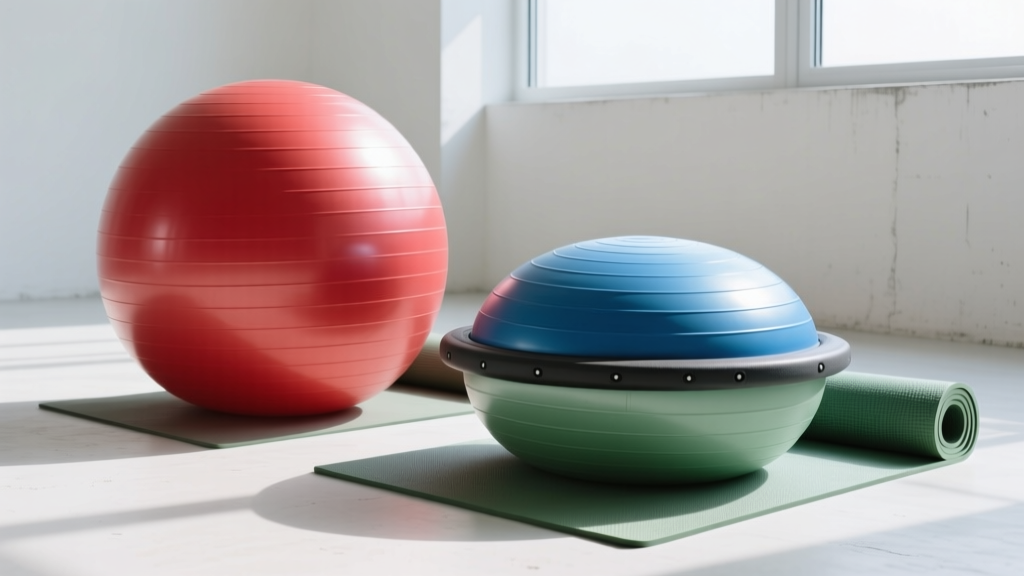
The standard 65cm stability ball (such as the TheraBand Stability Ball, retailing around $28.95) is a staple for spinal extension and deep core rollouts. However, its geometry is a spatial nightmare for small rooms. A fully inflated 65cm ball commands a 4.5 square foot static footprint. More importantly, according to guidelines from the American Council on Exercise (ACE), dynamic instability training requires a minimum of 3 feet of clearance in all directions to prevent wall strikes or furniture damage during rollouts. This pushes the operational footprint to nearly 27 square feet.
- Storage: Cannot be stacked. Must be deflated for seasonal storage or relegated to a massive corner.
- Best Layout Placement: Center of a 12x12 room, away from drywall and glass mirrors.
2. The BOSU Pro NexGen
The BOSU Pro NexGen ($149.99) features a 25-inch diameter base and an 8.5-inch dome height. While it costs significantly more than a PVC ball, its spatial efficiency is unmatched. The BOSU requires only 1.5 feet of operational clearance for lateral hops and single-leg balances, reducing its active footprint to roughly 12 square feet.
- Storage: Can be stored dome-down, acting as a small end table or tucked under a standard 30-inch desk.
- Best Layout Placement: Perimeter zones, allowing the user to face outward or utilize wall support for advanced balance work.
Expert Insight: If your room is under 80 square feet, the BOSU ball is the superior choice for spatial optimization. The traditional stability ball simply demands too much dynamic airspace, increasing the risk of drywall impacts in micro-gyms.
Foundation First: Are Thicker Yoga Mats Better for Compact Layouts?
Once you have selected your instability tool, you must address the floor. The question of whether are thicker yoga mats better depends entirely on the intersection of acoustic dampening, equipment friction, and joint loading in a confined space.
The Acoustic and Impact Factor
In a small apartment or second-story bedroom, noise transfer is a primary layout constraint. Dropping a 12-pound BOSU ball or stepping forcefully off a stability ball generates low-frequency impact noise. Thicker mats (defined as 1/2-inch or 13mm NBR foam, like the BalanceFrom GoYoga at $24.99) act as superior acoustic insulators, reducing impact decibels by up to 14dB compared to standard 3mm PVC travel mats.
The Compression and Friction Problem
However, thickness introduces a biomechanical flaw. Under the concentrated load of a 180-pound user performing a single-leg BOSU squat, a 13mm closed-cell NBR mat compresses unevenly, creating a "sway" effect that compromises the ankle stability the BOSU is meant to train. Furthermore, the Yoga Journal notes that thicker synthetic foams often lack the surface tension required to grip the urethane base of a BOSU ball, leading to dangerous micro-slips during lateral movements.
The Mat Thickness & Equipment Matrix
| Mat Type & Model | Thickness | Best Paired Equipment | Storage Roll Diameter | Price Range |
|---|---|---|---|---|
| Standard PVC (Gaiam Essentials) | 5mm | Stability Ball (Kneeling) | 5.5 inches | $20 - $30 |
| Natural Rubber (Jade Harmony) | 5mm | BOSU Ball (High Friction) | 6.0 inches | $75 - $85 |
| Dense Cushion (Manduka PRO) | 6mm | Both (Joint Support) | 6.5 inches | $130 - $140 |
| Thick NBR Foam (BalanceFrom) | 13mm (1/2") | Bodyweight Only (No BOSU) | 12.0 inches | $25 - $35 |
Synergizing Your Layout: Pairing Mats and Balls
To answer the prompt directly: No, thicker yoga mats are not universally better, especially when paired with a BOSU ball in a small space. The ideal layout utilizes a medium-thickness, high-density natural rubber mat. Natural rubber provides the static friction coefficient necessary to keep the BOSU base locked to the floor, while maintaining a low enough profile (5mm) to prevent ankle roll-overs during balance work.
According to physical therapy insights referenced by the Mayo Clinic's fitness guidelines, joint protection is vital, but it must not come at the expense of proprioceptive feedback. A 13mm foam mat dulls proprioception, making it dangerous for dynamic instability training.
Space-Saving Layout Blueprint (10x10 Room)
- The Anchor Zone (2x4 ft): Place your 5mm natural rubber mat in the corner furthest from the door. This is your dedicated BOSU and stretching zone.
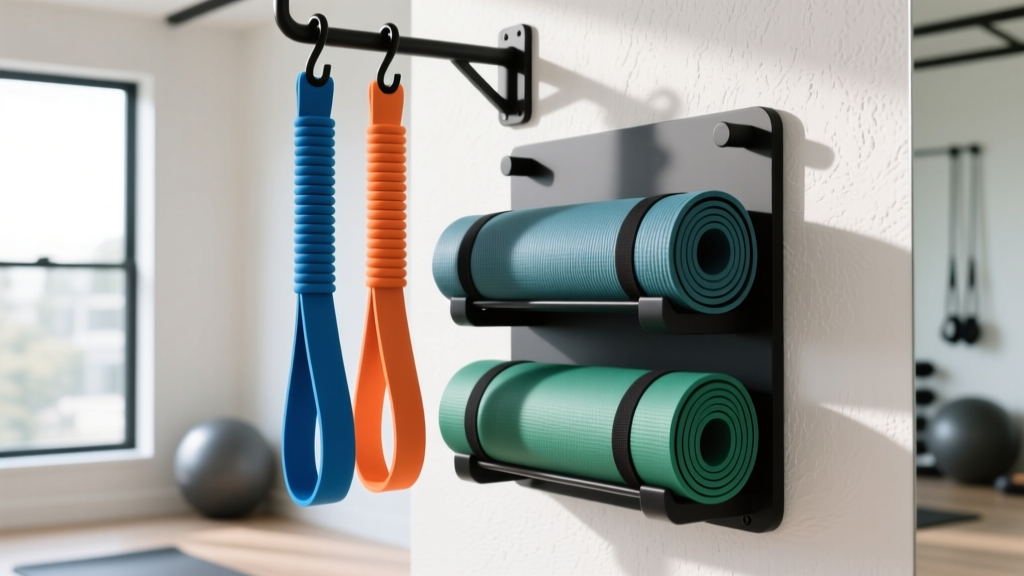
- The Vertical Storage Wall: Mount a heavy-duty wall rack (e.g., Rogue Fitness Mat Holder, $45) to store your mat vertically, freeing up the 12-inch floor roll space.
- The Dead Space Utilizer: Store the BOSU ball dome-down under your adjacent desk or bed. If using a 65cm stability ball, invest in a ceiling-mounted net hammock ($15) to hoist it into unused vertical airspace.
Frequently Asked Questions
Can I use a thick puzzle mat instead of a yoga mat for my BOSU ball?
EVA foam puzzle mats (typically 1/2-inch thick) are excellent for heavy weightlifting zones due to their shock absorption. However, the seams between puzzle pieces create uneven friction points. When a BOSU ball is placed across a seam, the base can tilt under load, creating a severe slip hazard. Stick to a seamless, single-piece rubber mat for instability training.
Does the color of my mat or ball matter for a small space layout?
From a purely psychological and spatial design perspective, yes. In rooms under 100 square feet, large, dark-colored objects (like a black 65cm stability ball or a dark grey thick mat) absorb light and make the room feel claustrophobic. Opting for translucent or light-colored equipment (like a clear TheraBand ball or a sage green Jade mat) maintains visual airflow, making the compact layout feel significantly larger.
How often should I replace my yoga mat if I use it with a stability ball?
The abrasive nature of PVC stability balls, combined with the friction of repetitive rollouts, will degrade the surface of a standard TPE or PVC yoga mat within 8 to 12 months of daily use. If your layout relies heavily on ball-to-mat contact, invest in a high-density polyurethane mat (like the Lululemon The Mat, $128), which resists abrasion and maintains its grip profile for over three years.
More gear to consider
All reviews
Compact Pilates Layouts: Space-Saving Gear & Bala Yoga Mat Towel

Anna McNulty Yoga Mat & Pilates Accessories: Budget Breakdown

Jade Voyager Yoga Mat Care: Stability Ball vs BOSU Ball Longevity
Stability Ball vs BOSU Ball Review: Materials & Yoga Mat Production
2026 Battle Rope Guide & Yoga Mat Wall Mount Space Hacks
