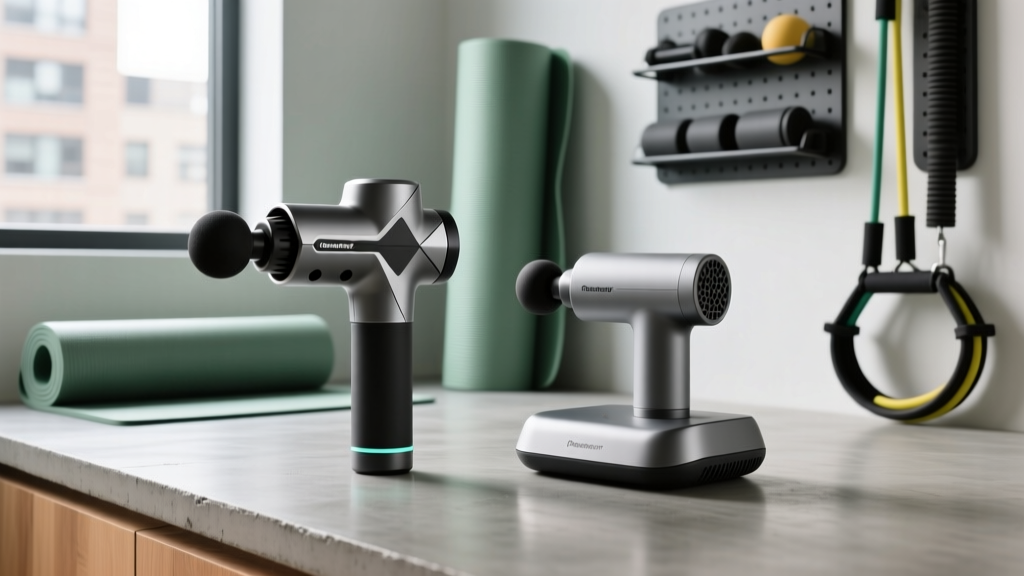
Percussion vs Vibration: Space-Saving Sportneer Massage Gun Layouts
Compare percussion and vibration therapy for home recovery zones. Learn how to optimize space and layout using a compact Sportneer massage gun.

As urban living spaces shrink and home gym footprints are forced to compete with home offices and multi-use living areas, the spatial efficiency of recovery equipment has become just as critical as its biomechanical efficacy. In 2026, the debate between percussion therapy and vibration therapy is no longer just about which modality clears lactic acid faster; it is fundamentally about spatial optimization, acoustic dampening, and layout design. For athletes and fitness enthusiasts designing a compact recovery zone, understanding the hardware constraints of these tools is essential. This is where a space-optimized tool like the Sportneer massage gun frequently outmaneuvers bulkier vibration alternatives.
The Biomechanical Divide: Percussion vs. Vibration
Before mapping out a recovery zone, we must distinguish the physiological mechanisms of both modalities. Percussion therapy relies on high-amplitude, low-frequency strikes to manipulate soft tissue. Devices like the Sportneer D9 or M2 deliver an amplitude of 12mm to 14mm at frequencies ranging from 20 to 50 Hz (1200 to 3000 RPM). This deep mechanical force stimulates the Golgi tendon organs, promoting autogenic inhibition and rapid muscle relaxation.
Vibration therapy, conversely, utilizes low-amplitude, high-frequency oscillations. According to Healthline's clinical overview of percussive and vibratory therapies, vibration primarily targets muscle spindles and increases localized blood flow through rapid, shallow contractions. While whole-body vibration plates (like the LifePro Waver) or localized vibrating rollers (like the Hyperice Vyper 3) are highly effective for neural priming, their hardware requirements introduce significant spatial and structural challenges that percussion guns simply do not possess.
Spatial Footprint: Hardware Dimensions & Storage Matrix
When designing a recovery layout, the "recovery triangle" (the spatial relationship between the user, the tool, and the storage dock) must be optimized. Below is a comparative matrix of standard recovery hardware to illustrate the spatial advantages of the Sportneer ecosystem.
| Device / Modality | Dimensions (L x W x H) | Weight | Storage Volume | Est. Price (2026) |
|---|---|---|---|---|
| Sportneer M2 (Percussion) | 9.5 x 6.5 x 2.5 in | 1.6 lbs | ~0.10 cu ft | $129 |
| Hyperice Vyper 3 (Localized Vibration) | 12.5 x 6.0 x 6.0 in | 2.5 lbs | ~0.26 cu ft | $229 |
| LifePro Waver (Whole-Body Vibration) | 24.0 x 15.0 x 6.0 in | 35.0 lbs | ~1.25 cu ft | $199 |
| Power Plate Personal (Whole-Body) | 34.0 x 26.0 x 63.0 in | 295.0 lbs | ~32.4 cu ft | $2,895 |
As the data illustrates, the Sportneer massage gun requires roughly 90% less storage volume than a standard oscillating vibration plate. In a 24-square-foot micro-recovery zone, a whole-body vibration plate consumes nearly 15% of the total floor space, whereas the Sportneer can be wall-mounted or tucked into a shallow 12-inch deep cabinetry system alongside foam rollers and resistance bands.
Designing the 24-Square-Foot Compact Recovery Zone
Optimizing a small space requires moving away from floor-based storage and utilizing vertical real estate. Here is a step-by-step framework for integrating a percussion device into a high-density layout:
- Vertical Pegboard Integration: Mount a 24x36-inch steel pegboard on the primary wall. Use custom 3D-printed or heavy-duty steel hooks to cradle the Sportneer handle. This keeps the 1.6 lb device off the floor and displays the 6 attachment heads (ball, flat, bullet, fork, etc.) in an organized, accessible row.
- Concealed Charging Docks: Lithium-ion batteries degrade faster when exposed to ambient temperature fluctuations. Install a shallow, ventilated wall cabinet (minimum 4 inches deep) with a built-in USB-C passthrough. This allows the Sportneer to charge out of sight while protecting the battery from UV exposure and dust.
- The Floor Mat Boundary: Use a 4x6-foot high-density EVA foam mat (minimum 12mm thick) to define the recovery zone. This mat serves a dual purpose: it provides cushioning for floor-based stretching and acts as an acoustic dampener for any localized vibration tools you might pair with your percussion routine.
Acoustic and Kinetic Transfer Constraints
One of the most overlooked aspects of recovery equipment layout in multi-family housing (apartments, condos, townhomes) is kinetic transfer. Whole-body vibration plates generate low-frequency structural resonance. Even with dampening mats, a 30 Hz oscillation from a 35-pound plate will transfer through floor joists, creating an audible hum in the unit below you.
Layout Warning for Multi-Family Dwellings: If you live above a shared ceiling, avoid whole-body vibration plates entirely. The Mayo Clinic notes that while vibration therapy has systemic benefits, the mechanical stress on shared structural framing can violate lease agreements regarding noise and vibration disturbances. The Sportneer D9 operates at a whisper-quiet 35 to 55 decibels, and its kinetic energy is entirely absorbed by the user's soft tissue, resulting in zero structural transfer.Modality Decision Matrix: What to Use When
Space optimization also means avoiding redundant purchases. By understanding the exact use-case for each modality, you can design a layout that relies on a single, versatile tool rather than cluttering your zone with overlapping tech. Use this decision framework to maximize your Sportneer's utility:
- Pre-Workout Neural Priming (Percussion替代 Vibration): While vibration plates are traditionally used for pre-workout central nervous system (CNS) activation, you can replicate this effect in a fraction of the space. Use the Sportneer's flat head on the 4th or 5th speed setting (approx. 2800 RPM) for 15 seconds per muscle group. This rapid, shallow striking mimics the neural wake-up call of a vibration plate without requiring you to dedicate 9 square feet of floor space to a machine.
- Post-Workout DOMS Clearance (Percussion Superiority): For delayed onset muscle soreness (DOMS), percussion is vastly superior due to its 12-14mm amplitude. Vibration tools simply cannot penetrate the fascial layers deeply enough to mechanically disrupt adhesions or promote localized interstitial fluid movement. Dedicate 2 minutes per major muscle group using the bullet or fork attachments.
- Joint and Tendon Rehab (Vibration Superiority): If you are recovering from tendinopathy (e.g., Achilles or patellar tendon issues), localized vibration is preferred as it stimulates collagen synthesis without the blunt force trauma of percussion. In this edge case, a compact vibrating roller is a better spatial investment than a full vibration plate.
Edge Cases: Battery Storage and Attachment Loss
When optimizing for space, users often make critical errors in how they store compact recovery tools. The most common failure mode for the Sportneer massage gun in space-optimized setups is battery degradation due to improper charging environments. Because the Sportneer utilizes high-capacity lithium-ion cells, storing it in a tightly enclosed, unventilated wall cabinet while actively charging can cause thermal throttling, permanently reducing the battery's maximum lifecycle by up to 20% over two years.
Furthermore, compact layouts often lead to the loss of specialized attachment heads. The standard ball and flat heads get used daily, but the pneumatic dampener or the heated attachment (available on newer 2026 premium models) often get tossed into a junk drawer. Design Tip: Dedicate a specific 6-inch magnetic strip on your pegboard exclusively for metal-based attachment stems, or use a small, wall-mounted acrylic organizer with individual slots for each polymer head. This ensures your spatial footprint remains tight while maintaining 100% inventory visibility.
Final Thoughts on Spatial Recovery
The modern recovery zone is an exercise in spatial discipline. While whole-body and localized vibration therapies hold distinct clinical value for specific rehabilitative protocols, their hardware footprints, acoustic profiles, and structural resonance make them impractical for the majority of compact, multi-use home environments. By anchoring your layout around a high-amplitude, low-decibel, and ultra-compact device like the Sportneer massage gun, you can achieve elite-level myofascial release while preserving the square footage necessary for your actual training.
More gear to consider
All reviews
Human Vehicle Recovery Tools: Best Stretching Equipment

Home Cold Plunge Layouts & Massage Gun Triggerpoint Therapy

Cupping for Athletes: 2026 Trends & How to Use Massage Gun Protocols

Trigger Point Tools: The Microsoft Exchange Server Recovery Tool

Lenovo Recovery Tool Trends 2026: Percussion vs Vibration Therapy
