
Rubber Hex vs Urethane: Space Layouts for Dumbbell Curls on Bench
Discover how rubber hex vs urethane dumbbells impact home gym space optimization, rack footprints, and clearance for dumbbell curls on bench.

The Spatial Dilemma: Bulk vs. Density in Modern Home Gyms
Designing a high-performance home gym in 2026 requires a meticulous approach to spatial geometry. Every square foot of floor space dictates the flow of your workouts, the placement of your power rack, and the clearance required for isolation movements. When outfitting your free weight zone, the choice between rubber hex dumbbells and urethane dumbbells is rarely just about aesthetics or drop-durability; it is fundamentally a space optimization decision. The physical density of the material directly influences your storage rack footprint, shelf spacing, and the lateral clearance needed when performing exercises like dumbbell curls on bench.
Layout TL;DR: The Space-to-Weight Ratio
- Rubber Hex: Lower cost ($1.50–$2.20/lb), larger physical volume, requires wider 3-tier racks (36"+ width), and demands more lateral clearance around benches.
- Urethane: Premium cost ($3.50–$5.00/lb), ultra-dense compact profile, fits on narrow racks (32" width), and maximizes central floor space for dynamic movements.
Material Density and Rack Footprint Analysis
To understand how dumbbell composition affects your gym layout, we must look at material density. Virgin polyurethane (urethane) is significantly denser than the recycled rubber composites used in standard hex dumbbells. This density differential means that a 50lb urethane dumbbell occupies noticeably less physical volume than a 50lb rubber hex dumbbell.
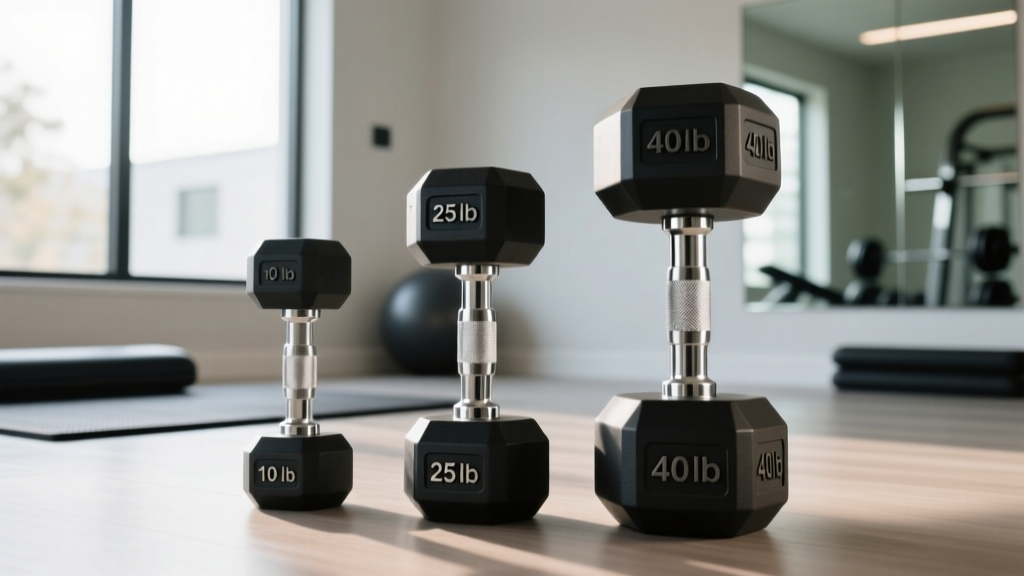
According to equipment specifications from Rogue Fitness Urethane Lines, the heads of urethane dumbbells are cast with a tighter, more spherical or compact cylindrical profile. In contrast, Rep Fitness Rubber Hex Dumbbells utilize a wider, flatter hexagonal head to prevent rolling, which inherently increases the overall length and diameter of the weight.
| Metric | Standard Rubber Hex | Premium Urethane | Spatial Impact |
|---|---|---|---|
| Overall Length | ~14.5 inches | ~11.5 inches | Urethane saves ~3" per pair on rack shelves |
| Head Diameter | ~6.5 inches | ~5.5 inches | Allows tighter vertical shelf spacing |
| Rack Shelf Depth Needed | 14" - 16" | 10" - 12" | Urethane racks protrude less into walkways |
Designing the Layout: Clearance for Dumbbell Curls on Bench
The true test of a gym layout is how well it accommodates the biomechanics of your exercises without spatial interference. When you sit down to perform dumbbell curls on bench, your lateral clearance becomes the primary bottleneck. Seated bicep curls require the elbows to track vertically and slightly forward, with the dumbbells descending fully past the torso.
Calculating the Movement Envelope
A standard adjustable FID (Flat/Incline/Decline) bench, such as the AB-3100 2.0, has a footprint of roughly 48" x 22". To execute dumbbell curls on bench safely with heavy 50lb or 60lb dumbbells, you need a minimum of 24 inches of unobstructed lateral space on both the left and right sides of the bench pad.
- The Rubber Hex Interference Zone: Because rubber hex dumbbells are longer (up to 15" for heavier pairs), the distance from your shoulder joint to the outer edge of the dumbbell head increases. If your bench is positioned parallel to a dumbbell rack, a bulky rubber hex rack (which protrudes up to 16" from the wall) will force you to move the bench further into the center of the room to avoid knuckle-scraping the rack uprights during the eccentric phase of the curl.
- The Urethane Advantage: The compact heads of urethane dumbbells reduce the lateral extension of the weight by 2 to 3 inches per arm. Furthermore, urethane storage racks can be mounted flush against walls with shallower shelves (10"-12"). This allows you to push the bench 4-6 inches closer to the perimeter wall, opening up vital central floor space for kettlebell swings, lunges, or deadlifts.
"In facilities under 200 square feet, the spatial penalty of recycled rubber composites compounds quickly. The extra three inches of shelf depth required for hex profiles frequently encroaches on the ADA-recommended 36-inch walkway clearance, turning a well-planned garage gym into an obstacle course." — Facility Layout Guidelines, National Strength and Conditioning Association (NSCA)
Floor Load, Matting, and Vertical Space Optimization
Space optimization is not strictly a two-dimensional floor plan issue; it also involves vertical load distribution and flooring thickness. This is where the density of urethane introduces a non-obvious spatial trade-off.
The Point-Load Problem
Because urethane is denser, its surface area in contact with the floor (or the rack shelf) is smaller, resulting in a higher PSI (pounds per square inch) point-load. When dropping a 75lb urethane dumbbell, the force is concentrated on a smaller footprint compared to the wider, flatter base of a rubber hex dumbbell.
⚠️ Flooring Thickness Warning
If you opt for urethane to save horizontal rack space, you must compensate vertically. Standard 1/2" EVA foam or thin rubber mats will compress and crack under the point-load of dropped urethane. You must allocate budget and vertical clearance for 3/4" or 1" thick vulcanized rubber horse-stall mats in the free-weight zone. Rubber hex dumbbells, with their wider load distribution, are generally safe on standard 1/2" commercial gym flooring.
Cost Per Square Foot of Storage: 2026 Market Pricing
As of 2026, global supply chain stabilizations have slightly reduced the premium on raw polyurethane, but urethane remains a luxury investment compared to rubber hex. To determine if the space-saving benefits justify the cost, we must analyze the price per square foot of rack storage.
Real-World Rack Pairings & Pricing
Let us compare the cost of outfitting a 5lb to 50lb set (10 pairs, 550 total lbs) and the corresponding rack required to store them efficiently.
- Rubber Hex Setup: 550lbs of Rep Fitness Rubber Hex @ ~$1.80/lb = $990. Requires a standard 36" wide 3-Tier Dumbbell Rack (approx. $250). Total Investment: $1,240. Total Rack Footprint: 4.5 sq ft.
- Urethane Setup: 550lbs of Rogue Urethane @ ~$4.20/lb = $2,310. Requires a compact 32" wide 3-Tier Urethane Rack (approx. $350). Total Investment: $2,660. Total Rack Footprint: 2.6 sq ft.
You are effectively paying a $1,420 premium to save 1.9 square feet of floor space. In a sprawling 400 sq ft basement gym, this ROI is negligible. However, in a high-end apartment gym, a converted 10x10 spare bedroom, or a luxury garage gym where every inch dictates the inclusion of a cable machine or a rowing ergometer, that 1.9 sq ft of reclaimed floor space is invaluable.
Final Verdict for Compact Gym Layouts
Choosing between rubber hex and urethane is an exercise in spatial prioritization. If your home gym layout features a dedicated, spacious free-weight alcove where the bench can be positioned centrally without impeding walkways, rubber hex dumbbells offer superior economic value and adequate floor-load distribution.
However, if you are engineering a high-density micro-gym, prioritizing wall-hugging storage, and require maximum lateral clearance for strict isolation movements like dumbbell curls on bench, urethane is the undisputed champion of spatial efficiency. The compact profile allows for shallower racks, tighter shelf spacing, and a cleaner biomechanical envelope, proving that in modern gym design, density is just as important as durability.
More gear to consider
All reviews
Best Adjustable Dumbbells for Dumbbell Weight Training (2026)

Cast Iron vs Competition Kettlebells: Gear for a Proper Dumbbell Row
Best Adjustable Dumbbells for Two Arm Seated Dumbbell Extension

EZ Curl Bar vs Straight Bar & How to Work Chest with Dumbbells

Barbell Collar Clamp Types & Dumbbell Skull Crusher Workout Safety
