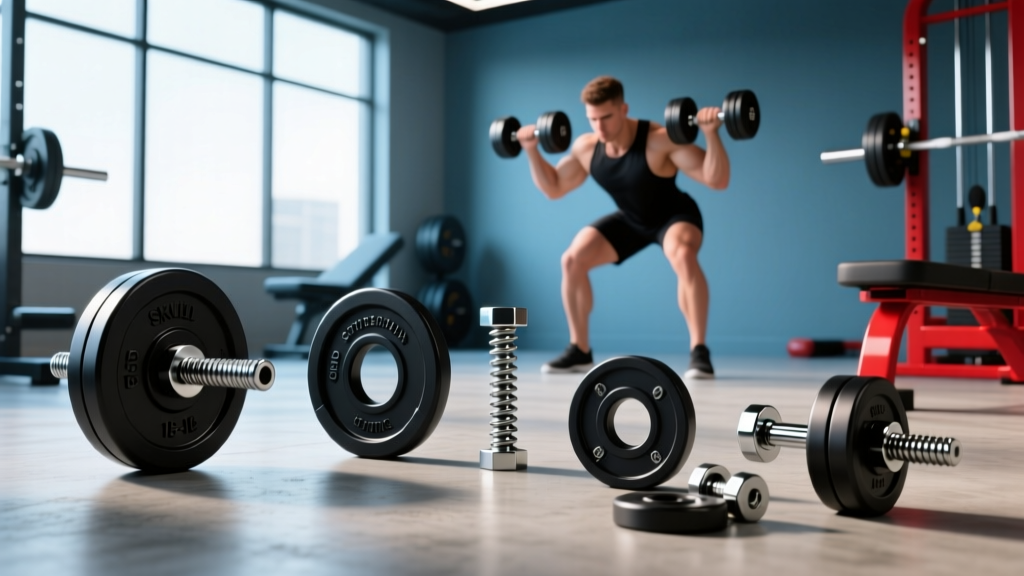
Barbell Collar Clamp Types & Dumbbell Skull Crusher Workout Safety
Compare barbell collar clamp types and learn essential safety protocols for the dumbbell skull crusher workout to prevent catastrophic plate slippage.

The Hidden Danger in Your Home Gym: Why Collar Selection Matters
When building a free weight arsenal, lifters obsess over barbell whip, dumbbell knurling, and rack stability. Yet, the most critical safety component in your gym is often the cheapest: the collar. A failing collar doesn't just ruin a set; it turns a controlled lift into a projectile hazard. This is especially true when performing movements where the weight is suspended directly over your face or vital joints.
In this comprehensive 2026 buying guide, we break down the engineering, failure modes, and practical applications of every major barbell and dumbbell collar type. More importantly, we apply this knowledge to one of the most unforgiving triceps isolation movements in existence, proving why premium clamps are non-negotiable for facial-axis exercises.
The Biomechanical Threat: Why the Dumbbell Skull Crusher Workout Demands Premium Collars
The dumbbell skull crusher is a staple for targeting the long and lateral heads of the triceps. However, when executed with loadable Olympic dumbbell handles or standard plate-loaded dumbbells, the physics of the movement place extreme, multi-directional stress on your collars.
Unlike a barbell bench press where the sleeves remain relatively horizontal, the dumbbell skull crusher workout requires the handles to rotate freely in your grip as your elbows flex and extend. This introduces severe rotational torque and lateral shear force against the inner face of the collar. If you are using 25-pound plates on a 15-pound loadable handle, the rotational inertia at the bottom of the eccentric phase (when the dumbbells are hovering inches from your forehead) is immense.
⚠️ Biomechanical Warning: According to the ACE Fitness Exercise Library, maintaining a neutral wrist and secure grip during overhead and facial triceps extensions is paramount. A slipping plate alters the center of gravity mid-rep, instantly compromising the elbow joint and risking catastrophic impact to the skull or orbital bone.Comprehensive Barbell & Dumbbell Collar Comparison Matrix
Not all collars are created equal. Below is a data-driven comparison of the primary collar types available on the market today, evaluated on grip force, durability, and suitability for high-torque movements.
| Collar Type | Mechanism | Grip Force | Weight (Pair) | Price Range | Skull Crusher Safe? |
|---|---|---|---|---|---|
| Clamp-Style (Aluminum) | Cam-lever & Tension Screw | Extremely High | 1.0 - 11.0 lbs | $45 - $90 | ✅ Yes |
| Polymer Lock-Jaw | Snap-fit Polymer Clamp | High | 0.6 lbs | $35 - $50 | ✅ Yes (with caveats) |
| Spin-Lock Nut | Threaded Sleeve Screw | Moderate | 1.5 - 3.0 lbs | $15 - $30 | ⚠️ Only if Asterisk |
| Spring Clip | Steel Tension Spring | Very Low | 0.2 lbs | $5 - $15 | ❌ Never |
Deep Dive: Collar Categories and Real-World Failure Modes
To make an informed purchase, you must understand how these tools fail in the real world. Here is the unvarnished truth about each category.
1. Clamp-Style Aluminum Collars (The Gold Standard)
Models like the Rogue HG 2.0 Aluminum Collars ($45/pair) and the Eleiko Olympic Weightlifting Collars ($85/pair) dominate commercial gyms and elite home setups. They utilize a cam-lever action that pulls a tension screw tight against the steel sleeve.
- The Advantage: Unmatched lateral grip. They will not budge even if you drop the dumbbell from shoulder height.
- Real-World Failure Mode: Chalk Blindness. If you use heavy liquid or block chalk, a layer of magnesium carbonate builds up on the dumbbell sleeve. This acts as a dry lubricant, reducing the friction coefficient between the aluminum collar and steel sleeve. Wipe your sleeves with a damp microfiber cloth weekly to maintain grip integrity.
2. Polymer Lock-Jaw & Pro-Loc Collars
The Lock-Jaw Pro ($40/pair) and Pro-Loc ($35/pair) are made from high-density, glass-reinforced nylon. They snap onto the sleeve and lock via a secondary safety latch.
- The Advantage: Lightning-fast changes. Ideal for drop sets or supersets where you are rapidly changing plate loads on your dumbbell handles.
- Real-World Failure Mode: Thermal Brittleness. If your home gym is an uninsulated garage in a northern climate, polymer collars become brittle at temperatures below 45°F (7°C). A dropped dumbbell can shatter a cold polymer collar, releasing the plates mid-set.
3. Spin-Lock Nuts (Loadable Dumbbell Specific)
Standard 1-inch or 2-inch threaded dumbbell handles rely on spin-lock nuts. While generally secure, the rotational torque of a triceps extension can literally unscrew a standard smooth nut.
- The Advantage: Integrated into the handle design; zero extra gear required.
- Real-World Failure Mode: Rotational Back-Out. During the concentric phase of a skull crusher, the friction of your hand twisting the handle can transfer rotational force to the sleeve. Solution: Only use Asterisk Lock Nuts (which feature a star-shaped inner grip that bites into the sleeve threads) for overhead and facial movements.
4. Spring Clips (The Danger Zone)
The traditional metal spring clips are relics of a bygone era. They offer negligible lateral resistance and are prone to metal fatigue.
"Using spring clips for any movement where the barbell or dumbbell sleeve tilts past 45 degrees is a gross negligence of basic gym safety. The kinetic energy of a sliding 10lb plate is enough to fracture a nasal bone."
Step-by-Step: Securing Your Weights for Overhead & Facial Movements
When prepping for your dumbbell skull crusher workout, follow this exact sequence to ensure maximum safety, particularly when using clamp-style collars on Olympic dumbbell handles:
- Sleeve Inspection: Wipe the dumbbell handle sleeve with a dry brush or cloth to remove chalk dust and oil.
- Plate Seating: Slide your bumper or steel plates flush against the inner sleeve flange. Ensure no debris is trapped between the plate and the flange.
- Collar Placement: Slide the clamp collar onto the sleeve until it makes firm contact with the outer plate. Do not leave a gap.
- Tension Pre-Load: If using a cam-lever collar (like the Rogue HG 2.0), adjust the tension screw so that you feel heavy resistance when the lever is at a 90-degree angle, before snapping it fully flush against the collar body.
- The Shake Test: Grip the handle and violently shake it horizontally. If you hear a metallic 'clack' or feel the plates shift, increase the tension screw by a half-turn and repeat.
Buying Framework: Which Collar Should You Buy in 2026?
Your purchasing decision should be dictated by your equipment type and training environment:
- For Olympic Loadable Dumbbells & Heavy Barbell Work: Invest in Clamp-Style Aluminum Collars. The $45-$85 investment is a literal life-saver for skull crushers, overhead presses, and heavy deadlifts.
- For CrossFit, High-Volume Drop Sets, & Climate-Controlled Gyms: Choose Polymer Lock-Jaw Collars. The speed of changeover outweighs the extreme grip of aluminum, provided your gym stays above 50°F year-round.
- For Standard 1-Inch Threaded Dumbbells: Discard standard smooth nuts immediately. Upgrade to Asterisk Lock Nuts and always use a wrench to tighten them before performing skull crushers.
Expert FAQ
Do I need collars if I am using fixed rubber hex dumbbells?
No. Fixed hex dumbbells are cast or bolted as a single unit. However, if you are performing the dumbbell skull crusher workout with adjustable dial-system dumbbells (e.g., Bowflex or PowerBlock), ensure the internal retention pins are fully seated and the dial clicks securely into the weight plate groove before lifting over your face.
Does the weight of the collar matter for my skull crusher tracking?
For general hypertrophy, the 0.5 lb weight of an aluminum collar is negligible. However, if you are a competitive Olympic weightlifter using calibrated plates, you must account for the 5.5 lbs of a pair of Eleiko competition collars when calculating your total load. For triceps isolation, focus on the grip security rather than the micro-weight addition.
Can I use barbell collars on dumbbell handles?
Yes, provided the sleeve diameter matches. Most Olympic dumbbell handles feature the same 50mm (2-inch) sleeve diameter as standard Olympic barbells. Clamp collars and polymer collars will fit perfectly and provide the necessary lateral security for high-torque triceps extensions.
More gear to consider
All reviews
What Muscles Do Incline Dumbbell Press Work? & Barbell Collar Types Compared

Setup Guide: Alternating Dumbbell Raises With Neoprene Weights
Adjustable Dumbbell Setup, Reviews & Dumbbell Necklace Charm

EZ Bar vs Straight Bar & Face Pull Dumbbell Alternative Care

Beyond the Heaviest Dumbbell: Olympic vs Standard Plates
