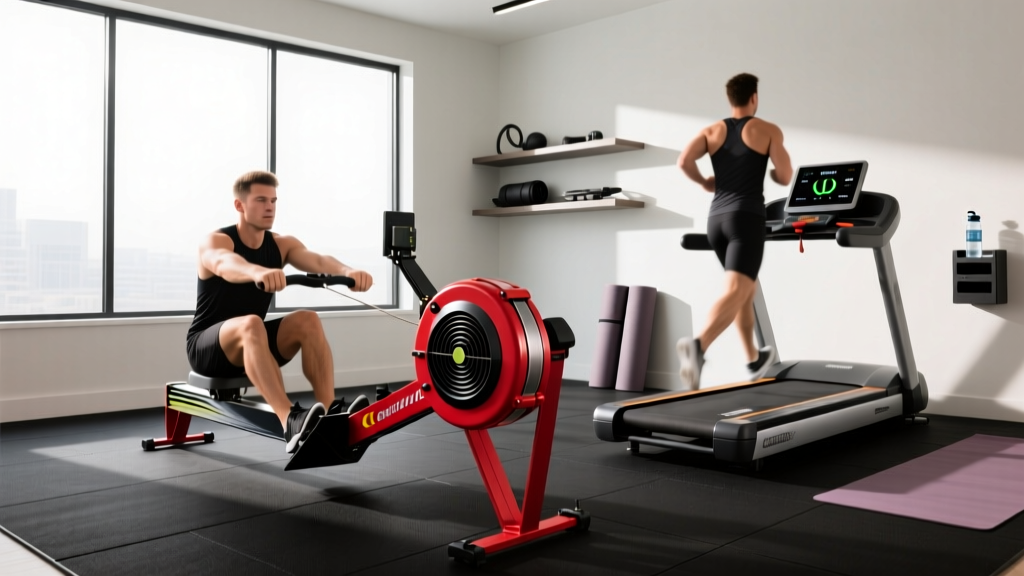
Rowing vs Working Out on Treadmill to Lose Weight: A Guide
Discover why a rowing machine beats working out on treadmill to lose weight. Get our beginner buying guide, step-by-step technique, and 4-week plan.

The Great Cardio Debate: Why Rethink the Treadmill?
When most people decide to start a fitness journey, their default choice is running or walking at the local gym. Many beginners spend months working out on treadmill to lose weight, only to hit a frustrating plateau due to metabolic adaptation and a lack of full-body muscle recruitment. While treadmills are excellent for building lower-body endurance and bone density, they primarily engage the lower half of your body. If your primary goal is efficient, high-yield fat loss, the indoor rowing machine (ergometer) offers a biomechanically superior alternative.
Rowing is a closed-chain, low-impact exercise that recruits approximately 86% of the body's musculature per stroke. By shifting your focus from the treadmill belt to the rowing rail, you trigger a massive metabolic demand without subjecting your knees, hips, and ankles to the repetitive ground-reaction forces of running. This guide will break down exactly why the rower wins the weight-loss debate, how to buy the right machine in 2026, and the exact technique you need to burn fat safely.
Biomotor Breakdown: Rower vs. Treadmill
To understand why the ergometer is a fat-loss powerhouse, we need to look at the physiological demands of both machines. According to Harvard Medical School, vigorous rowing can burn between 255 and 440 calories in just 30 minutes, depending on your body weight. However, the true advantage lies in the afterburn effect (Excess Post-exercise Oxygen Consumption, or EPOC) generated by full-body resistance cardio.
| Feature | Indoor Rower (Ergometer) | Treadmill (Incline/Run) |
|---|---|---|
| Muscle Engagement | 86% (Legs, Core, Back, Arms) | 40-50% (Primarily Lower Body) |
| Joint Impact | Zero-impact (Closed kinetic chain) | High-impact (Running) / Low (Walking) |
| Caloric Burn (155lb person, 30m) | ~255 (Moderate) / ~369 (Vigorous) | ~240 (Moderate) / ~360 (Running 6mph) |
| Posture & Core Demand | High (Requires active spinal stabilization) | Low to Moderate |
| Spatial Footprint | High (Requires ~9ft length) | High (Requires ~6ft length, tall ceiling) |
Step-by-Step Rowing Technique for Maximum Fat Burn
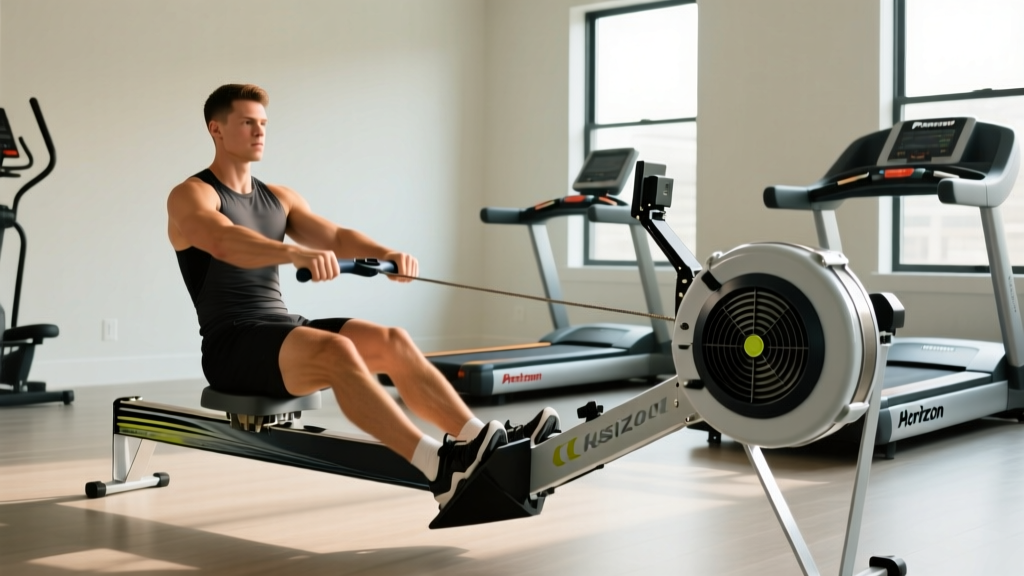
The biggest mistake beginners make is treating the rowing machine like a seated bicycle, pulling frantically with their arms. According to the Concept2 Technique Guide, a proper rowing stroke is a sequential transfer of power. Mastering this sequence is critical for preventing lower back pain and maximizing caloric output.
The Four Phases of the Stroke
- The Catch (Setup): Sit with your shins vertical (do not compress past 90 degrees). Hinge forward from the hips, keeping your chest up and arms straight. Your lats should be engaged, and your core braced.
- The Drive (Power): This is where the fat burns. Push explosively with your legs first. When your legs are about 75% extended, hinge your torso backward. Finally, draw the handle to your lower ribcage using your biceps and upper back. Sequence: Legs, Torso, Arms.
- The Finish (Stabilization): Your legs are fully extended, torso is leaning back slightly (about 11 o'clock), and the handle is resting just below your chest. Squeeze your shoulder blades together momentarily.
- The Recovery (Reset): Reverse the sequence smoothly. Extend your arms, hinge your torso forward past your hips, and finally bend your knees to slide back to the catch. Sequence: Arms, Torso, Legs.
Your drive should take 1 second (explosive power), while your recovery should take 2 seconds (active rest). This ratio ensures you are utilizing the anaerobic and aerobic energy systems efficiently, mimicking high-intensity interval training (HIIT) naturally.
2026 Beginner Rowing Machine Buying Guide
Not all rowers are created equal. When shopping for a machine to support your weight loss journey, you must consider resistance type, monitor accuracy, and build quality. Here are the top three models dominating the home fitness market right now.
1. The Gold Standard: Concept2 RowErg
- Price: ~$990
- Resistance Type: Air
- Best For: Serious beginners, data nerds, and CrossFit athletes.
The Concept2 RowErg remains the undisputed king of indoor rowing. Its air resistance means the harder you pull, the more resistance it generates, perfectly matching your effort. The PM5 monitor is incredibly accurate, allowing you to track your 500-meter split times and wattage. It takes up about 9 feet of space but can be separated into two pieces for storage.
2. The Budget Magnetic Option: Sunny Health & Fitness SF-RW5515
- Price: ~$259
- Resistance Type: Magnetic
- Best For: Apartment dwellers and strict budgets.
If the whooshing sound of air resistance bothers your household, this magnetic rower is the solution. It offers 12 levels of magnetic tension. While the monitor is basic and lacks the advanced data metrics of the Concept2, it provides a smooth, near-silent stroke that is excellent for steady-state, low-intensity cardio sessions while watching TV.
3. The Premium Smart Rower: Hydrow
- Price: ~$2,495
- Resistance Type: Electromagnetic
- Best For: Tech enthusiasts who need external motivation.
Hydrow uses a patented electromagnetic drag mechanism that perfectly simulates the feeling of water. The 22-inch touchscreen offers live, on-the-water workouts led by Olympic athletes. If you struggle with the boredom of solo cardio and need an immersive experience to keep you consistent with your weight loss goals, the Hydrow is a worthwhile investment.
Your 4-Week Beginner Weight Loss Rowing Protocol
To align with the CDC Physical Activity Guidelines, adults need at least 150 minutes of moderate-intensity aerobic activity per week. This 4-week plan builds your aerobic base while introducing interval training to accelerate fat loss.
Understand the Damper SettingDo not set the damper to 10! The damper on an air rower is like the gears on a bicycle, not a weight stack. A setting of 10 drops the flywheel speed quickly, forcing you to work harder just to keep it moving, which often leads to lumbar fatigue. Keep the damper between 3 and 5 (a drag factor of 110-130) for the most realistic water simulation and optimal cardiovascular conditioning.
Week 1: Building the Aerobic Base
- Frequency: 3 Days/Week
- Workout: 10 minutes continuous rowing at a relaxed pace.
- Target Stroke Rate: 18-22 strokes per minute (spm).
- Focus: Perfecting the Legs-Torso-Arms sequence. Do not worry about speed.
Week 2: Introducing Intervals
- Frequency: 3 Days/Week
- Workout: 5 rounds of [1 minute moderate effort / 1 minute active rest (very light rowing)].
- Target Stroke Rate: 22-24 spm during work intervals.
- Focus: Learning how to control your breathing and recover while still moving.
Week 3: Distance Progression
- Frequency: 4 Days/Week
- Workout: Day 1 & 3: 15 minutes steady state. Day 2 & 4: 8 rounds of [250 meters fast / 1 minute rest].
- Target Stroke Rate: 24-26 spm for the 250m sprints.
- Focus: Generating more watts per stroke by pushing harder with the legs, not pulling faster with the arms.
Week 4: The Fat-Burn Threshold
- Frequency: 4 Days/Week
- Workout: 2,000 Meter Time Trial (Day 1), 20 minutes steady state (Day 2), 10 rounds of [30 seconds max effort / 30 seconds rest] (Day 3), 15 minutes easy recovery row (Day 4).
- Focus: Testing your cardiovascular improvement and pushing your lactate threshold.
'Weight loss is ultimately a byproduct of consistency and a caloric deficit. The rowing machine doesn't just burn calories during the session; the massive recruitment of the posterior chain (glutes, hamstrings, erectors, and lats) builds lean muscle tissue, which elevates your resting metabolic rate long after you've unstrapped your feet.' - Sports Science Biomechanics Review
Frequently Asked Questions
Will rowing make my legs bulky?
No. Rowing is an endurance-strength activity. The resistance is limited by your own aerobic output and the machine's air/magnetic drag. You will develop lean, dense, and highly conditioned leg muscles, similar to a track cyclist or speed skater, but not the hypertrophy seen in heavy barbell squatters.
Can I row every day to lose weight faster?
While rowing is low-impact, your lower back and central nervous system need recovery. Aim for 4 to 5 days a week, alternating between high-intensity interval days and low-intensity steady-state (LISS) recovery days to prevent burnout and overuse injuries.
Why does my lower back hurt after rowing?
Lower back pain in beginners is almost always caused by one of two errors: opening the torso before the legs are fully extended during the drive, or rounding the lumbar spine at the catch. Focus on keeping your chest tall and hinging strictly from the hips.
More gear to consider
All reviews
Under Desk Treadmills 2026: Adapting a Popular Treadmill Workout

Cardio Machine Noise Comparison: Max Speed on Treadmill Tested
Sole Fitness F80 Folding Treadmill vs Under Desk Office Treadmills
Stair Climber Guide: Translating Mile Times on Treadmill
Rowing Machine Setup: Better Than a ProForm vs Horizon Treadmill?
