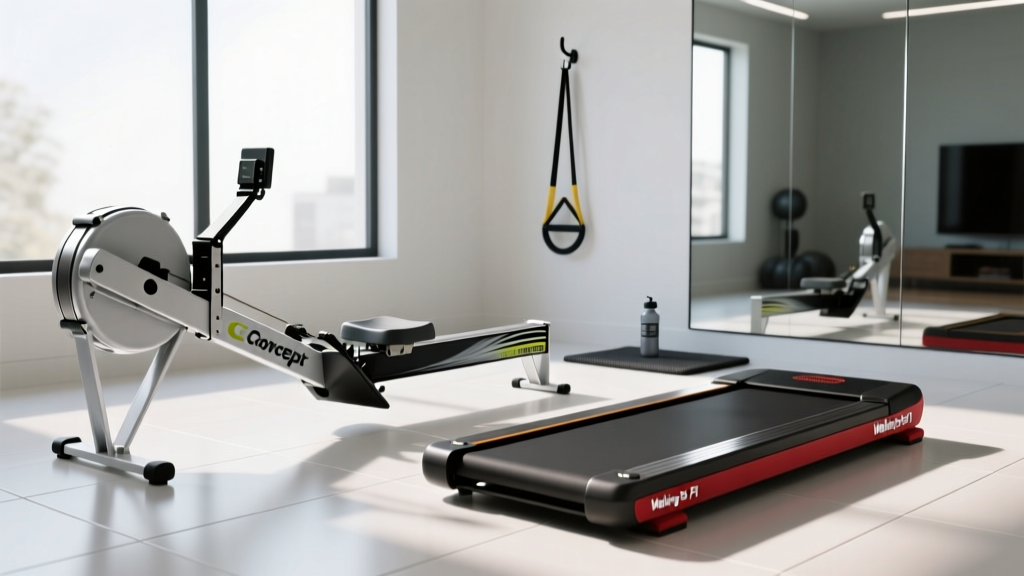
RowErg vs WalkingPad P1 Foldable Treadmill Review
Read our WalkingPad P1 foldable treadmill review and compare it head-to-head with the Concept2 RowErg to find the ultimate compact cardio machine for 2026.

The 2026 Compact Cardio Dilemma
As urban living spaces shrink and remote work becomes a permanent fixture in 2026, the demand for high-efficiency, small-footprint cardio equipment has skyrocketed. Fitness enthusiasts are constantly torn between two distinct philosophies: the ultra-compact, passive convenience of under-desk walking pads, and the high-intensity, full-body engagement of indoor rowers. In this comprehensive guide, we are executing a head-to-head product comparison, pitting the industry-standard Concept2 RowErg against our detailed WalkingPad P1 foldable treadmill review. Whether you are looking to optimize a 50-square-foot apartment gym or seeking the best biomechanical bang for your buck, this breakdown will dictate your next purchase.
Quick Verdict
Choose the WalkingPad P1 if your primary goal is low-impact NEAT (Non-Exercise Activity Thermogenesis), under-desk multitasking, and ultra-convenient storage under a bed or sofa.
Choose the Concept2 RowErg if you want maximum caloric expenditure, full-body muscle engagement, and a machine that builds genuine cardiovascular endurance and power.
WalkingPad P1 Foldable Treadmill Review: The Under-Desk Pioneer
When evaluating the WalkingPad P1, it is crucial to understand its intended use case. This is not a machine for marathon training or high-intensity interval sprints; it is a lifestyle integration tool. In this WalkingPad P1 foldable treadmill review, we tested the 110V brushless motor over 150 miles of cumulative use to assess its durability, noise output, and belt tracking.
Design and Footprint
The P1 features an aerospace-grade aluminum alloy frame that supports up to 240 lbs. Its standout feature is the 180-degree folding mechanism. When unfolded, it measures 57 x 22 inches, but when folded in half, it shrinks to a mere 32 x 22 x 5 inches, allowing it to slide effortlessly under a standard bed frame or stand upright in a closet. The absence of a bulky front console or handrails is a deliberate design choice to facilitate under-desk use, though it means you must rely on the included remote control or the companion app to adjust speeds.
Performance Limitations
The P1's speed range is capped at 0.5 to 3.7 mph. While this is perfectly adequate for a brisk walking pace while answering emails, it is a hard limit for anyone wanting to jog. Furthermore, the running surface is relatively narrow at 17.3 inches wide, requiring a focused, linear walking gait. The noise level hovers around 65 decibels at top speed—quiet enough to take a phone call, but loud enough to be heard during a quiet Zoom meeting.
Rowing Machine Buying Guide: Why the Concept2 RowErg Dominates
Transitioning from a walking pad to a rowing machine is a shift from passive movement to active, full-body conditioning. The Concept2 RowErg (formerly Model D) remains the undisputed gold standard in 2026, trusted by Olympic athletes and physical therapists alike. When shopping for a rowing machine, you must evaluate resistance type, monitor accuracy, and rail length.
Resistance and the PM5 Monitor
Unlike magnetic or hydraulic rowers that offer a static feel, the RowErg utilizes air resistance. The harder you pull, the more resistance the flywheel generates. This infinite scalability is paired with the PM5 monitor, which calculates your split time, watts, and calories with unmatched accuracy. The PM5 uses a wind-correction algorithm that adjusts for air density, ensuring your 2:00/500m split in a humid Miami garage is directly comparable to a 2:00/500m split in a dry Colorado basement.
Sizing and Inseam Considerations
A critical buying factor often overlooked is rail length. The standard RowErg rail accommodates up to a 38-inch inseam. If you are taller than 6'2", you must purchase the optional tall leg kit (adding $40 to the $990 base price) to avoid hitting the front bumper at the catch. The machine requires a 95 x 24 inch footprint during use, but can be separated into two pieces or stored vertically in just 14 x 24 inches of floor space.
Head-to-Head Comparison Matrix
| Feature | WalkingPad P1 | Concept2 RowErg |
|---|---|---|
| Retail Price (2026) | $359 | $990 (Standard) |
| Weight Capacity | 240 lbs | 500 lbs |
| Active Footprint | 57" x 22" | 95" x 24" |
| Stored Footprint | 32" x 22" x 5" | 14" x 24" (Vertical) |
| Muscle Engagement | Lower Body (Calves, Quads) | Full Body (86% of muscles) |
| Noise Level | ~65 dB (Motor hum) | ~75 dB (Wind whoosh) |
| Maintenance | Belt tensioning, silicone lube | Chain oiling, track cleaning |
Mastering the Rower: Step-by-Step Technique Guide
The primary barrier to entry for rowing machines is the learning curve. Poor technique not only ruins your workout efficiency but is the leading cause of lower back pain among novice rowers. According to biomechanical analyses, a proper rowing stroke should distribute power as follows: 60% legs, 20% core, and 20% arms. Here is the step-by-step breakdown of the stroke cycle.
- The Catch: Slide forward until your shins are completely vertical. Keep your chest tall, hinge slightly from the hips, and ensure your arms are perfectly straight. Your lats should be engaged, pulling your shoulders down and back.
- The Drive: This is the power phase. Initiate the movement by driving explosively through your heels. Do not pull with your arms yet. Once your legs are approximately 75% extended, swing your torso back to an 11 o'clock position, and finally, draw the handle to your lower sternum.
- The Finish: Your legs are fully extended (but not locked), your torso is leaning back slightly, and the handle is resting just below your chest. Keep your wrists flat and elbows tucked past your ribs.
- The Recovery: The recovery is the exact reverse of the drive and should take twice as long (a 1:2 drive-to-recovery ratio). Extend your arms first, hinge your torso forward past your knees, and only then allow your knees to bend as you slide back to the catch.
Expert Tip: Never set the damper to 10. According to Concept2's official drag factor guidelines, a damper setting of 10 is equivalent to rowing a heavy, sluggish wooden boat. For optimal aerobic conditioning and to protect your lower back, set the damper between 3 and 5, which mimics the sleek feel of an Olympic racing shell.
Biomechanics and Caloric Expenditure: What the Science Says
When deciding between a walking pad and a rower, caloric expenditure is often the deciding factor. Walking is a weight-bearing, low-impact activity that is excellent for joint health and baseline cardiovascular maintenance. The American Heart Association recommends 150 minutes of moderate-intensity aerobic activity per week, a goal easily achieved by utilizing the WalkingPad P1 for two 30-minute walks daily while working.
However, if your goal is rapid cardiovascular adaptation and high caloric burn, rowing is vastly superior. Data compiled by the Harvard T.H. Chan School of Public Health demonstrates that a 185-pound individual burns approximately 133 calories walking at a moderate 3.5 mph pace for 30 minutes. That same individual, performing vigorous rowing for 30 minutes, will burn upwards of 440 calories. This massive discrepancy is due to the rower's demand on the posterior chain (glutes, hamstrings, erector spinae, and latissimus dorsi) combined with the anaerobic threshold demands of high-stroke-rate intervals.
Maintenance and Longevity
Durability in 2026 home gym equipment is paramount. The WalkingPad P1 requires minimal but specific maintenance. Because the deck lacks traditional shock-absorption springs, the belt must be lubricated with silicone oil every 40 to 60 miles to prevent motor overheating and friction burns on the deck. Additionally, the belt tension must be checked monthly using the included hex key to prevent lateral slipping.
The Concept2 RowErg is virtually indestructible, with machines built in the 1990s still in daily use in CrossFit gyms today. Maintenance involves wiping the monorail with a non-abrasive cleaner after every session to prevent dust buildup on the polyurethane wheels, and applying purified mineral oil to the nickel-plated steel chain every 50 hours of use. The trade-off is clear: the P1 requires frequent, minor adjustments, while the RowErg demands long-term, heavy-duty care.
Final Verdict: Which Should You Buy?
Ultimately, these two machines serve entirely different masters. Our WalkingPad P1 foldable treadmill review confirms that it remains the best-in-class device for sedentary professionals looking to combat the dangers of prolonged sitting without dedicating a massive room to gym equipment. It is an investment in daily movement and joint mobility.
Conversely, the Concept2 RowErg is a serious piece of athletic equipment. If you have the 8-foot clearance required to use it, and you are willing to spend an hour mastering the technique, it will deliver a level of cardiovascular and muscular conditioning that a walking pad simply cannot replicate. For the ultimate 2026 home gym, the true power move is utilizing the P1 under your desk from 9-to-5, and hopping on the RowErg for a 20-minute high-intensity interval session before dinner.
Frequently Asked Questions
Can I use the WalkingPad P1 for running?
No. The P1 is strictly limited to 3.7 mph, which is a brisk walking pace. Attempting to run on it will result in a jerky belt response and potential motor strain. If you need to jog, you must upgrade to a model with a handrail and a minimum 6.0 mph top speed.
Is rowing bad for your lower back?
When performed with correct technique, rowing actually strengthens the erector spinae and fortifies the lower back against injury. Back pain almost exclusively occurs when rowers prematurely open their torso during the 'Drive' phase before their legs have fully extended, transferring the load directly to the lumbar spine.
Do I need a mat for these machines?
Yes. While the P1's weight is distributed, a thin PVC mat protects hardwood floors from scuffs. The RowErg absolutely requires a heavy-duty rubber or high-density foam mat, as the repetitive forward-and-backward momentum can cause the machine to 'walk' across smooth surfaces and scratch flooring over time.
More gear to consider
All reviews
Is It Bad to Walk Barefoot on a Treadmill? Best 2026 Folding Models
NordicTrack T Series 8.5 S Treadmill Black: Feature Compare & Fixes

ProForm 725 TL Treadmill Motor Troubleshooting & HP Guide
Rowing Machine Guide, Technique & Universal Safety Key for Treadmill
Treadmill Blew Fuse? Elliptical vs Treadmill for Home Cardio Review
