ReneStar Treadmills vs Ellipticals: Space-Saving Cardio (2026)
Compare ReneStar treadmills and compact ellipticals for home use. Discover space-saving layouts, clearance metrics, and electrical requirements for 2026.

The Spatial Dilemma: Footprint vs. Functionality in 2026
As urban living spaces shrink and dedicated home gym square footage becomes a premium commodity in 2026, the debate between purchasing a treadmill or an elliptical is no longer just about biomechanics—it is fundamentally an exercise in spatial geometry. When optimizing a spare bedroom, garage corner, or micro-apartment layout, fitness enthusiasts must weigh the mechanical realities of their equipment against the physical boundaries of their walls.
For budget-conscious consumers prioritizing foldability and compact storage, ReneStar treadmills have emerged as a highly popular category. However, how do these foldable running machines compare to compact ellipticals when mapping out a functional, safe, and breathable home cardio zone? This guide breaks down the exact dimensions, clearance requirements, and infrastructure needs to help you design the ultimate space-efficient cardio layout.
The Geometry of Home Cardio: Active vs. Stored Footprints
The most common mistake in home gym design is measuring only the 'stored' footprint of a machine. A piece of equipment might fold down to a neat 2-square-foot rectangle, but if it requires 45 minutes of heavy lifting to deploy, it will remain stored 90% of the time. We must evaluate both the active operational footprint and the safety clearance zones.
Analyzing ReneStar Treadmills for Compact Layouts
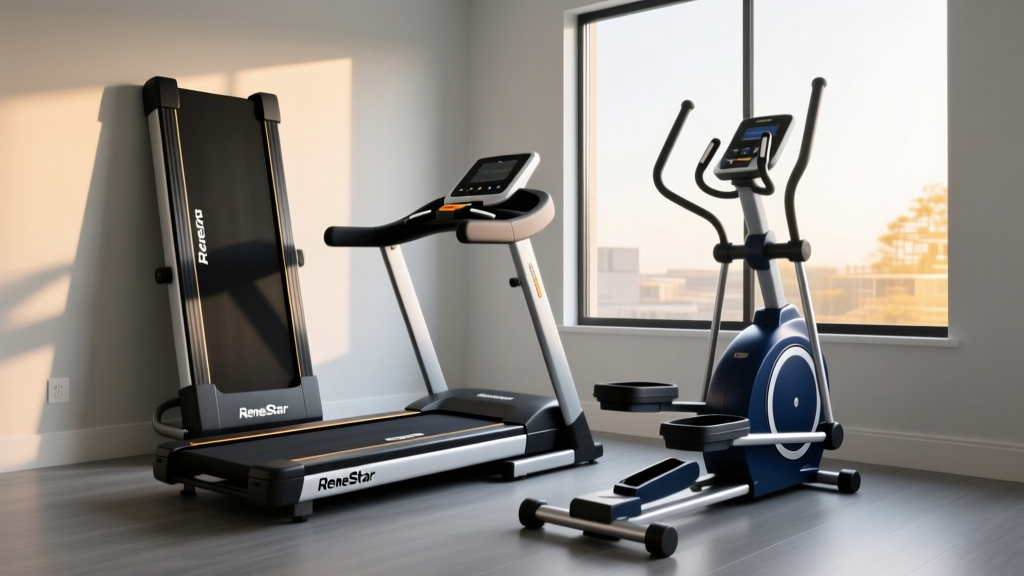
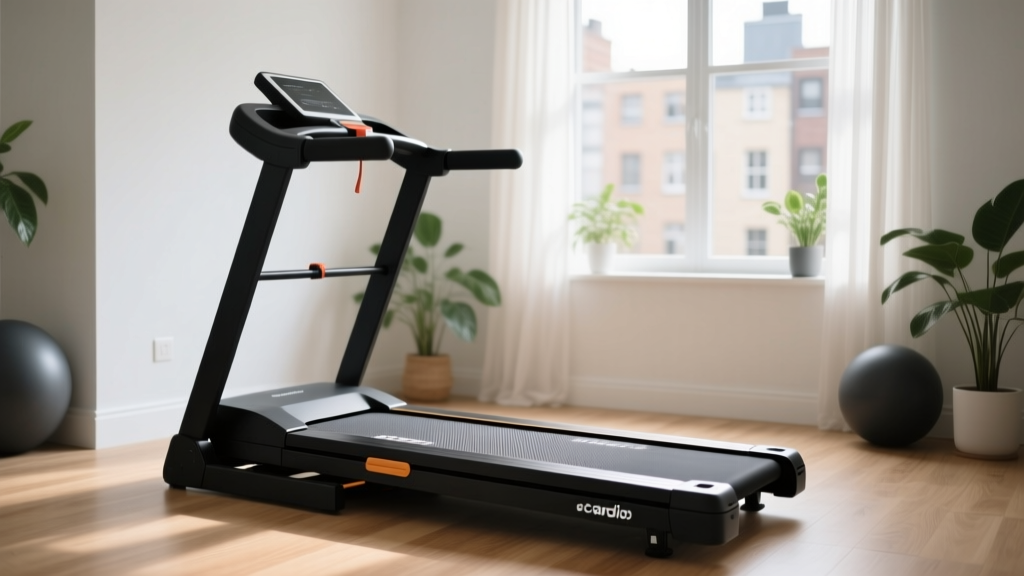
ReneStar treadmills, particularly their 2.25 HP and 3.0 HP folding models (typically priced between $299 and $449 in 2026), are engineered for spatial efficiency. A standard ReneStar folding model features an active footprint of roughly 63 inches long by 27 inches wide. However, the running belt itself is often a compact 48 x 18 inches, which is sufficient for jogging but requires users to maintain spatial awareness to avoid clipping the side rails.
CRITICAL CLEARANCE RULE: According to industry safety standards, treadmills require a minimum of 30 inches of unobstructed clearance behind the deck. If a user slips, this fall zone prevents them from being propelled into a wall, desk, or glass window. Therefore, a 63-inch ReneStar treadmill actually demands a 93-inch linear wall space during operation.When folded, ReneStar's hydraulic or gas-strut mechanisms allow the deck to lock vertically, reducing the footprint to approximately 32 x 27 inches. This makes it an excellent candidate for sliding into a closet or tucking behind a sofa, provided the ceiling height in the storage zone exceeds 61 inches.
The Elliptical Alternative: Vertical Space Tax and Stride Compromises
Ellipticals eliminate the need for a rear fall zone, making them flush-wall friendly. However, they introduce a 'vertical space tax.' Compact ellipticals like the Bowflex Max M9 (footprint: 49 x 30 inches) or the Sole E20 (footprint: 70 x 24 inches) feature elevated pedal heights.
The average elliptical step-up height ranges from 10 to 15 inches. When you add the user's height and the natural vertical bounce of the stride (roughly 3-5 inches), a 6-foot-tall user on an elliptical requires a ceiling height of at least 8 feet 4 inches to avoid head strikes. In basement gyms or rooms with low-hanging ceiling fans, ellipticals often fail the spatial compliance test, making low-profile ReneStar treadmills the superior choice for low-clearance rooms.
Head-to-Head Spatial & Infrastructure Matrix
Below is a comparative matrix detailing the spatial and infrastructural requirements for a standard ReneStar folding treadmill versus a mid-tier compact elliptical.
| Feature | ReneStar 3.0 HP Folding Treadmill | Compact Front-Drive Elliptical (e.g., Sole E20) |
|---|---|---|
| Active Floor Footprint | 63" L x 27" W | 70" L x 24" W |
| Mandatory Safety Clearance | 30" rear / 12" lateral | 0" rear / 12" lateral |
| Minimum Ceiling Height | Standard (User Height + 6") | User Height + 18" (Pedal clearance) |
| Electrical Draw (Peak) | 12 - 15 Amps (Requires dedicated circuit) | < 2 Amps (Standard outlet safe) |
| Impact & Vibration | High (Requires 3/8" rubber mat) | Low (Standard EVA foam mat sufficient) |
| 2026 Avg. Price Range | $299 - $449 | $899 - $1,299 |
Infrastructure: Electrical Loads and Floor Deflection
Space optimization is not just about physical dimensions; it is also about the invisible infrastructure of your room. Treadmills and ellipticals interact with your home's electrical and structural systems in vastly different ways.
The Amperage Bottleneck
When a user sprints or climbs on a ReneStar treadmill, the 3.0 HP motor can draw between 12 and 15 amps of continuous current. If your treadmill shares a standard 15-amp bedroom circuit with a space heater, air conditioner, or even a high-draw gaming PC, you risk tripping the breaker mid-workout. Layout Rule: Always position your treadmill within 6 feet of a dedicated 15-amp or 20-amp outlet. Avoid using extension cords, which can cause voltage drops and prematurely burn out the treadmill's motor controller.
Conversely, magnetic-resistance ellipticals draw negligible continuous amperage (often under 2 amps just to power the display console). This allows you to place an elliptical anywhere in the room, utilizing standard power strips or distant wall outlets without electrical anxiety.
Floor Joists and Vibration Transfer
According to the Centers for Disease Control and Prevention (CDC), achieving 150 minutes of moderate-to-vigorous aerobic activity weekly is vital for cardiovascular health. However, achieving this on a treadmill in a second-story apartment creates structural challenges. The repetitive impact force of a 180-pound runner can generate peak dynamic loads exceeding 400 pounds per square inch on the floorboards below.
To mitigate this, treadmill layouts must incorporate a 3/8-inch thick vulcanized rubber mat that extends at least 4 inches beyond the machine's perimeter. Ellipticals, being zero-impact machines, do not generate this downward kinetic shock. As noted by Mayo Clinic experts, ellipticals provide a low-impact alternative that spares the joints from the repetitive striking forces associated with treadmill running, which translates directly to sparing your floor joists and downstairs neighbors from acoustic vibration.
Strategic Layout Frameworks for Small Rooms
When mapping your 2026 home cardio zone, use the following layout frameworks based on your room's geometry and your equipment choice.
1. The 'Flush-and-Fold' Corridor Layout (Best for ReneStar Treadmills)
- Orientation: Face the treadmill toward the room's entrance or a window. Never face a blank wall less than 18 inches away, as this induces claustrophobia and restricts airflow.
- Ventilation: Treadmill running generates significant body heat. Position the machine so that a wall-mounted fan or open window is within 4 feet of the user's torso.
- Storage: Ensure the wall behind the folded treadmill is free of baseboard heaters. The folded deck can trap heat and warp the plastic console housing over time.
2. The 'Corner Arc' Layout (Best for Ellipticals)
- Orientation: Ellipticals can be safely tucked into a 90-degree corner since they lack a rear fall zone. Angle the machine 45 degrees outward from the corner to allow for easy mounting and dismounting from both sides.
- Overhead Check: Before finalizing the corner placement, have the tallest user in the household stand on the machine's pedals at their highest rotation point and raise their arms. Ensure a minimum 6-inch gap between their fingertips and the ceiling or any recessed lighting fixtures.
- Lateral Access: Leave at least 18 inches of space on the 'flywheel side' of the machine to allow for maintenance, lubrication, and clearing dust accumulation.
Pro-Tip for Multi-Purpose Rooms: If your cardio machine shares space with a home office, avoid placing the equipment directly behind your desk chair. The acoustic footprint of a treadmill (often 65-75 decibels) and the visual distraction of movement will severely degrade cognitive focus during remote work hours. Use a room divider or a tall potted plant to create a visual break between the 'work zone' and the 'sweat zone.'
Final Verdict: Which Wins the Space War?
The choice between ReneStar treadmills and compact ellipticals ultimately hinges on your room's specific dimensional bottlenecks. If your primary constraint is ceiling height (e.g., basements, attics, or rooms with low fans) and you require a machine that can be physically hidden away in a closet post-workout, a folding ReneStar treadmill is the undisputed champion of spatial flexibility. Just remember to account for the 30-inch rear safety zone and the dedicated electrical circuit.
However, if your constraint is linear wall space (e.g., narrow galley-style rooms or studio apartments where a 93-inch linear footprint is impossible to achieve), an elliptical's flush-to-the-wall capability and zero-impact profile make it the superior, neighbor-friendly investment. By mapping your clearance zones, electrical loads, and ventilation pathways before purchasing, you can transform even the most restrictive square footage into a highly functional, professional-grade cardio sanctuary.
More gear to consider
All reviews
Air Bike vs Assault Bike Comparison Guide & Umay U50 Treadmill
Under Desk Treadmill Review: How Much Electricity Does It Use?
Folding Treadmills for Small Spaces to Prevent Knee Pain After Jogging

Curved vs Motorized Treadmill Board Troubleshooting Guide

Rowing Machine Guide: Technique Mistakes and Treadmill Moving Service