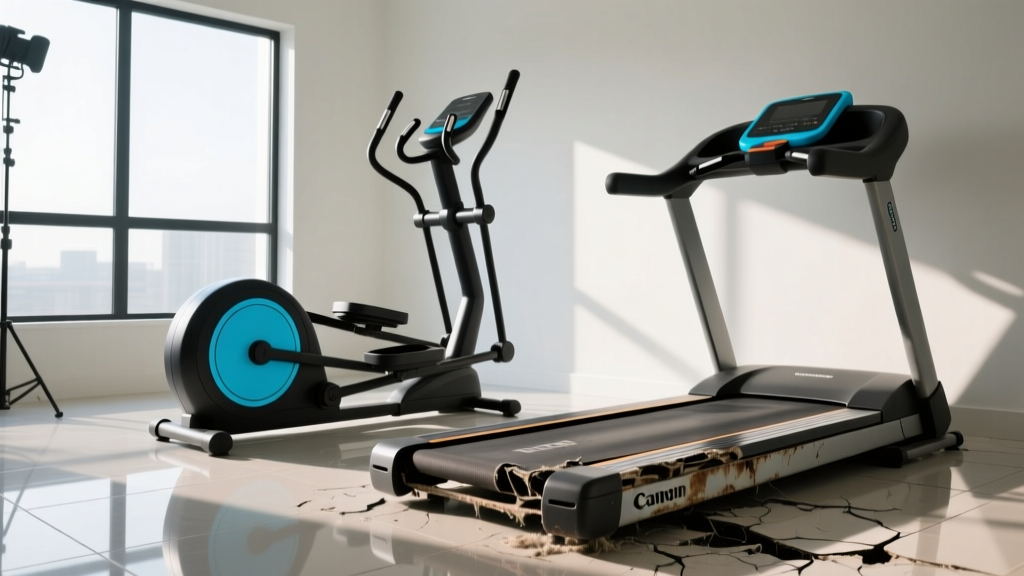
Worn Treadmill Deck Repair vs Compact Portable Cardio Options
Is a worn treadmill deck worth fixing? We break down repair costs versus pivoting to budget-friendly compact portable cardio equipment.

The Hidden Economics of a Worn Treadmill Deck
There is a distinct, unpleasant symptom that plagues aging home treadmills: a subtle slipping sensation underfoot, followed by the faint smell of hot rubber and ozone. If you are experiencing this, you likely have a worn treadmill deck. For years, the fitness equipment industry has pushed massive, 200-pound folding treadmills as the ultimate home cardio solution. However, when the deck fails, owners are suddenly faced with a harsh financial reality. In 2026, with the rise of highly efficient compact portable cardio equipment, throwing hundreds of dollars at an aging, space-hogging machine is no longer the default smart move.
To make an informed budget decision, we must first understand the mechanical failure at play. Most mid-tier treadmill decks (found on popular models from ProForm, Horizon, and NordicTrack) are constructed from 1-inch thick medium-density fiberboard (MDF) coated with a low-friction phenolic resin or wax. Over three to five years of regular use, this coating wears away. Once the bare MDF is exposed, it acts like sandpaper against the underside of the running belt.
⚠️ Warning: The Motor Burnout CascadeWhen a deck wears down to bare wood, the friction coefficient spikes dramatically. A healthy drive motor typically pulls 6 to 8 amps under a 180-pound user. A worn deck forces the motor to pull 14 to 18+ amps to maintain speed. This excessive amp draw will eventually trip the thermal breaker, melt the wiring harness, or permanently fry the Lower Motor Control Board (MCB), turning a $200 deck repair into a $600+ total machine replacement.
Budget Breakdown: Repairing vs. Pivoting
Let us look at the hard numbers. If you own a mid-range treadmill (original retail price between $600 and $1,200), here is the actual out-of-pocket cost to remedy a worn treadmill deck in 2026:
- OEM Replacement Deck: $140 to $220
- Matching Running Belt: $45 to $65 (Never replace a deck without replacing the belt; the old belt will have conformed to the damaged deck)
- 100% Silicone Lubricant: $15
- Professional Labor/Service Call: $150 to $250 (Or 2-3 hours of your own frustrating labor)
Total Repair Cost: $350 to $550.
Spending $500 to fix a machine that takes up 25 square feet of floor space and folds down to a still-bulky 10 inches is increasingly hard to justify. This is where the pivot to compact portable cardio equipment options provides immense financial and spatial value.
| Option | Upfront Cost | Footprint | Maintenance Cost | 5-Year Value |
|---|---|---|---|---|
| Repair Worn Deck | $350 - $550 | ~22 sq ft | High (Lube/Belts) | Poor |
| Smart Walking Pad | $250 - $350 | ~8 sq ft (Stores flat) | Low | Excellent |
| Under-Desk Elliptical | $200 - $300 | ~3 sq ft | Zero | Excellent |
| Compact Hydraulic Stepper | $70 - $120 | ~2 sq ft | Low | Good |
Top Compact Portable Cardio Alternatives for 2026
If you decide to abandon the traditional treadmill, where should you reallocate that $400 repair budget? Here are the top-tier portable options that deliver exceptional cardiovascular value without dominating your living space.
1. UREVO Strol 2E Smart Walking Pad ($299)
Walking pads have evolved significantly from the flimsy under-desk models of the early 2020s. The UREVO Strol 2E features a robust 2.5 HP motor and a 300-pound weight capacity, bridging the gap between a toy and a true fitness machine. It folds entirely flat to just 4.5 inches thick, allowing you to slide it under a sofa or bed. Value Proposition: For less than the cost of a treadmill service call, you get a dedicated LISS (Low-Intensity Steady State) cardio machine that requires zero assembly and takes up 70% less space than a folded traditional treadmill.
2. Cubii JR2 Under-Desk Elliptical ($249)
If your worn treadmill deck was the result of heavy, high-impact running that ultimately caused joint pain, pivoting to an elliptical motion is a biomechanical upgrade. The Cubii JR2 utilizes a whisper-quiet magnetic resistance system with 8 levels of tension. Weighing in at just 12.5 pounds, it can be moved from the home office to the living room with one hand. Value Proposition: It completely eliminates the impact-related wear and tear associated with treadmill belts and decks, offering a zero-maintenance lifespan that easily exceeds five years.
3. Sunny Health & Fitness SF-E3912 Compact Stepper ($79)
For those on a strict budget who want a high-calorie-burn alternative, the Sunny SF-E3912 is a revelation. Unlike treadmills that require you to maintain a steady pace, hydraulic steppers allow for variable, high-intensity interval training (HIIT) in a tiny footprint. The SF-E3912 includes detachable resistance bands for upper-body engagement. Value Proposition: At under $80, you could buy five of these for the price of a single treadmill deck replacement. It is the ultimate low-risk, high-reward cardio investment.
The Science of Low-Impact Portable Cardio
A common misconception is that you need a heavy-duty, 12-mph incline treadmill to achieve meaningful cardiovascular health. However, authoritative health organizations emphasize consistency and moderate intensity over extreme machine specifications. According to the American Heart Association, adults need at least 150 minutes of moderate-intensity aerobic activity per week to significantly reduce the risk of heart disease and stroke.
'Moderate-intensity aerobic activity means you're working hard enough to raise your heart rate and break a sweat, but you can still talk while doing it. A brisk walk on a portable walking pad or steady pedaling on an under-desk elliptical perfectly fulfills this requirement.'
— Adapted from CDC Physical Activity Guidelines
Furthermore, the Mayo Clinic highlights that low-impact aerobic exercises, such as elliptical training or steady stepping, are highly effective for cardiovascular conditioning while preserving joint cartilage—a benefit you lose when pounding on a stiff, worn treadmill deck.
The Space-to-Value Decision Framework
To make your final decision, apply the Space-to-Value Ratio (SVR). Calculate the permanent footprint of your equipment in square feet, then divide the total cost (purchase + 5-year maintenance) by that number.
- Traditional Treadmill (Repaired): $900 (original cost + repair) / 22 sq ft = $40.90 per sq ft.
- UREVO Walking Pad: $299 / 4 sq ft (when stored) = $74.75 per sq ft. (Wait, lower is better for cost, but higher is better for space efficiency. Let's frame it as Cost per Usable Square Foot of Living Space Preserved).
Let's reframe: By switching to a portable option, you reclaim an average of 15 square feet of permanent floor space. In a modern home where real estate costs average $150 to $300 per square foot, reclaiming 15 square feet is akin to gaining $2,250 to $4,500 in usable home value. The financial argument for abandoning a failing traditional treadmill in favor of compact portable cardio equipment is overwhelming.
Final Verdict: When to Walk Away
If you own a premium, commercial-grade treadmill (such as a Landice, Woodway, or high-end Life Fitness) with a retail value exceeding $4,000, repairing a worn treadmill deck is a mathematically sound investment. These machines feature reversible, 1-inch thick phenolic decks and heavy-duty steel frames designed for decades of use.
However, if your machine is a sub-$1,200 consumer model from a big-box store, a worn deck is the machine's way of telling you it has reached the end of its economic lifecycle. Do not sink $400 into a depreciating asset that dominates your room. Sell the broken machine for parts, reclaim your floor space, and invest that repair budget into a high-quality walking pad or under-desk elliptical. Your joints, your wallet, and your living room will thank you.
More gear to consider
All reviews
LEGO on a Treadmill: 2026 Walking Pad Comparison Guide
Elliptical vs Treadmill: Budgeting a Treadmill Fitness Program

Belt Lubrication Guide for the Quietest Home Treadmill Models

NordicTrack C1550 Treadmill vs 2026 Compact Portable Cardio Options
Sole F85 Treadmill Assembly vs Walking Pad Setup 2026
