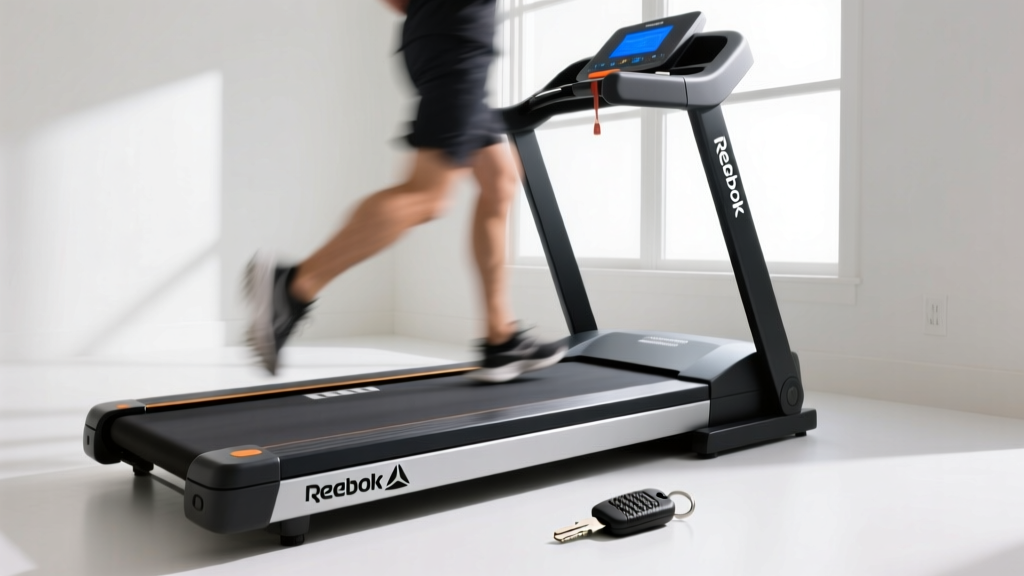
Lost Your Reebok Treadmill Safety Key? Compact Cardio Care
Learn how to replace a lost Reebok treadmill safety key and master maintenance routines for compact portable cardio equipment to maximize lifespan.

The Shift to Compact Portable Cardio Equipment Options
As urban living spaces shrink and home gym layouts evolve in 2026, compact portable cardio equipment options have dominated the market. From ultra-slim walking pads that slide under sofas to folding treadmills and portable under-desk ellipticals, these machines offer incredible convenience. However, their compact engineering introduces unique maintenance challenges. Tighter motor housings, folding hinges, and specialized safety mechanisms require a meticulous care routine to ensure longevity and prevent catastrophic failure.
Critical Safety Mechanisms: The Reebok Treadmill Safety Key
One of the most frequent support tickets we see at FitGearPulse involves lost or demagnetized safety tethers, specifically concerning the Reebok treadmill safety key on their compact folding ZR and ZT series models. This small, red plastic piece houses a magnet that engages a reed switch inside the console. Without it, the machine is completely immobilized.
Why Universal Replacements Often Fail
When users lose their OEM Reebok treadmill safety key, a common DIY hack is taping a standard refrigerator magnet to the console. This almost always fails. The reed switches in modern compact Reebok models require a specific magnetic flux density to close the circuit. A standard ferrite fridge magnet lacks the necessary gauss rating.
⚠️ Safety Warning: Never attempt to bypass the reed switch by splicing the wires. According to the Consumer Product Safety Commission (CPSC), bypassing safety shut-off mechanisms is a leading cause of severe friction-burn injuries in home environments, particularly with children or pets nearby.Sourcing the Correct Replacement
To properly replace your Reebok treadmill safety key, you need a key equipped with an N42 or N52 grade neodymium magnet (typically 15mm in diameter and 5mm thick). While OEM replacements directly from Reebok fitness parts distributors cost between $18 and $24, high-quality third-party universal magnetic keys with the correct neodymium core can be sourced for $12 to $15. Always verify the magnetic pull force before purchasing a generic replacement.
Maintenance Matrix: Compact Treadmills and Walking Pads
Compact portable cardio equipment options like the Kingsmith WalkingPad R2 or the Sunny Health & Fitness SF-T7863 folding treadmill operate with much lower deck clearance than commercial gym models. This means dust, pet hair, and debris are sucked directly into the motor compartment at a higher rate.
1. Belt Lubrication and Tensioning
Because compact treadmills use smaller rollers (often 1.5 to 1.75 inches in diameter compared to the 2.5-inch rollers on commercial decks), the belt experiences higher friction and heat buildup.
- Lubricant: Use only 100% pure silicone treadmill lubricant. Never use WD-40 or petroleum-based oils, which will melt the PVC belt backing.
- Application Rate: Apply exactly 1 oz (30 ml) of silicone under the belt every 150 miles or every 3 months, whichever comes first.
- Tension Check: You should be able to lift the center of the belt exactly 2 to 3 inches off the deck. If it lifts higher, tighten the rear roller adjustment bolts by exactly one-quarter (1/4) turn clockwise on each side using a 6mm Allen wrench.
2. Folding Hinge and Gas Shock Care
The folding mechanism is the most vulnerable point on portable treadmills. The pivot bushings and hydraulic gas shocks endure immense shear stress when the deck is lowered.
- Wipe down the pivot bolts monthly with a dry microfiber cloth to remove abrasive dust.
- Apply a thin layer of white lithium grease to the metal-on-metal pivot joints every six months.
- Inspect the hydraulic gas shock for micro-leaks. If the deck no longer holds its own weight when folded upright, the shock has lost its nitrogen charge and must be replaced (typically a $35-$50 part).
Upkeep for Portable Ellipticals and Mini-Steppers
Compact portable cardio equipment options extend beyond treadmills. Portable ellipticals and mini-steppers rely on exposed pivot arms and small flywheels that are highly susceptible to environmental degradation.
Expert Insight: The number one killer of compact under-desk ellipticals is carpet fiber ingestion. The low-profile flywheel housing acts as a vacuum, pulling in micro-fibers that eventually wrap around the main axle bearing, causing irreversible seizing.
To prevent this, use a static-dissipative equipment mat beneath your portable elliptical. Additionally, use a can of compressed air to blow out the flywheel housing and pedal crank joints every 30 days. For mini-steppers, the hydraulic resistance cylinders will eventually lose their seal integrity. If you notice the stepping resistance becoming uneven or the cylinders leaking a light oil film, it is time to replace the hydraulic shocks (usually a $25 repair kit).
Troubleshooting Compact Cardio Equipment
Below is a diagnostic matrix for the most common failure modes encountered with compact and portable cardio machines in 2026.
| Symptom | Probable Cause | Actionable Fix |
|---|---|---|
| Console powers on, but belt won't move | Demagnetized or missing Reebok treadmill safety key; tripped motor thermal breaker. | Replace with N42 neodymium key; wait 15 mins for thermal reset. |
| Belt jerks or hesitates at foot-strike | Insufficient belt lubrication causing amp-spike; worn motor drive belt. | Apply 1 oz 100% silicone; inspect internal ribbed drive belt for fraying. |
| High-pitched squeal during incline changes | Dry incline lift motor gear rack; lack of white lithium grease. | Unplug unit, access lift motor, apply white lithium grease to the steel gear teeth. |
| WalkingPad remote fails to sync | CR2032 battery depletion; IR sensor blocked by dust. | Replace battery; wipe front-deck IR receiver with isopropyl alcohol. |
Environmental Factors and Storage Longevity
Because compact portable cardio equipment options are frequently moved or stored in closets, they are subjected to rapid temperature and humidity fluctuations. The deck of a budget walking pad is often constructed from medium-density fiberboard (MDF) coated with a phenolic resin. If stored in a damp garage or basement, the MDF will absorb ambient moisture, causing the deck to warp and the belt to track permanently to one side.
Always store your portable cardio equipment in a climate-controlled environment (ideally 40-60% relative humidity). If you must store a folding treadmill in a non-climate-controlled space, wrap the base in a breathable cotton equipment cover. Never use a plastic tarp, which traps condensation and promotes rust on the motor housing and internal wiring terminals.
Frequently Asked Questions
Can I use a generic safety key on my Reebok folding treadmill?
Yes, but only if the generic key contains a neodymium magnet of the correct strength (N42 or higher). Standard ceramic magnets will not trigger the internal reed switch, and the console will display an E07 or SAFE error code.
How often should I lubricate a low-profile walking pad?
Walking pads require more frequent lubrication than standard treadmills due to their smaller roller diameter and higher friction profile. Apply 0.5 oz of 100% silicone lubricant every 100 miles or every 60 days of regular use. For comprehensive safety and maintenance standards, always refer to the ASTM International F1749 Standard for home fitness equipment terminology and safety guidelines.
Is it safe to fold the treadmill immediately after a workout?
No. Wait at least 20 minutes after your workout before folding the deck. The motor and controller board retain significant heat post-workout. Folding the deck immediately traps this heat inside the motor shroud, which can prematurely degrade the internal wiring insulation and shorten the lifespan of the lower control board.
More gear to consider
All reviews
Treadmill Broke? Beginner Guide to Motor Horsepower

Rowing Machine Setup, Technique & Treadmill Belt Tightening Guide

Best Treadmill for Glute Growth: Folding Small Space Reviews & Care

Beyond the x22i Treadmill: 2026 Home Stair Climber Guide
Walking Backwards on Treadmill Knees Hurt? Best Stationary Bike Types
