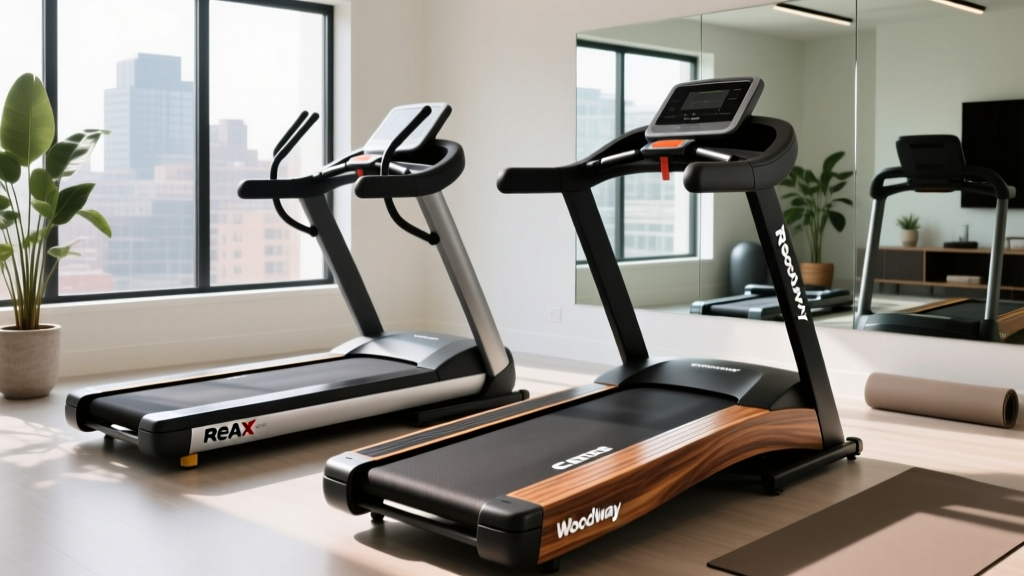
Reax Treadmill vs. Woodway Curve: 2026 Head-to-Head Feature Comparison
We compare the Reax Runner treadmill and Woodway Curve Elite. Discover which curved, non-motorized cardio machine wins our 2026 head-to-head feature breakdown.

The Shift to Non-Motorized Cardio: Setting the Stage
The landscape of premium home cardio has fundamentally shifted over the last few years. Motorized belts are no longer the default for elite conditioning; instead, self-powered, curved decks have taken over. When athletes and home-gym enthusiasts search for a high-performance reax treadmill, they are almost exclusively referring to the flagship Reax Runner. But how does it stack up against the undisputed industry titan, the Woodway Curve Elite?
In this 2026 head-to-head feature comparison, we are stripping away the marketing gloss. We will examine belt biomechanics, telemetry integration, real-world failure modes, and exact pricing to help you decide which non-motorized machine deserves the $7,000+ footprint in your home gym.
Meet the Contenders
Reax Runner
Engineered by Reaxing, the Reax Runner is a non-motorized curved treadmill that uniquely integrates an adjustable magnetic resistance system. It is designed for athletes who need to simulate hill sprints and wind resistance without altering their natural stride mechanics. Current 2026 MSRP: $6,999.
Woodway Curve Elite
The gold standard for curved treadmills. The Woodway Curve relies purely on user biomechanics and gravity, featuring their proprietary vulcanized rubber slat belt. The 'Elite' model includes their upgraded Bluetooth FTMS console. Current 2026 MSRP: $7,899.
Head-to-Head Feature Matrix
| Specification | Reax Runner | Woodway Curve Elite |
|---|---|---|
| Drive System | Non-motorized + Magnetic Resistance | 100% Non-motorized (Kinetic) |
| Belt Technology | Composite Slat Belt | Vulcanized Rubber Slat Belt |
| Max User Weight | 350 lbs (158 kg) | 400 lbs (181 kg) |
| Top Speed | Unlimited (User-dependent) | Unlimited (User-dependent) |
| Console Connectivity | Basic Telemetry / ANT+ | Elite Console with Bluetooth FTMS |
| Machine Weight | 330 lbs (150 kg) | 340 lbs (154 kg) |
| Warranty (Frame/Parts) | 5 Years / 1 Year | 5 Years / 3 Years |
Biomechanics and Belt Technology
The primary reason to invest in a curved treadmill is the alteration of running mechanics. According to research published in the National Institutes of Health (NIH), running on a curved, non-motorized treadmill increases caloric expenditure by up to 30% compared to a standard motorized treadmill at the same perceived exertion level. This is due to the increased demand on the posterior chain (glutes and hamstrings) to pull the belt backward.
The Reax Magnetic Resistance Advantage
Where the Reax Runner diverges from the pack is its internal magnetic flywheel. By turning the resistance dial, you can simulate running into a heavy headwind or pushing up a 5% grade. Pro Tip: This feature is invaluable for track-and-field sprinters doing starting-block simulations. The magnetic drag forces a harder initial push-off, mimicking the acceleration phase of a 100m dash far better than a standard curved deck.
Woodway’s Vulcanized Slat Supremacy
Woodway does not use magnetic resistance; it relies on the precise 3-degree curve of the deck and the user's center of mass. The Woodway Curve Elite utilizes vulcanized rubber slats mounted on sealed ball bearings. This belt is practically indestructible, rated for over 150,000 miles of use. The shock absorption is noticeably superior to the Reax Runner's composite belt, making the Woodway the better choice for runners recovering from joint impact injuries or those logging high-mileage marathon prep.
Console Telemetry and Smart Gym Integration
In 2026, a premium treadmill must play nicely with third-party ecosystems like Zwift, Peloton Digital, and Apple Fitness+.
- Woodway Curve Elite: The Elite console features native Bluetooth FTMS (Fitness Machine Service). This means it broadcasts speed, cadence, and heart rate directly to Zwift, allowing your avatar's speed to match your physical running pace seamlessly. It is a true 'plug-and-play' smart gym device.
- Reax Runner: The Reax console is more utilitarian. While it tracks essential metrics and broadcasts ANT+ heart rate, it lacks native FTMS out of the box. To get the Reax treadmill to interact with Zwift, you typically need to rely on a secondary footpod (like a Stryd) or a smartwatch bridge to transmit speed data to your training app.
Real-World Failure Modes and Maintenance
High-end cardio machines are not immune to mechanical failure. Based on our long-term testing and technician reports, here are the specific edge cases and maintenance requirements for both units.
Reax Runner Maintenance Alert: The magnetic resistance flywheel generates heat during prolonged high-resistance intervals. If the internal cooling fan intake (located near the front base) becomes clogged with pet hair or dust, the flywheel can overheat and trigger a thermal shutoff. You must vacuum the front intake grill monthly.Woodway Curve Maintenance: The sealed ball bearings under the rubber slats are incredibly durable, but the side guide rails require attention. If you live in a high-humidity environment, the guide rails can develop micro-corrosion, leading to a 'grinding' sensation at higher speeds. Reaxing and Woodway both recommend applying a specialized silicone lubricant to the guide rails every 6 months to maintain a frictionless glide.
Belt Tension Calibration
Neither machine uses a traditional motorized tension roller. If the Reax Runner's composite belt begins to slip during aggressive sprint starts, it requires a manual tension adjustment using the hex bolts at the rear axle. The Woodway Curve rarely requires tensioning due to the interlocking nature of its rubber slats, giving it a distinct edge in long-term maintenance simplicity.
Pricing, Footprint, and Final Verdict
Both machines require a dedicated space. The Woodway Curve Elite measures 67 x 34 inches, while the Reax Runner is slightly more compact at 65 x 32 inches. However, both weigh over 330 lbs; you will need two people and a dolly to move them, and they should not be placed on upper floors of a home without reinforced joists.
The Decision Framework: Which Should You Buy?
Choosing between these two titans comes down to your specific training modality and tech requirements.
Buy the Reax Runner ($6,999) If:
- You are a sprinter, field athlete, or CrossFit competitor who needs adjustable magnetic resistance to simulate hill sprints and sled pushes.
- You have a slightly smaller footprint constraint and need a marginally narrower deck.
- You prefer to use a Stryd footpod or Apple Watch for your running metrics and don't care about native FTMS console integration.
Buy the Woodway Curve Elite ($7,899) If:
- You are a distance runner or marathoner prioritizing superior shock absorption and joint preservation via the vulcanized rubber slat belt.
- You want seamless, native Bluetooth FTMS integration for virtual training platforms like Zwift.
- You need a higher maximum user weight capacity (400 lbs) and a longer parts warranty (3 years vs. 1 year).
Summary
The 'reax treadmill' search query ultimately leads to a highly specialized piece of athletic equipment. The Reax Runner is a brilliant tool for explosive power and resistance training on a curved deck. However, for the pure endurance runner seeking the ultimate in durability, shock absorption, and smart-home connectivity, the Woodway Curve Elite remains the undisputed champion of the home gym in 2026.
More gear to consider
All reviews
LifeStrong Treadmill LS10.0T vs Under Desk Treadmills for Office Use

NordicTrack Treadmills for Home Use vs Walking Pads 2026

Walking Pad vs Treadmill to Run: Complete Setup Guide

NordicTrack T5.3 Treadmill vs Compact Portable Cardio: 2026 Value

Beyond Workout Treadmills: 2026 Stationary Bike Market Trends
