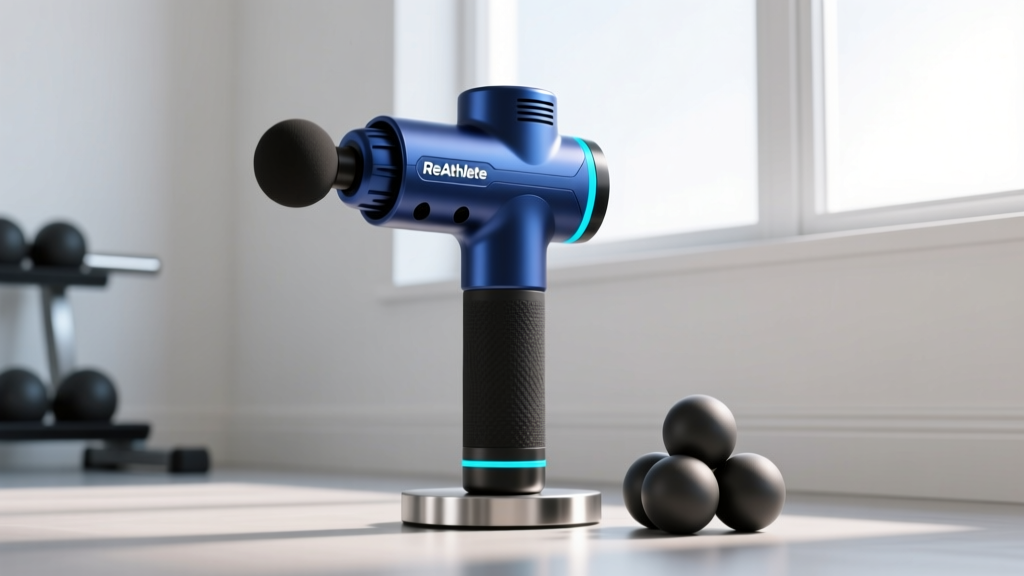
ReAthlete Massage Gun vs Trigger Point Balls: 2026 Value Guide
Is a ReAthlete massage gun worth the premium over trigger point balls? We break down the 2026 costs, biomechanics, and ROI of both recovery tools.

The Recovery Budget Dilemma: High-Tech Percussion vs. Low-Tech Compression
When building a home recovery arsenal in 2026, athletes and weekend warriors face a common budgetary crossroads: Should you invest $150+ in a percussion device like the ReAthlete massage gun, or allocate $30 to a collection of manual trigger point therapy tools and balls? Both modalities promise to alleviate delayed onset muscle soreness (DOMS), improve range of motion, and dismantle myofascial adhesions. However, their biomechanical mechanisms, long-term financial footprints, and time-cost efficiencies are vastly different.
To determine the true return on investment (ROI), we must look beyond the upfront price tag. This comprehensive value analysis dissects the exact pricing, material longevity, and clinical efficacy of ReAthlete percussion devices versus manual trigger point instruments, helping you allocate your recovery budget with precision.
The Biomechanics of Release: Percussion vs. Ischemic Compression
Understanding where your money goes requires understanding what these tools actually do to your tissue. They do not achieve the same physiological outcome.
ReAthlete Percussion Therapy (Neurological Down-Regulation)
Percussive therapy relies on high-frequency, repetitive strikes to stimulate mechanoreceptors—specifically the Pacinian corpuscles and Golgi tendon organs. According to the Gate Control Theory of pain, this rapid sensory input overrides nociceptive (pain) signals traveling to the brain. Furthermore, the rapid oscillation increases localized blood flow and temporarily alters the viscosity of the hyaluronic acid in your fascial layers. It is highly effective for acute neurological down-regulation and broad muscle flushing.
Trigger Point Balls (Mechanical Ischemic Compression)
Manual tools like lacrosse balls and the Rad Roller utilize sustained ischemic compression. By applying targeted, static pressure (usually at a 7/10 pain threshold) to a sarcomere contracture (a 'muscle knot') for 60 to 90 seconds, you temporarily restrict local blood flow. Upon release, a reactive hyperemia (flush of oxygenated blood) occurs. More importantly, the sustained mechanical load forces the actin and myosin cross-bridges in the muscle fiber to detach, physically breaking the contractile knot. As noted by the Cleveland Clinic, sustained pressure is often required to deactivate hyperirritable myofascial trigger points that vibration alone cannot mechanically disrupt.
ReAthlete Massage Gun: 2026 Pricing and Value Proposition
ReAthlete has positioned itself as a premium-but-accessible alternative to the $600 Theragun PRO. Let us break down the financial and functional reality of their flagship models in the current market.
- ReAthlete Deep Massager: Retailing around $149.99, this corded/cordless hybrid offers a 12mm amplitude and a 40 lb stall force. The 12mm amplitude places it in the 'mid-range' category—excellent for superficial to mid-depth fascia (calves, forearms, pecs) but lacking the 16mm depth required to penetrate thick gluteal or hamstring tissue without bouncing off surface tension.
- ReAthlete AirCord: Priced at $199.00, this model features a specialized pneumatic cord design that reduces hand fatigue and allows for unique angle-of-attack adjustments, making it easier to reach the thoracic spine and lats without shoulder impingement.
The Hidden Costs: Lithium-ion batteries in percussion devices degrade. Expect a 20% to 30% loss in battery capacity by year three. While ReAthlete offers replacement batteries (approx. $35-$45), the internal motor brushes will eventually fail, meaning the device has a functional lifespan of roughly 4 to 6 years with daily use.
Trigger Point Tools: The Low-Cost Contenders
Manual tools are characterized by their low upfront cost, zero reliance on electricity, and near-infinite lifespans, though they demand physical effort from the user.
- Standard Lacrosse Balls (e.g., Kinetik, Champion): Costing between $8.00 and $12.00, these solid rubber spheres feature a durometer (hardness) of 70-80 Shore A. They are virtually indestructible and provide the aggressive, pinpoint pressure needed for the piriformis and plantar fascia.
- Rad Roller / Peanut Tools: Priced around $34.99, these dual-ball setups are engineered specifically for the paraspinal muscles and suboccipital ridge. The center gap protects the spinous processes of the vertebrae while the dual spheres dig into the erector spinae.
- Thera Cane / Armaid Hooks: Ranging from $29.95 to $39.99, these fiberglass or hard plastic levers provide mechanical advantage, allowing you to apply up to 20 lbs of pressure to the trapezius and rhomboids without exhausting your grip strength.
According to research published in the National Center for Biotechnology Information (NCBI), self-myofascial release using hard spherical tools significantly improves localized joint range of motion without the systemic fatigue associated with deep tissue massage.
5-Year Cost and ROI Matrix
Value is not just about the purchase price; it is about the cost per effective use over time. Below is a 5-year projection assuming daily recovery sessions.
| Tool Category | Upfront Cost | Maintenance / Replacement | Time Cost (Per Session) | 5-Year True Cost |
|---|---|---|---|---|
| ReAthlete Deep Massager | $149.99 | $40 (Battery swap in Yr 3) | 2-4 mins (Low effort) | $189.99 |
| Lacrosse Ball (x2) | $16.00 | $0 | 10-15 mins (High effort) | $16.00 |
| Rad Roller (Peanut) | $34.99 | $0 | 5-8 mins (Moderate) | $34.99 |
| Thera Cane Hook | $29.95 | $0 | 5 mins (Moderate) | $29.95 |
| Total Manual Stack | $80.94 | $0 | 15-20 mins total | $80.94 |
Note: The 'Time Cost' reflects the physical exertion and duration required to achieve a meaningful release across the posterior chain. The Mayo Clinic notes that consistency is the primary driver of recovery success; if a tool takes too much effort, compliance drops.
Scenario-Based Value Breakdown: Which Tool Wins?
To maximize your budget, you must match the tool to the specific anatomical failure mode.
Scenario 1: Broad Muscle Groups (Quads, Lats, Calves)
Winner: ReAthlete Massage Gun. Attempting to roll out an entire vastus lateralis (outer quad) with a lacrosse ball is a grueling, 15-minute ordeal that often results in bruising and user fatigue. The ReAthlete Deep Massager can flush the entire quad complex in 90 seconds with zero grip fatigue. The time-ROI heavily favors the percussion device here.
Scenario 2: Deep Cervical & Suboccipital Release
Winner: Trigger Point Peanut / Rad Roller. Using a percussion gun near the cervical spine is dangerous due to the proximity of the carotid artery, vagus nerve, and delicate cervical vertebrae. A $35 Rad Roller allows you to lie supine, using gravity to apply sustained, safe ischemic pressure to the base of the skull, effectively curing tension headaches that a massage gun cannot safely touch.
Scenario 3: Stubborn Piriformis & Glute Medius Knots
Winner: Lacrosse Ball. Because the ReAthlete Deep Massager maxes out at a 12mm amplitude, the percussive wave often dissipates before reaching the deep rotators of the hip. A $10 lacrosse ball, leveraged against a wall or the floor, utilizes your entire body weight to drive mechanical pressure deep into the piriformis, breaking adhesions the gun simply cannot reach.
The 'Hybrid Protocol' for Maximum ROI
Do not view these tools as mutually exclusive. The most cost-effective and clinically sound strategy in 2026 is the Hybrid Protocol:
- Phase 1 (Flush): Use the ReAthlete massage gun for 60 seconds per broad muscle group to increase local tissue temperature, stimulate blood flow, and neurologically prime the tissue.
- Phase 2 (Target): Follow up with a lacrosse ball or Thera Cane for 60-90 seconds only on the specific, localized trigger points that remain palpable after the flush.
This reduces the manual time-cost of trigger point therapy by 50% while achieving a deeper mechanical release than percussion alone.
Verdict: Where Should You Allocate Your Recovery Budget?
If your budget is strictly under $50, abandon the idea of a cheap, sub-$50 'knock-off' massage gun. The stall force is abysmal, the amplitude is superficial (usually under 8mm), and the motor will burn out in months. Instead, build a premium manual stack: buy a high-quality Rad Roller ($35), two Champion lacrosse balls ($16), and a Thera Cane ($30). This $81 stack will outlive you and provide genuine mechanical release.
However, if you have $150 to $200 and value your time, the ReAthlete massage gun offers exceptional value. Its mid-range amplitude is perfect for daily maintenance, and the drastic reduction in physical effort ensures you will actually use it daily. For the ultimate setup, pair the ReAthlete Deep Massager ($149) with a single lacrosse ball ($10) for deep hip and neck work. At $159 total, this hybrid approach covers 100% of your biomechanical recovery needs without the diminishing returns of a $600 luxury percussion device.
Frequently Asked Questions
Can a ReAthlete massage gun replace a foam roller or trigger point ball?
No. Massage guns provide neurological pain gating and broad blood flow, but they cannot mechanically break down deep fascial adhesions or actin-myosin cross-bridges the way sustained pressure from a hard trigger point ball can.
Is the ReAthlete AirCord worth the $50 upgrade over the Deep Massager?
Only if you have limited shoulder mobility or struggle to reach your own thoracic spine and lats. The pneumatic cord acts as a lever, reducing the grip and shoulder strength required to apply adequate stall force to your back.
How often should I replace my lacrosse balls or EVA foam rollers?
Solid rubber lacrosse balls effectively never need replacing unless lost. However, EVA foam rollers and softer trigger point balls compress and lose their structural density after 12 to 18 months of daily use, requiring replacement to maintain effective tissue penetration.
More gear to consider
All reviews
Adjustable Dumbbell Review: Setup for Dumbbell Wrist Extensions

Best Adjustable Dumbbells for the Trapezius Dumbbell Exercise (2026)

Practical, Secure, and Compliant Guns Storage Ideas for Homeowners and Collectors

Bumper vs Iron Plates: Gym Layouts for Good Tricep Dumbbell Workouts

Rubber Hex vs Urethane Fixed Dumbbell Trends 2026
