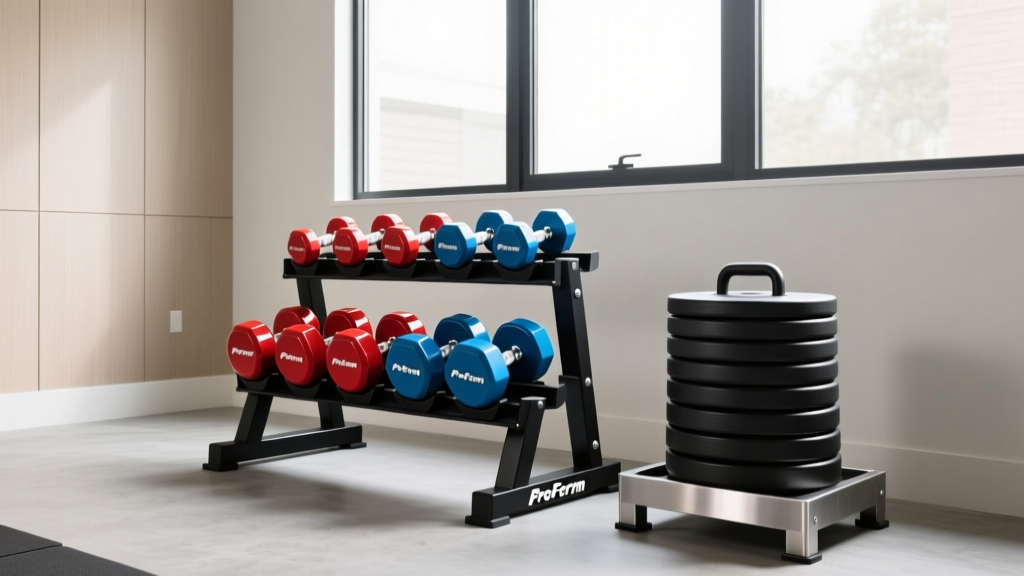
Power Rack vs Squat Stand: SA Dumbbell Bench Press Setups
Compare power racks, half racks, and squat stands. Discover which setup best supports heavy lifting and the SA dumbbell bench press in your home gym.

The Home Gym Dilemma: Footprint vs. Functionality in 2026
Building a home gym requires navigating a constant tug-of-war between available floor space and equipment versatility. When outfitting your space for heavy barbell work and specialized unilateral movements, the foundation of your setup comes down to three primary categories: the full power rack, the half squat rack, and the minimalist squat stand. While most buyers focus exclusively on barbell squats and deadlifts, a truly optimized gym must accommodate complex accessory movements. One of the most demanding litmus tests for any rack setup is the SA dumbbell bench press (single-arm variation). This movement introduces severe anti-rotational torque, requiring specific spatial clearances, bench positioning, and safety mechanisms that not all racks can support.
In this comprehensive head-to-head comparison, we break down the structural differences, 2026 market pricing, and real-world functionality of power racks, squat racks, and squat stands to help you make an informed investment.
Defining the Contenders: Cage, Half-Rack, and Stand
Before analyzing specific exercise compatibility, we must establish the architectural differences between these three categories. According to equipment guidelines from Rogue Fitness, the structural footprint dictates not just safety, but the types of accessories you can integrate.
- Power Rack (Full Cage): Features four to six vertical uprights, creating an enclosed 'cage' that allows for inside-rack lifting. Capacities typically exceed 1,000 lbs.
- Squat Rack (Half Rack): Utilizes two main front uprights with rear stabilizing feet. It offers an open-front design for easier barbell racking but sacrifices the 360-degree safety enclosure of a full cage.
- Squat Stand: Consists of two independent or lightly braced vertical posts. It is highly portable and space-efficient but offers minimal safety spotting capabilities.
The SA Dumbbell Bench Press: Why It Breaks Bad Setups
Why use the SA dumbbell bench press as a benchmark for rack quality? Unilateral pressing is a cornerstone of athletic hypertrophy and core stabilization. As noted by strength experts at Men's Health, the single-arm dumbbell bench press forces the obliques and transverse abdominis to work overtime to prevent the torso from rolling off the bench.
This anti-rotational demand creates three distinct equipment requirements:
- Lateral Clearance: Your elbows and the dumbbell will naturally track wider and more unpredictably than a bilateral barbell press.
- Spotter Arm Width: If you fail a rep, the dumbbell will drop laterally. Narrow safety arms will result in the weight bypassing the catchers entirely.
- Bench Anchoring: The rotational torque can cause a lightweight bench to slide or tip if it is not properly tucked or secured within a stable frame.
1. The Power Rack: The Ultimate Enclosure
The full power rack is the gold standard for safety and versatility. Let's look at a premium 2026 market example: the Rogue RM-6 Monster Power Rack (priced between $1,650 and $2,200 depending on configuration).
SA Dumbbell Bench Press Compatibility
When performing the SA dumbbell bench press inside a 49-inch wide power rack, you have ample room to position a standard 45-inch flat or adjustable bench. The critical advantage here is the deployment of pin-pipe safety catches. By running a pipe through the pin across the entire 43-inch interior width, you create a continuous safety net. If your core gives out and you drop a 120-lb dumbbell laterally, it hits the pipe, not your floor or your face.
'The enclosed nature of a power rack allows lifters to push unilateral movements to absolute failure without a spotter, which is essential for hypertrophy and athletic conditioning.' - Stronger By Science
The Drawback: Footprint. A standard RM-6 requires a minimum of 49x49 inches, and up to 49x65 inches if you add a front foot extension. In a tight garage gym, this dominates the floor plan.
2. The Half Squat Rack: The Open-Front Compromise
Half racks, like the Titan T-3 Series Half Rack ($599 - $750), offer a compelling middle ground. They feature heavy-duty 11-gauge 3x3 uprights but leave the front completely open.
SA Dumbbell Bench Press Compatibility
The open-front design is actually a massive benefit for heavy dumbbell work. Maneuvering a pair of 100-lb dumbbells into position inside a closed cage can result in knuckle-scraping and awkward loading. With a half rack, you simply back your bench up to the uprights. However, the safety arms on half racks are typically only 24 to 36 inches long. When executing the SA dumbbell bench press, if you roll too far to the non-working side, the dumbbell can easily clear the edge of the short safety arms.
- Pros: Easy dumbbell entry, saves 12-18 inches of depth compared to a full cage, highly stable base.
- Cons: Shorter safety arms require precise bench alignment for heavy unilateral pressing.
3. Squat Stands: Minimalist but Limited
Squat stands, such as the PRx Performance Profile Squat Stands ($349) or the Rogue S-Series ($295 - $350), are designed for micro-gyms, apartments, or temporary setups.
SA Dumbbell Bench Press Compatibility
From a safety perspective, squat stands are the least ideal for heavy SA dumbbell bench pressing. Because the uprights are completely independent (or connected only by a thin base stabilizer), there is no continuous cross-member to support wide safety pipes. You are forced to use short, flip-down spotter arms attached directly to the uprights. If you fail a single-arm rep and your torso twists, the dumbbell will almost certainly miss the spotter arms. You must be prepared to drop the weight safely to the floor, which requires specialized rubber drop pads to protect your concrete slab.
Head-to-Head Matrix: 2026 Equipment Specifications
Below is a structured comparison of the three categories based on current market leaders, pricing, and spatial requirements.
| Feature | Power Rack (e.g., Rogue RM-6) | Half Rack (e.g., Titan T-3) | Squat Stand (e.g., PRx Profile) |
|---|---|---|---|
| Avg. Price (2026) | $1,650 - $2,200 | $599 - $850 | $295 - $399 |
| Footprint | 49' x 49' to 49' x 65' | 48' x 48' (Base) | 23' x 23' per stand |
| Steel Gauge | 7 or 11-Gauge | 11-Gauge | 11 to 14-Gauge |
| SA DB Press Safety | Excellent (Full width pipes) | Good (Requires alignment) | Poor (High drop risk) |
| Weight Capacity | 1,000 - 1,500 lbs | 800 - 1,100 lbs | 350 - 500 lbs |
Decision Framework: Which Setup is Right for You?
Choosing the right equipment is not just about buying the most expensive option; it is about matching the tool to your specific training environment and biomechanical needs.
Choose the Power Rack If:
You have a dedicated room or a spacious two-car garage (minimum 10x10 ft clear space). You train alone frequently and push unilateral movements like the SA dumbbell bench press to absolute failure. The ability to set interior pin-pipe safeties at exact ribcage height is a non-negotiable safety feature for heavy dumbbell work. Furthermore, if you plan to integrate lat pulldown attachments, belt squat mechanisms, or multi-grip pull-up rigs, the 4-upright cage is mandatory.
Choose the Half Squat Rack If:
You are dealing with a low ceiling (under 84 inches) or limited depth in your gym space. Half racks are exceptional for Olympic lifting variations (catches and cleans) where a full cage might restrict bar path or elbow clearance. For dumbbell pressing, the open front allows for easy loading and unloading of heavy bells, provided you are disciplined about aligning your bench with the 36-inch spotter arms.
Choose the Squat Stand If:
You are outfitting a small apartment, a shared office space, or a garage where the equipment must be pushed against a wall when not in use. Squat stands are highly effective for basic barbell squats, overhead presses, and deadlifts. However, if the SA dumbbell bench press is a staple in your hypertrophy programming, you must accept the inherent risks. Always use a bench with a wide, rubberized base to prevent sliding, and never lift dumbbells that exceed your ability to safely drop them to the floor.
Final Verdict
The evolution of home gym equipment in 2026 means you no longer have to sacrifice build quality for space. While squat stands offer unparalleled portability and half racks provide an excellent balance of cost and function, the full power rack remains the undisputed king of safety and versatility. When programming complex, high-torque accessory movements like the SA dumbbell bench press, the spatial allowance and continuous safety catching systems of a power rack provide the psychological and physical security required to lift heavy, lift hard, and lift alone.
More gear to consider
All reviews
Beyond the Decline Dumbbell Fly: Barbell Weight & Knurling Guide

Best 50 lb Adjustable Dumbbell Sets: 2026 Beginner Guide
Romanian Deadlift Form Dumbbells: Setup & Adjustable Review
Home Gym Setup: Neoprene Gear & Bicep Exercises Using Dumbbells

Squat Stand vs Power Rack: Space for Dumbbell Side Plank Hip Lifts