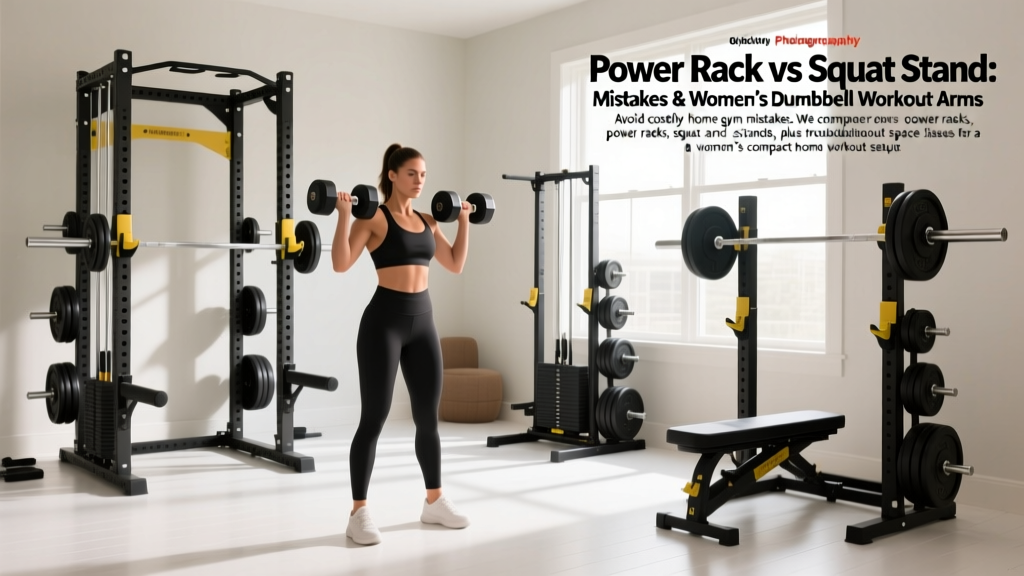
Power Rack vs Squat Stand: Mistakes & Women's Dumbbell Workout Arms
Avoid costly home gym mistakes. We compare power racks, squat racks, and stands, plus troubleshoot space issues for a women's dumbbell workout arms routine.

The Overbuying and Underbuying Trap: A 2026 Home Gym Reality Check
Choosing the right racking system is the most critical—and expensive—decision you will make for your home gym. In 2026, the market is saturated with options ranging from $300 budget squat stands to $2,500 commercial-grade power racks. The most common mistake lifters make is evaluating a rack solely on its barbell squat capacity, completely ignoring spatial requirements for accessory movements, bench integration, and floor stability.
Whether you are outfitting a two-car garage or a cramped spare bedroom, misunderstanding the differences between a power rack, a squat rack, and a squat stand leads to costly errors. Furthermore, many lifters fail to account for the clearance needed for isolation movements. For example, designing a dedicated women's dumbbell workout arms routine—think heavy incline hammer curls, seated overhead tricep extensions, and concentrated bicep curls—requires specific bench angles and dumbbell swing paths that will instantly expose the flaws of a poorly sized rack.
This troubleshooting guide breaks down the structural differences, common setup failures, and spatial edge cases of power racks vs. squat racks vs. squat stands, ensuring your equipment matches your actual training reality.
⚠️ Troubleshooting Alert: The 24-Inch Depth MistakeThe most frequent spatial error in 2026 is purchasing a 24-inch deep squat stand or short rack (like the Titan T-2) and attempting to use a standard adjustable bench inside it. When you recline the bench to 45 degrees for incline work, your head extends past the uprights, and the dumbbells will strike the steel frame during your descent.
Equipment Matrix: Power Rack vs. Squat Rack vs. Squat Stand
To troubleshoot your setup, you must first understand the architectural differences. Below is a comparative matrix of the three primary racking systems based on current industry standards, steel gauges, and footprint requirements.
| Feature | Power Rack (e.g., Rogue R-3) | Squat Rack (e.g., Rep SR-4000) | Squat Stand (e.g., Rogue SML-2C) |
|---|---|---|---|
| Uprights | 4 (Fully Enclosed) | 2 Front + 2 Rear Stabilizers | 2 (Independent) |
| Standard Depth | 30" to 34" | 24" to 33" | 18" to 24" |
| Steel Gauge | 11-Gauge (3x3 Tubing) | 11 or 14-Gauge | 11-Gauge (Heavy Duty) |
| Safety Mechanism | Internal Pin/Pipe Safeties | Spotter Arms (External) | Spotter Arms (Add-on) |
| Avg. Price (2026) | $900 - $1,500+ | $500 - $800 | $350 - $550 |
Troubleshooting Spatial Constraints for Isolation Work
While heavy barbell squats and bench presses dictate the strength requirements of your rack, isolation exercises dictate the geometry. Let us address a highly specific, often-overlooked scenario: executing a comprehensive women's dumbbell workout arms routine inside your rack footprint.
The Clearance Failure Mode
Many female lifters (and male lifters, for that matter) utilize adjustable benches for targeted arm hypertrophy. Movements like seated dumbbell skull crushers, incline bicep curls, and single-arm overhead tricep extensions require significant lateral and vertical clearance.
- The Squat Stand Error: If you place an adjustable bench between two independent squat stands (which are typically spaced 49 inches apart), you lack the structural support to safely rack heavy dumbbells at the top of a movement. Furthermore, if your ceiling height is under 84 inches, overhead tricep extensions will result in the dumbbells striking the ceiling or the top of the uprights.
- The Short Rack Error: In racks with a 24-inch depth (like the popular Titan T-2), performing incline curls means your elbows will physically collide with the front uprights during the eccentric (lowering) phase of the lift. According to biomechanical guidelines from ExRx.net Weight Room Testing Standards, the elbow path on a 45-degree incline extends roughly 14-18 inches behind the torso. A 24-inch rack leaves zero margin for error.
- The Power Rack Solution: A 30-inch or 34-inch deep power rack allows you to push the adjustable bench back, away from the front uprights, providing the necessary swing path for heavy dumbbells without compromising structural integrity.
Expert Insight: "When programming high-volume arm isolation work, the rack is no longer just a safety device; it is a spatial boundary. If your rack depth forces you to alter your natural range of motion to avoid hitting the steel uprights, you are leaving hypertrophy gains on the table and increasing joint shear stress."
Safety Pin & J-Cup Placement Errors
A rack is only as safe as its lowest failure point. Troubleshooting your J-cup and safety pin placement is critical, especially when transitioning between barbell compounds and dumbbell accessories.
1. The UHMW Plastic Liner Oversight
In 2026, standard metal-on-metal J-cups are considered obsolete and dangerous for knurled barbells. Ensure your chosen rack features UHMW (Ultra-High Molecular Weight) plastic-lined J-cups. If you are buying a budget squat stand, verify that the J-cups are compatible with your specific upright tubing (e.g., 2x2 vs. 3x3). A common mistake is purchasing 3x3 J-cups for a 2x2 squat stand, resulting in a loose fit that can dislodge during heavy re-racking.
2. Spotter Arm Limitations on Squat Stands
Unlike power racks, which utilize internal cross-member safety pipes, squat stands rely on external spotter arms. The National Institutes of Health (NIH) notes that external spotter arms fundamentally alter the center of gravity of a freestanding rack. If you fail a squat forward onto the spotter arms of a squat stand, the forward momentum can tip the entire unit over if it is not bolted down or heavily counterweighted.
💡 Troubleshooting Tip: The Sandbag CounterweightIf you own a squat stand or open-front squat rack and cannot bolt it to concrete, purchase two 50lb sandbags (approx. $25 each). Drape them over the rear stabilizer cross-members. This lowers the center of mass and prevents forward-tipping during failed barbell reps or aggressive dumbbell racking.
Real-World Failure Modes: Hole Spacing and Tubing
Not all steel is created equal, and not all hole patterns serve the same purpose. When troubleshooting rack purchases, pay close attention to these specifications:
- 11-Gauge vs. 14-Gauge Steel: 11-gauge steel (approx. 0.120 inches thick) is the gold standard for heavy lifting and dynamic movements like kipping pull-ups. 14-gauge steel is thinner and prone to flexing under 400+ lb loads. If you are buying a budget power rack (e.g., Rep Fitness PR-1100), inspect the welds at the base gussets, as this is where 14-gauge racks typically fail under lateral stress.
- Westside vs. Standard Hole Spacing: Standard racks have 2-inch hole spacing throughout. Westside spacing features 1-inch holes in the bench press and squat zone. This is crucial for micro-adjusting safety pins. If you use a squat stand with 2-inch spacing, you may find that one pin height is too high (restricting depth) and the next hole down is too low (failing to catch a missed rep in time).
- Metric (1080mm) vs. Imperial (49") Width: Olympic weightlifting racks often use 1080mm (42.5") internal width to provide extra lateral clearance for snatch and clean & jerk catches. Standard powerlifting racks use 49" width. Ensure your bench pad width aligns with your rack width to avoid awkward re-racking angles.
Expert Verdict & Buying Framework
To avoid the most common home gym mistakes, use this decision framework based on your spatial reality and training goals:
- Choose a Power Rack (30"+ Depth) if: You have the ceiling height (90"+), plan to do heavy barbell work unsupervised, and require internal bench clearance for extensive isolation routines, including a high-volume women's dumbbell workout arms circuit, without striking the uprights.
- Choose a Squat Rack (Open Front) if: You have low ceilings (under 84"), need to save 10-15 square feet of floor space, and primarily train with a spotter or use safety spotter arms for barbell work. It offers a good middle ground for bench pressing but limits internal accessory storage.
- Choose a Squat Stand if: You are strictly limited on space and budget, primarily perform Olympic lifts or outdoor garage squats, and do not require an enclosed cage for unassisted heavy benching. Mandatory troubleshooting: You must bolt it down or use heavy counterweights to prevent tipping.
For comprehensive equipment specifications and current load-testing data, always refer directly to the Rogue Fitness Equipment Specifications or your manufacturer's official 2026 engineering manuals before finalizing your home gym layout. By respecting the geometry of your rack, you ensure both your safety and the unimpeded execution of every exercise in your program.
More gear to consider
All reviews
Space-Saving Dumbbell Racks for Upper Chest Exercises With Dumbbells

Optimizing Gym Layouts: Watson Dumbbell Rack & Storage Solutions

Power Rack vs Squat Rack vs Stand: PowerBlock Elite EXP Dumbbells
Best Dumbbell Racks to Support Dumbbell Only Back Exercises

The Long Dumbbell Name Guide: EZ Curl vs Straight Bar Layouts
