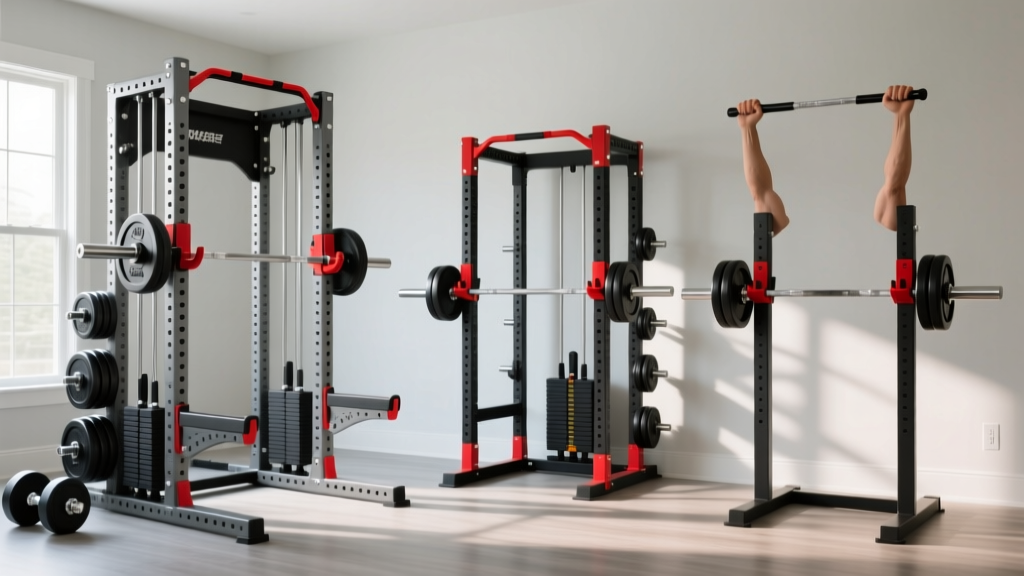
Power Rack vs Squat Rack vs Stand: Best for Dumbbell Overhead Press?
Compare power racks, squat racks, and squat stands for the dumbbell overhead press. Discover safety features, 2026 pricing, and the best setups.

The Biomechanical Challenge of the Dumbbell Overhead Press
When building or upgrading a home gym in 2026, the decision between a power rack, a squat rack (half rack), and a squat stand often comes down to budget and floor space. However, if your programming heavily features the dumbbell overhead press, this decision becomes a critical safety calculation. Unlike the barbell overhead press, which follows a relatively fixed vertical bar path constrained by a pronated grip, the dumbbell overhead press introduces independent limb movement, lateral drift, and a posterior shift at lockout.
According to ExRx.net's biomechanical breakdown of the shoulder press, the glenohumeral joint requires significant freedom of movement during this lift. The dumbbells do not travel in a perfectly straight vertical line; they move laterally outward during the eccentric phase and drift slightly posteriorly (backward) to lock out over the cervical spine. This unpredictable bar path means that when you reach muscular failure, the weights are rarely in a position to be safely racked on standard J-hooks. You must drop them. How and where you drop them depends entirely on the rack system you choose.
Head-to-Head: The Three Rack Contenders
To determine the best setup for heavy dumbbell pressing, we must evaluate the structural design, safety mechanisms, and spatial footprint of the three primary rack categories available on the market today.
1. Power Racks (Full Cages): The Ultimate Safety Net
A power rack, such as the Rogue R-3 Power Rack or the REP Fitness PR-4000, encloses the lifter on four sides. These units are typically constructed from 11-gauge steel and feature 3x3-inch uprights with 5/8-inch or 1-inch hardware holes.
- Seated OHP Safety: Exceptional. By placing an adjustable FID (Flat/Incline/Decline) bench inside the cage and setting pin-pipe or flip-down safeties at nose-level, you create a fail-safe environment. If you fail a 100 lb dumbbell press, you simply let the weights drop two inches onto the UHMW-lined safety pipes.
- Standing OHP Safety: Moderate to High. You can set the safeties at chest height. However, stepping out of the cage to press is often preferred for bar path freedom, which negates the cage's protective benefits unless you press strictly inside the footprint.
- 2026 Pricing: $900 to $1,600+ depending on attachments and brand.
2. Squat Racks (Half Racks): The Space-Saving Compromise
Half racks, like the Titan Fitness X-2 Half Rack, feature two main uprights with extended spotter arms that project forward (usually 20 to 24 inches). They are bolted to the floor or heavily weighted at the base to prevent tipping.
- Seated OHP Safety: Poor to Moderate. If you sit inside the rack facing outward, the spotter arms are in front of you. Because the dumbbell overhead press drifts backward at lockout, failing a rep means the weights will fall behind the spotter arms, potentially striking your torso or the bench.
- Standing OHP Safety: High. Standing inside the rack with spotter arms set at upper-chest height provides a good safety net for standing strict presses, provided you do not drift too far backward.
- 2026 Pricing: $500 to $850.
3. Squat Stands: The Minimalist Open Platform
Squat stands, such as the REP SR-4000 or budget options from Fitness Reality, consist of two independent uprights. They offer maximum spatial flexibility but zero overhead or lateral protection.
- Seated OHP Safety: Extremely Low. There are no spotter arms or crossmembers to catch a failed lift. If you fail a heavy seated dumbbell press, you are forced to dump the weights forward or laterally, which places extreme eccentric load on the anterior deltoid and risks severe wrist hyperextension.
- Standing OHP Safety: Low. Similar to seated pressing, a failed standing rep requires you to actively guide heavy dumbbells to the floor, which is dangerous when your core and shoulder stabilizers are fully fatigued.
- 2026 Pricing: $200 to $450.
Feature Comparison Matrix
| Feature | Power Rack (Full Cage) | Squat Rack (Half Rack) | Squat Stand (Independent) |
|---|---|---|---|
| Avg Footprint | 48' x 48' (Standard) | 48' x 36' (Base) | 24' x 24' (Uprights only) |
| Seated DB OHP Safety | 5/5 (Pin-pipe safeties) | 2/5 (Arms in wrong position) | 1/5 (No catch mechanism) |
| Standing DB OHP Safety | 4/5 (If pressing inside) | 4/5 (Extended spotter arms) | 1/5 (Must dump to floor) |
| Bench Integration | Full internal clearance | External or partial internal | External only |
| Avg Cost (2026) | $900 - $1,600 | $500 - $850 | $200 - $450 |
Real-World Failure Modes & Edge Cases
Understanding what happens at the exact moment of muscular failure is where E-E-A-T separates generic buying guides from expert analysis. Let us examine the specific failure modes of the dumbbell overhead press across these racks.
WARNING: The Posterior Drift TrapWhen pressing heavy dumbbells (80 lbs+) to lockout, the natural biomechanical groove forces the weights slightly behind the coronal plane of the torso. If you fail a rep in this posterior position on a squat stand or half rack, you cannot safely lower the weights to your knees. You are forced to dump them forward, which requires rapid, fatigued internal rotation of the shoulder. According to the American Council on Exercise (ACE), maintaining proper spinal alignment is critical during overhead movements; dumping weights forward often compromises the lumbar spine as you violently arch to avoid dropping the load on your head.
Edge Case: The Wide FID Bench Problem
Many lifters purchase wide-pad FID benches (14 to 16 inches wide) for chest pressing comfort. However, when performing the dumbbell overhead press inside a power rack, a wide pad restricts scapular retraction and forces the elbows to flare, altering the bar path. Furthermore, a 16-inch bench leaves less lateral clearance inside a standard 43-inch internal cage width, increasing the risk of the dumbbells clipping the uprights during the eccentric descent. For dedicated overhead pressing inside a rack, a 12-inch narrow pad bench is the optimal choice.
2026 Buyer’s Framework: Matching Your Rack to Your Space
Use this step-by-step decision framework to select the right equipment for your specific environment and lifting style.
- The Ceiling Height Audit: Standard power racks stand 90 inches tall. If your basement ceiling is 84 inches or lower, you are forced into a squat stand or a specialized 72-inch short rack. Note that short racks eliminate the ability to perform standing overhead presses, leaving seated dumbbell presses as your only vertical pushing option. If forced into a short rack, buy a power rack configuration (with safeties) rather than an open stand.
- The Budget vs. Safety Calculation: If your budget is under $500, you are looking at squat stands. If you choose this route, you must pair it with heavy-duty crash pads (like the Titan Fitness Crash Pads, approx. $150) placed behind your bench to catch posterior drifts. Never press heavy dumbbells over a hard floor without a fail-safe.
- The Attachment Ecosystem: If you plan to use lat pulldowns, cable crossovers, and belt squats alongside your overhead pressing, a power rack with a 3x3 upright and 1-inch hole spacing (like the Bells of Steel or REP PR-4000 series) offers the most robust attachment ecosystem in 2026.
'The best rack is the one that allows you to train to absolute failure without the psychological brake of fearing for your life. For the dumbbell overhead press, that means enclosing the lift.' — FitGearPulse Editorial Team
Frequently Asked Questions
Can I use a squat stand for heavy dumbbell shoulder presses?
You can, but it is not recommended for sets taken to failure. Without spotter arms or a cage, a failed rep requires you to actively guide 70+ lb dumbbells to the floor, risking wrist, shoulder, and lower back injuries. If you must use a stand, utilize crash pads or limit your sets to 2 reps in reserve (RIR).
Is a half rack better than a power rack for overhead pressing?
Generally, no. While half racks save about 12 inches of depth, their forward-facing spotter arms are designed for barbell squats and bench presses. For the dumbbell overhead press, which drifts backward, a power rack with internal pin-pipe safeties is vastly superior.
What is the best bench for seated dumbbell overhead presses?
Look for an adjustable FID bench with a 12-inch wide back pad and an 85-degree maximum incline. A true 90-degree vertical bench forces the lifter to arch excessively, shifting the load away from the anterior deltoids and onto the upper chest and cervical spine. For deeper biomechanical insights, refer to T-Nation's comprehensive guide to overhead pressing mechanics.
More gear to consider
All reviews
Best Adjustable Dumbbells for Armpit Fat Exercises: 2026 Review
Olympic Barbell Buying Guide: Knurling & Dumbbell Leg Extensions
Fake Dumbbell Trap: Olympic vs Standard Weight Plates Compared

Rubber vs Urethane Care for Shoulder Workouts with Dumbbells for Men

One Dumbbell Shoulder Press: Adjustable Dumbbell Review & Mistakes
