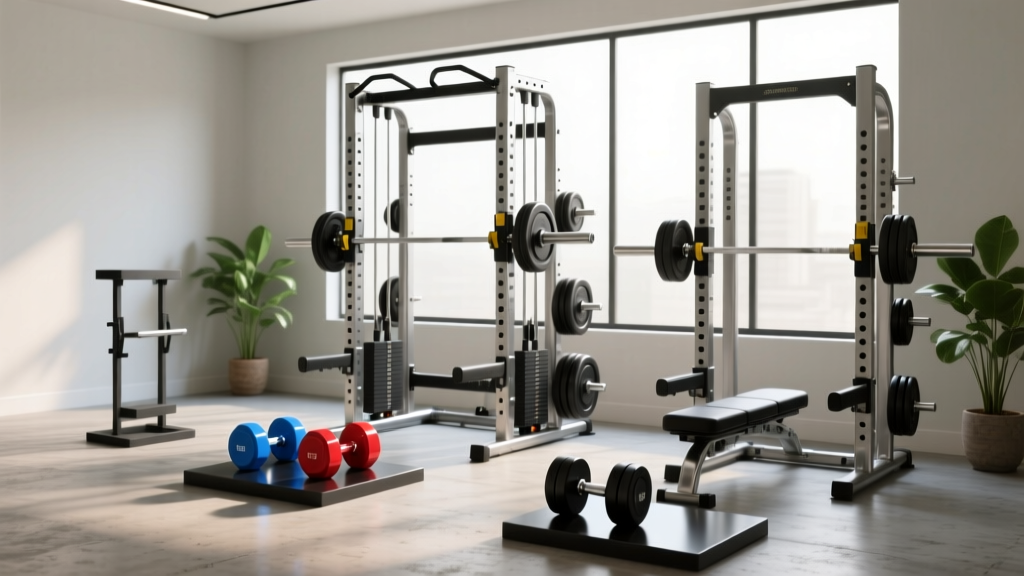
Power Rack vs Squat Rack vs Stand: Best Dumbbell Chest Exercise Setup
Compare power racks, squat racks, and stands to find the safest, most versatile setup for your dumbbell chest exercise routine and heavy barbell lifts.

The Home Gym Dilemma: Beyond the Barbell Squat
When building a home gym, most beginners obsess over barbell squats and deadlifts. However, a well-rounded physique requires a dedicated, safe environment for your dumbbell chest exercise routines, incline presses, and heavy flyes. Choosing between a power rack, a squat rack, and a squat stand isn't just about where you rest your barbell—it fundamentally dictates your safety, range of motion, and versatility during dumbbell movements.
In this 2026 step-by-step guide, we break down exactly how these three rack styles impact your training, with specific measurements, real-world pricing, and safety protocols for solo lifters.
The Contenders: Quick Comparison Matrix
Before diving into the biomechanics, let's look at the baseline specifications for modern home gym racks. Prices reflect average 2026 market rates for 11-gauge steel, 3x3-inch upright models.
| Feature | Power Rack (Full Cage) | Squat Rack (Open 4-Post) | Squat Stand (2 Uprights) |
|---|---|---|---|
| Average Footprint | 48' x 48' (or 24' depth) | 48' x 48' | 24' x 20' |
| Interior Depth | 24' or 30' | Usually 24' | N/A (Open) |
| Weight Capacity | 800 - 1,000+ lbs | 600 - 800 lbs | 500 - 800 lbs |
| Avg. Price (2026) | $800 - $1,600 | $600 - $1,000 | $350 - $550 |
| Dumbbell Safety | Excellent (Enclosed) | Good (With spotters) | Poor (Tipping risk) |
Why Your Dumbbell Chest Exercise Routine Dictates Rack Choice
It is a common beginner mistake to assume a rack is only for barbells. When you lie back on an adjustable bench to perform a heavy dumbbell chest exercise—like the flat or incline dumbbell press—your spatial requirements change drastically.
The 24-Inch vs. 30-Inch Depth Problem
Most standard power racks and squat racks come in a 24-inch interior depth. If you are under 5'9', this is usually fine. However, if you are taller or have a wide wingspan, a 24-inch depth forces your head dangerously close to the rear crossmember. More importantly, during the eccentric (lowering) phase of a dumbbell chest press, your elbows flare out and drop below the bench. In a narrow 24-inch rack, your elbows or the dumbbells themselves can clip the uprights or safety straps, ruining your range of motion and risking injury.
Expert Tip: If your primary goal includes heavy dumbbell pressing, invest in a 30-inch deep power rack (like the REP Fitness PR-4000 3.0 or Rogue R-3 30'). The extra 6 inches provides the lateral clearance necessary for deep, unobstructed chest stretches.Solo Spotting: Straps vs. Pin-Pipe Safeties
According to biomechanics research published in the National Institutes of Health (NIH), the bench press and its dumbbell variations place immense stress on the pectoralis major and anterior deltoid, making failed reps a primary injury vector. When using a barbell, you can set pin-pipe safeties just above your chest. But with dumbbells, the bells drop on the outside of your torso.
If you fail a 90lb dumbbell press inside a squat stand, the stands can easily tip outward due to the lateral force of dropping the weights. A full power rack with safety spotter straps (which span the entire 43-inch interior width) is the only setup that safely catches both your arms and the dumbbells during a failed rep.
Step-by-Step Decision Framework for Beginners
Follow this three-step framework to finalize your equipment choice based on your specific room constraints and training style.
Step 1: Map Your Room and Swing Radius
- Measure Ceiling Height: Standard racks are 84' or 90'. Ensure you have at least 6 inches of clearance for pull-ups.
- Calculate the Dumbbell Swing Zone: Stand where your bench will be. Extend your arms laterally with imaginary dumbbells. You need a minimum of 5 feet of unobstructed lateral space to perform dumbbell flyes or get heavy bells into the starting position without hitting a wall or rack upright.
Step 2: Assess Your Attachment Needs
Modern power racks are modular ecosystems. If you want to supplement your dumbbell chest exercise routine with cable crossovers or lat pulldowns, you need a rack that accepts lat/low-row attachment towers. Squat stands and open squat racks rarely support these heavy cable attachments due to their lower overall mass and lack of rear crossmembers for stabilization.
Step 3: Allocate the Budget
- The 'No-Compromise' Budget ($1,500+): Buy a 30-inch deep Power Rack, a pair of safety spotter straps, and a commercial-grade adjustable bench (e.g., Rep AB-5200).
- The 'Space-Saver' Budget ($800): Buy a high-quality Squat Rack with flip-down safeties and bolt it to your lifting platform.
- The 'Minimalist' Budget ($500): Buy heavy-duty Squat Stands, but only if you plan to do your dumbbell chest work outside the rack on a standalone bench.
Deep Dive: Top 2026 Equipment Profiles
1. The Power Rack (e.g., REP Fitness PR-4000 3.0)
Best for: Solo lifters who prioritize heavy dumbbell pressing and cable attachments.
The PR-4000 features 1-inch spacing in the bench press zone, allowing you to set safety spotter arms at the exact millimeter required for your chest anatomy. As noted by the equipment testing experts at BarBend, enclosed cages with ultra-high-molecular-weight (UHMW) plastic-lined spotter arms protect your knurled dumbbells and wrists from impact damage during failed reps.
2. The Open Squat Rack (e.g., Titan T-3 Series)
Best for: Lifters with low ceilings or tight garages who still want 4-point stability.
Open racks remove the top and rear crossmembers. This makes getting into position for a dumbbell chest exercise much easier, as you don't have to maneuver around a cage. However, you sacrifice the ability to mount heavy cable pulleys, and you must ensure the rack is bolted down if you are dropping heavy dumbbells near the uprights.
3. The Squat Stand (e.g., Rogue SML-2 90')
Best for: Olympic weightlifters and minimalists.
Warning: Never perform heavy dumbbell chest presses inside a pair of unanchored squat stands. If your foot catches the bench or you dump the weights laterally, the kinetic energy can tip the 150lb stands directly onto your head. Always position your adjustable bench completely outside the footprint of squat stands when training with dumbbells.Biomechanics & Safety: Executing the Setup
The American Council on Exercise (ACE) emphasizes that proper setup and spotting are non-negotiable for free-weight chest training. Here is how to rig your chosen rack for a safe dumbbell session:
- Bench Placement: Align the bench so your eyes are directly under the barbell hooks. This ensures you have equal clearance on the left and right sides for your dumbbells.
- Safety Height: Set your safeties so that when the dumbbells touch your chest, the handles are 1 inch above the safety straps. This allows you to drop the bells onto the straps without crushing your ribcage.
- The Kick-Up: Use the uprights of a power rack to help knee-kick heavy dumbbells into position. Rest the bells on your thighs, grip the uprights for leverage, and rock back.
Final Verdict
If your training revolves around the barbell back squat and Olympic lifts, a squat stand or open squat rack will suffice. However, if you are a hypertrophy-focused lifter who treats the dumbbell chest exercise as a cornerstone of your upper-body development, the full power rack is mandatory. The 30-inch depth, enclosed safety spotting, and attachment versatility make it the only logical choice for a safe, comprehensive 2026 home gym.
More gear to consider
All reviews
Best Neoprene Dumbbells for Dumbbell Exercises (No Bench) 2026
2026 Bumper vs Iron Plate Market Trends & Seated Dumbbell Side Lateral Raises

1 Dumbbell Workout Guide: Rubber Hex vs Urethane Dumbbells

Budget Loadable Dumbbells & The Alternating Dumbbell Biceps Curl

Neoprene Dumbbell Mistakes: Why the Dumbbell Ball Design Fails
