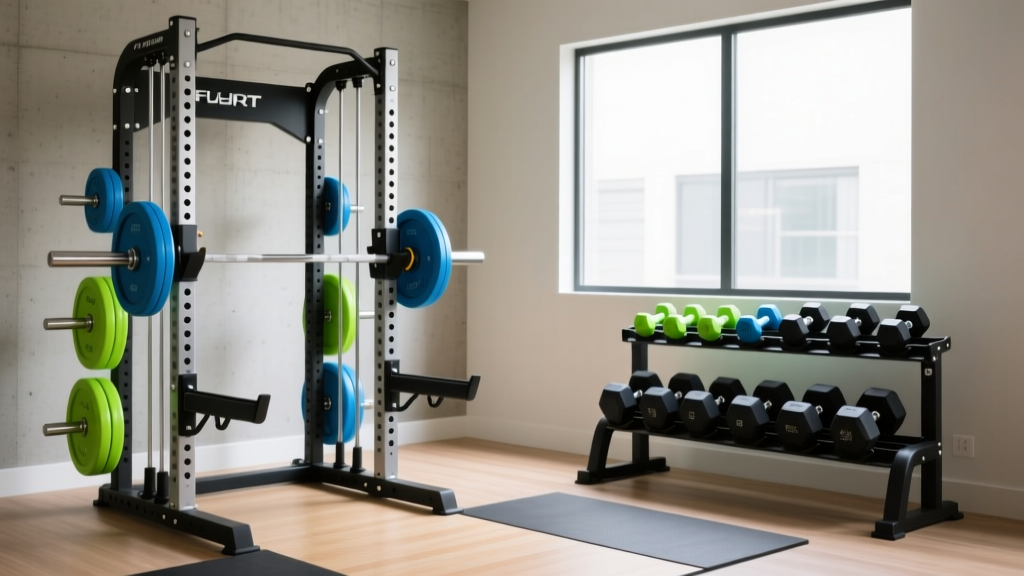
Power Rack vs Squat Stand Setup for Aerobic Dumbbell Exercises
Compare power racks, squat racks, and stands for home gym installation. Learn how to optimize floor space and safety for aerobic dumbbell exercises.

The modern 2026 home gym is rarely a single-purpose space. Today’s most effective training environments are hybrid setups that seamlessly transition between heavy barbell strength work and high-heart-rate metabolic conditioning. However, merging these two modalities creates a unique spatial conflict. When you install heavy steel equipment, you are permanently altering the floor plan. If your conditioning relies heavily on aerobic dumbbell exercises—such as high-rep dumbbell snatches, lateral lunge circuits, or sprawling renegade rows—the physical footprint, upright placement, and anchor points of your rack become critical safety and performance variables.
In this complete setup and installation walkthrough, we break down the power rack vs. squat rack vs. squat stand debate specifically through the lens of spatial zoning. We will cover exact installation measurements, subfloor preparation, and how to engineer a safe 'aerobic perimeter' that allows for unrestricted dynamic movement.
The Footprint Dilemma: Analyzing the Big Three
Choosing between a full power rack, a half squat rack, and freestanding squat stands dictates how much usable floor space you retain for dynamic conditioning. According to facility design principles outlined by the National Strength and Conditioning Association (NSCA), dynamic movement zones require a minimum of 36 inches of clearance from fixed obstructions to prevent impact injuries during lateral or backward movements.
| Equipment Type | 2026 Benchmark Model | Base Footprint | Spotter Arm Extension | Aerobic Clearance Rating |
|---|---|---|---|---|
| Full Power Rack | Rogue R-3 (90" Depth) | 49" x 90" | Internal (No extension) | Low (Confines floor work) |
| Squat Rack (Half Rack) | Titan T-2 Power Rack (Short) | 48" x 24" | 17" External | Medium (Allows lateral flow) |
| Squat Stands | Rep Fitness Open Box Stands | 23" x 22" (per stand) | 12" External | High (Maximizes open floor) |
For athletes prioritizing aerobic dumbbell exercises that require sprawling, lateral shuffles, or wide-stance rotational movements, squat stands or shallow half-racks offer the highest aerobic clearance rating. Full power racks provide unmatched safety for heavy solo benching but create a 'cage' that restricts the flow of high-tempo dumbbell circuits.
Step-by-Step Installation & Spatial Zoning Walkthrough
Proper installation is about more than just securing the steel; it is about mapping the interaction between the rack's hardware and your body's movement pathways.
Phase 1: Subfloor Preparation and Mat Layout
Before unboxing your rack, you must prepare the subfloor. For a hybrid gym, 3/4-inch thick vulcanized rubber horse stall mats are the industry standard. They absorb the shock of dropped barbells and provide a stable, non-slip surface for rapid footwork during aerobic dumbbell exercises.
- Cut Precision: Use a straight edge and a utility knife with fresh blades to cut mats flush against the wall.
- The Anchor Gap: Do not run mats directly under the base plates of a bolt-down rack. Cut precise semi-circles or squares out of the mat where the wedge anchors will be placed. This allows the steel base plate to sit directly on the concrete, ensuring 100% of the anchor's holding power is utilized without the rubber compressing over time.
Phase 2: Mapping the 'Aerobic Perimeter'
Before drilling, tape off your movement zones. Use painter's tape to mark a 6x6 foot square directly in front of and to the sides of your rack. This is your 'Aerobic Perimeter.' When performing exercises like dumbbell thrusters or renegade rows, fatigue compromises spatial awareness. If the extended feet of your power rack or the rear stabilizer of your squat stand intrude into this 6x6 zone, you are creating a severe tripping hazard.
⚠️ SAFETY CALLOUT: Spotter Arm PlacementIf you are using a squat rack with external spotter arms, always rotate the arms inward or remove them entirely when transitioning to floor-based aerobic dumbbell exercises. Sweeping a dumbbell backward during a burpee or sprawl into a protruding 17-inch steel spotter arm is a leading cause of home gym wrist and shoulder injuries.
Phase 3: Drilling and Anchoring Protocol
If your chosen rack requires bolting (highly recommended for squat stands to prevent tipping during dynamic dumbbell loading), follow this exact protocol for 4-inch thick concrete slabs:
- Bit Selection: Use a hammer drill with a 3/4-inch carbide-tipped masonry bit.
- Depth Control: Wrap a piece of tape around the bit 4.5 inches from the tip to serve as a depth gauge. The hole must be deeper than the anchor to allow for concrete dust displacement.
- Clearing the Hole: Use a shop vac or compressed air to remove all silica dust from the hole. A dusty hole reduces wedge anchor friction by up to 40%.
- Seating the Anchor: Insert 1/2-inch x 5-1/2-inch zinc-plated wedge anchors through the rack base and into the concrete. Tighten with a torque wrench to 60 ft-lbs.
- Hardware Flushness: Ensure the nut and exposed threads do not protrude more than 1/4 inch above the base plate. Protruding threads will tear through rubber mats and catch the handles of dumbbells during ground-level aerobic work.
Designing the Dumbbell Storage Integration
A critical, often overlooked aspect of rack installation is weight storage placement. During high-rep aerobic dumbbell exercises, you need rapid access to varying weights for drop-sets or circuit transitions.
According to guidelines from the American Council on Exercise (ACE), equipment layout should minimize transitional friction to maintain target heart rate zones. If you are installing a full power rack, utilize vertical dumbbell horns attached to the rear uprights rather than a floor-standing tier rack. A floor-standing 3-tier dumbbell rack placed adjacent to your squat stand will eat into your 6x6 aerobic perimeter, forcing you to alter your movement mechanics to avoid kicking the steel frame during lateral lunges.
Real-World Gear Specs: 2026 Market Snapshot
When browsing catalogs from top manufacturers like Rogue Fitness, Titan, or Rep, pay close attention to the 'depth' and 'upright profile' specifications.
- Upright Profile: 3x3-inch 11-gauge steel is the current standard. While incredibly robust, the wider profile means attachment pins (like J-cups and spotter arms) sit further off the upright, slightly reducing internal working width for exercises like dumbbell floor presses done inside the rack.
- Hole Spacing: Opt for Westside (1-inch) spacing in the bench zone. This allows micro-adjustments for safety straps, which is vital if you are doing high-fatigue aerobic dumbbell floor presses where you may not have the energy to return the weights to a high rack position.
- Base Stabilizers: Look for racks with 'flat-foot' compatible base plates. Even if you don't bolt the rack down immediately, flat-foot plates with rear weight-storage pegs allow the rack to be counterbalanced safely without permanent concrete modification, preserving your floor for future aerobic zone reconfigurations.
Frequently Asked Questions
Can I do aerobic dumbbell exercises inside a full power rack?
Yes, but with limitations. A standard 4x4 power rack provides roughly 16 square feet of internal space. This is sufficient for stationary movements like dumbbell thrusters or goblet squats. However, it is entirely inadequate for traveling aerobic dumbbell exercises like walking lunges or lateral shuffles, as the uprights will obstruct your path and pose an impact risk.
Do squat stands tip over if I drop a heavy dumbbell nearby?
Squat stands are highly susceptible to lateral tipping if not bolted down or heavily counterbalanced. Dropping a 50lb dumbbell on the floor next to an unanchored squat stand will not tip it via direct contact, but the kinetic vibration combined with an off-center barbell load can cause instability. Always bolt squat stands to concrete if your gym floor will be subjected to the heavy impacts typical of intense aerobic conditioning circuits.
What is the best matting for a hybrid rack and aerobic zone?
For the area directly under the rack and weights, use 3/4-inch vulcanized rubber. For the extended aerobic perimeter where you perform high-rep dumbbell movements, consider interlocking 1-inch thick EVA foam or specialized athletic turf. Turf provides superior traction for lateral directional changes during aerobic dumbbell exercises while reducing joint impact compared to bare rubber.
More gear to consider
All reviews
Olympic Barbell Knurling & Chest Day Dumbbells Setup

EZ Curl Bar vs Straight Bar & Over the Head Dumbbell 2026 Trends

Is a Premium Dumbbells Logo Worth It? Rubber Hex vs Urethane Value

EZ Bar vs Straight Bar: The 2026 Alternative Dumbbell Press Trend

Power Rack vs Squat Rack vs Squat Stand: Dumbbell Mat Bench NYT Guide
