
Power Rack vs Squat Rack: Space for Side Plank Dumbbell Raises?
Compare power racks, squat racks, and squat stands. Discover which offers the safest footprint for heavy lifts and core work like side plank dumbbell raises.

The Hidden Metric: Interior Clearance for Accessory Work
When outfitting a home gym in 2026, most lifters obsess over pull-up bar height, weight capacity, and attachment ecosystems. While these are critical for heavy compound lifts, they completely ignore the secondary reality of functional training: floor space and accessory movement clearance. A well-rounded program isn't just about back squats and bench presses; it incorporates unilateral core stabilization, lateral movements, and dynamic floor work.
This is where the debate of power rack vs squat rack vs squat stand shifts from simple barbell storage to comprehensive spatial management. Consider a movement like side plank dumbbell raises. This exercise demands lateral stability, rotational control, and a safe, unobstructed radius. If you are performing this movement on the floor inside or immediately adjacent to your rack, the physical footprint and protruding hardware of your equipment dictate your safety and workflow.
The 'Safety Perimeter' Concept
In ergonomics and gym design, the 'safety perimeter' is the clear space required around a piece of equipment to perform non-linear movements. Squat stands offer zero interior perimeter. Half racks offer a compromised perimeter. Power racks offer an enclosed, predictable sanctuary. Let us break down how these three categories handle real-world accessory work.
2026 Comparison Matrix: Footprint & Clearance
The market has largely standardized around 3x3-inch, 11-gauge steel uprights with 5/8-inch hole spacing for mid-to-premium tier racks. However, the architectural footprint varies wildly. Below is a comparison of three industry benchmarks and how they accommodate lateral core work.
| Model Type | Example Model | Exterior Footprint | Interior Width | Lateral Floor Hazard | Avg. Price (2026) |
|---|---|---|---|---|---|
| Power Rack | REP PR-4000 | 47" x 48" | 42" | Low (Enclosed) | $799 - $999 |
| Squat Rack (Half) | Rogue SML-2 | 48" x 48" | Open Front | Medium (Spotter Arms) | $650 - $850 |
| Squat Stand | Titan T-2 | 48" x 48" | N/A | High (Weight Horns) | $399 - $450 |
Power Racks: The Enclosed Sanctuary
A full power rack (four uprights connected by crossmembers) is the gold standard for home gyms that prioritize both heavy lifting and diverse accessory work. Because the uprights form a rigid rectangle, the interior space becomes a dedicated 'clean zone.'
Why It Wins for Accessory Work
When you push a flat bench into the corner of a power rack to open up floor space, you are left with a 42-inch wide by 40-inch deep rectangular area completely free of hardware. If you are executing side plank dumbbell raises on the floor, your risk of clipping a weight horn or tripping over a spotter arm during the eccentric phase is virtually zero. Furthermore, power racks allow you to store heavy dumbbells on interior vertical pegs, keeping them off the floor and out of your lateral rolling path.
- Pros: Maximum safety for floor work; supports heavy band pegging; allows for attachment-heavy expansions (lat pulldowns, belt squats); structural rigidity requires no floor bolting if properly cross-braced.
- Cons: Highest cost; requires significant ceiling height (usually 84" to 90" clearance); visually dominates smaller rooms.
Squat Racks (Half Racks): The Open-Concept Compromise
Half racks, featuring two main front uprights and a rear stabilizer base, attempt to bridge the gap between the safety of a power rack and the spatial efficiency of squat stands. Models like the Rogue SML-2 or Bells of Steel Half Rack utilize extended rear gussets for stability without enclosing the lifter.
The Spotter Arm Dilemma
The primary issue with half racks for lateral floor work is the spotter arms. To safely catch a missed bench press or squat, these arms must extend 18 to 24 inches outward from the uprights. When you transition to floor-based core work, these protruding steel arms become severe strike hazards. If you lose your balance during a dynamic movement, the open sides of a half rack offer little protection from the surrounding hardware.
Expert Insight: If you must buy a half rack but prioritize floor mobility, invest in 'flip-up' or 'pin-and-pipe' spotter arms that can be tucked away or completely removed in under 10 seconds when transitioning from barbell work to dumbbell accessory circuits.
Squat Stands: The Minimalist Trap
Squat stands are essentially two independent uprights (sometimes connected by a thin front crossbar). They are incredibly popular for garage gyms with low ceilings or tight budgets. However, from a holistic programming perspective, they present significant limitations.
The Weight Storage Hazard
Because squat stands lack a rear cage, weight plates must be stored on rear-facing horns attached directly to the uprights. This means the rear of your squat stand is essentially a wall of spinning steel plates. Performing side plank dumbbell raises adjacent to squat stands means your head, elbows, and dumbbells are inches away from loaded plate storage. A slight lateral drift during core fatigue can result in a painful collision with a 45-pound bumper plate or the steel horn itself.
- Pros: Unbeatable price point; easy to fold or move; ideal for strict barbell-only routines in low-clearance spaces.
- Cons: Zero interior floor space; high risk of hardware collision during lateral movements; requires bolting to concrete or using massive sandwich plates for rear stability.
Biomechanics & Safety: The Side Plank Dumbbell Raises Test
Why use side plank dumbbell raises as the ultimate stress test for rack clearance? According to the exercise biomechanics database at ExRx.net, lateral core stabilization requires unrestricted rotational freedom and a stable base. When a lifter is holding a dumbbell in the top hand and rotating through the transverse plane, their spatial awareness is entirely focused on the weight and their core tension, not the floor environment.
Research published in the National Center for Biotechnology Information (NCBI) highlights that core muscle activation during unstable or constrained movements is compromised when the subject is subconsciously guarding against environmental hazards. If your brain is subconsciously mapping the location of a squat stand's weight horn to avoid striking it, your oblique and transverse abdominis activation is neurologically inhibited. You cannot train effectively if your environment induces micro-flinching.
The American Council on Exercise (ACE) consistently emphasizes that functional core training requires a safe, unobstructed radius to allow for natural movement patterns and failure-point testing. A power rack provides this psychological and physical safety net; squat stands actively work against it.
Final Decision Framework: Which Should You Buy?
Stop looking at racks solely as barbell holders. View them as the architectural anchor of your training space. Use this framework to make your 2026 purchasing decision:
- Choose a Power Rack IF: Your budget exceeds $700, your ceiling is over 84 inches, and your programming includes heavy accessory work, floor-based core routines, and band-resisted movements. The enclosed footprint guarantees safety for exercises like side plank dumbbell raises.
- Choose a Squat Rack (Half Rack) IF: You need the safety of spotter arms and pull-up bars but suffer from claustrophobia or spatial constraints that make a 4-post rack feel oppressive. Ensure you buy flip-up spotters to maximize floor clearance.
- Choose Squat Stands IF: You are strictly a powerlifter or Olympic weightlifter who only uses the rack for squats, benching, and rack pulls. If your accessory work is done in a completely different area of the room, the lack of interior clearance won't impact your workflow.
The Bottom Line
Your equipment should facilitate your programming, not restrict it. While squat stands win on price and power racks win on versatility, evaluating your rack based on its 'accessory clearance' will ensure your home gym supports your entire fitness journey, from heavy 1-rep maxes to the final core burnout set.
More gear to consider
All reviews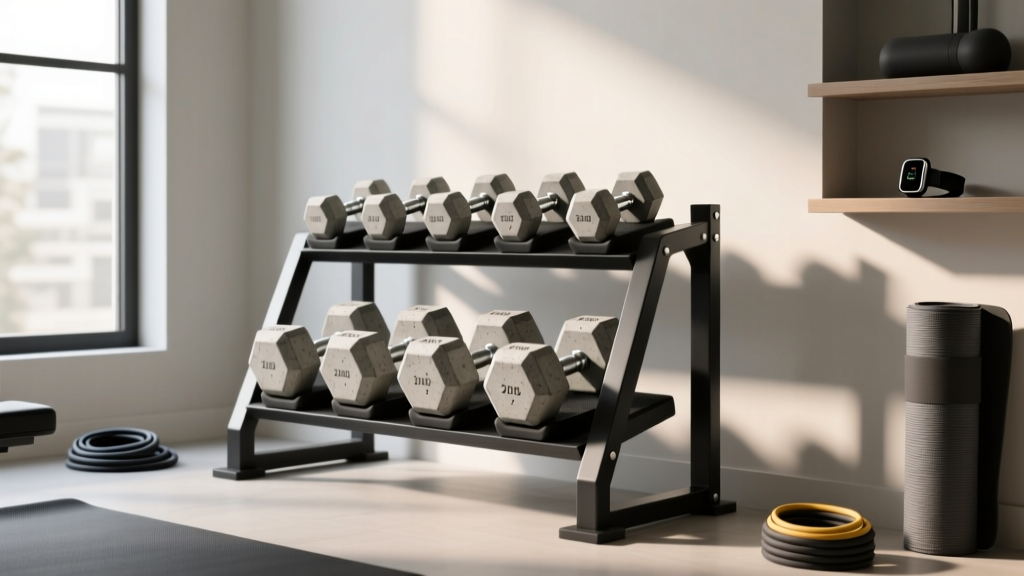
Cement Dumbbells Storage: 2026 Rack Trends and Market Analysis

Olympic vs Standard Plates: Setup for Dumbbell Rows

Olympic Barbell Weight & Knurling: Setup for Single-Arm Dumbbell Rows
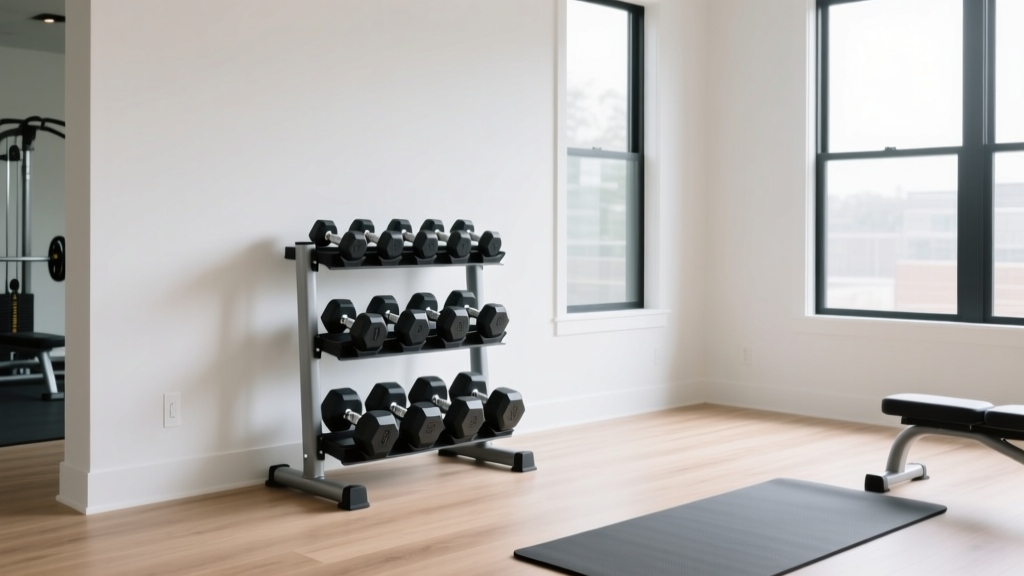
Clear Floor Space for the Dumbbell Glute Bridge March: Rack Guide

Rack Care & Storage for a Complete Shoulder Workout with Dumbbells
