
Pull-Up Assist Band Sizing & The Difference Between Yoga Mats
Master pull-up assist band sizing with our tension chart. Plus, learn the difference between yoga mats for stretching and joint support.

The Home Gym Axis: Vertical Pulling and Horizontal Mobility
Building a functional home gym in 2026 requires more than just a barbell and a rack; it demands a thoughtful approach to both vertical pulling mechanics and horizontal floor mobility. Two of the most misunderstood accessories in the 'Bands, Balls & Accessories' category are resistance loop bands and floor mats. Athletes frequently purchase the wrong tension bands, leading to stalled progress, or choose the wrong floor surface, resulting in joint pain during mobility work. This comprehensive guide breaks down the exact science of pull-up assist band sizing and explores the critical difference between yoga mats to ensure your rig and floor setup are perfectly calibrated to your biomechanics.
The Biomechanics of Pull-Up Assist Band Sizing
Pull-up assist bands are not merely 'stretchy ropes'; they are variable-resistance tools that offset a specific percentage of your body weight. The assistance provided by a loop band is highest at the bottom of the movement (when the band is maximally stretched) and decreases as you approach the bar. According to ExRx biomechanics data, the latissimus dorsi experiences its greatest mechanical disadvantage in the bottom third of a pull-up. This is exactly where the band provides the most force, effectively 'spotting' your weakest range of motion.
However, selecting the right band requires understanding the correlation between band width, thickness, and tension output. Below is the industry-standard sizing chart, modeled after the widely used Rogue Monster Bands specifications.
Pull-Up Assist Band Tension Matrix
| Band Color | Dimensions (Width x Thickness) | Tension Range (lbs) | Best Use Case |
|---|---|---|---|
| Red | 1/4' x 4.5mm | 15 - 35 lbs | Warm-ups, mobility, adding slight assistance to advanced athletes |
| Black | 1/2' x 4.5mm | 30 - 50 lbs | High-rep hypertrophy, assisting users within 10 lbs of their first pull-up |
| Purple | 3/4' x 4.5mm | 40 - 80 lbs | Intermediate strength building, learning strict kipping mechanics |
| Green | 1-1/4' x 4.5mm | 50 - 120 lbs | Beginners learning scapular engagement, heavy eccentric overloads |
| Blue | 1-3/4' x 4.5mm | 80 - 200 lbs | Heavier athletes (220+ lbs) starting their first pull-up journey |
| Orange | 2-1/2' x 4.5mm | 100 - 250 lbs | Rehabilitation, extreme assistance for heavy plus-size athletes |
Never use a band that shows micro-tears or white stress lines along the edges. In 2026, most premium bands are made from layered natural latex. When a layered band fails, it does not just snap; it delaminates, creating a whip-like effect that can cause severe lacerations. Inspect the inner lumen of your bands every 90 days.
Step-by-Step Selection Framework for Pull-Up Bands
To select the correct band, you must calculate your 'Assistance Deficit'. Do not guess based on color. Use this formula:
- Establish your baseline: If you cannot perform a strict dead-hang pull-up, your baseline is 0.
- Calculate the deficit: A standard pull-up requires moving roughly 95% of your body weight (accounting for the forearms). If you weigh 200 lbs, you are moving 190 lbs.
- Match the band: If your current max unassisted strength is 140 lbs (tested via lat pulldown or negative holds), your deficit is 50 lbs. You need a Black (30-50 lbs) or Purple (40-80 lbs) band to bridge the gap.
'The goal of an assist band is not to make the exercise easy; it is to allow you to train the exact neurological pathway of a strict pull-up with perfect form, despite current strength limitations.' - Strength & Conditioning Journal Principles
For a complete progression system, we recommend purchasing a 3-band set (e.g., Black, Purple, Green). Sets typically range from $85 to $130, offering a $40 savings over buying individually, and allow you to micro-load your progression as you shed body fat and build lat strength.
Transitioning to the Floor: The Difference Between Yoga Mats
Once you step off the pull-up rig, your floor setup dictates the quality of your mobility and core work. This is where understanding the difference between yoga mats becomes critical. Many home gym owners mistakenly use cheap, closed-cell PVC foam mats for heavy stretching, only to experience wrist compression and knee bruising. The mat market is segmented by material science, density, and surface texture.
Material Breakdown: PVC vs. Natural Rubber vs. Polyurethane
When evaluating premium yoga mats, the core material determines the mat's lifespan, grip, and shock absorption.
- PVC (Polyvinyl Chloride): High-density, closed-cell. Extremely durable (lifetime warranty common). Offers firm joint support but requires a 'break-in' period to remove the factory lipid coating. Example: Manduka PRO (6mm, ~$120).
- Natural Rubber: Open-cell, eco-friendly. Provides immediate, aggressive grip and excellent cushioning. However, it degrades faster with exposure to UV light and heavy sweat. Example: JadeYoga Harmony (5mm, ~$80).
- Polyurethane (PU) over Rubber: The gold standard for hot environments. The PU top layer absorbs micro-sweat to prevent slipping, while the rubber base provides bounce. Example: Liforme Original (4.2mm, ~$140).
Comparative Analysis: Top 2026 Floor Mats for Athletes
| Model | Material | Thickness | Weight | Best For |
|---|---|---|---|---|
| Manduka PRO | High-Density PVC | 6.0 mm | 7.5 lbs | Heavy athletes, joint protection, lifetime durability |
| JadeYoga Harmony | Natural Rubber | 5.0 mm | 5.0 lbs | Dynamic mobility, eco-conscious buyers, dry environments |
| Liforme Original | Eco-Polyurethane | 4.2 mm | 5.5 lbs | Sweaty sessions, alignment-focused stretching |
| Gaiam Essentials | TPE Foam | 6.0 mm | 2.0 lbs | Light travel, budget setups (Not recommended for heavy lifting areas) |
If your yoga mat will live directly under a pull-up rig where chalk dust and dropped dumbbells are common, avoid open-cell natural rubber. Chalk will permanently embed into the pores of a JadeYoga mat. Opt for a closed-cell PVC mat like the Manduka PRO, which can be wiped clean with a 50/50 water and white vinegar solution.
Maintenance and Edge Cases for Bands and Mats
Proper maintenance extends the life of your accessories and prevents catastrophic failures.
Band Degradation Factors
Latex bands are highly susceptible to photo-degradation. Storing your pull-up bands on a pegboard near a sunlit garage window will reduce their tensile strength by up to 40% within six months. Store them in a dark, climate-controlled drawer. Furthermore, never anchor a loop band to a rough, knurled barbell sleeve or a rusty pull-up bar; the microscopic abrasions will initiate a tear that will eventually snap under load.
Mat Compression and Outgassing
When unboxing a new PVC mat, you may notice a strong chemical odor. This is 'outgassing'—the release of volatile organic compounds (VOCs) from the manufacturing process. Leave the mat unrolled in a well-ventilated, shaded area for 72 hours before use. Regarding compression: while a 6mm mat is excellent for yoga and bodyweight core work, it is too soft for heavy kettlebell swings or Olympic lifting. Keep your mat strictly designated for mobility, stretching, and floor-based accessory work.
Expert FAQ
Can I combine two pull-up bands for more assistance?
Yes, but with caution. Looping a Green and a Purple band together creates an uneven tension curve and increases the risk of the bands slipping off the bar. It is safer to buy a single, higher-tension band (like a Blue) than to stack two medium bands.
How do I clean a polyurethane yoga mat without ruining the grip?
Never use essential oils or harsh chemical degreasers on PU mats; they will clog the micro-pores and destroy the sweat-wicking grip. Use a dedicated PU mat cleaner or a simple damp microfiber cloth after every session.
Do I need a mat if I only do pull-ups and weightlifting?
Yes. Thoracic spine extensions, latissimus dorsi floor slides, and deep hip-flexor stretches are mandatory for pull-up athletes to maintain shoulder health. Performing these on bare concrete or hard rubber gym tiles will inhibit your range of motion and cause patellar bruising.
More gear to consider
All reviews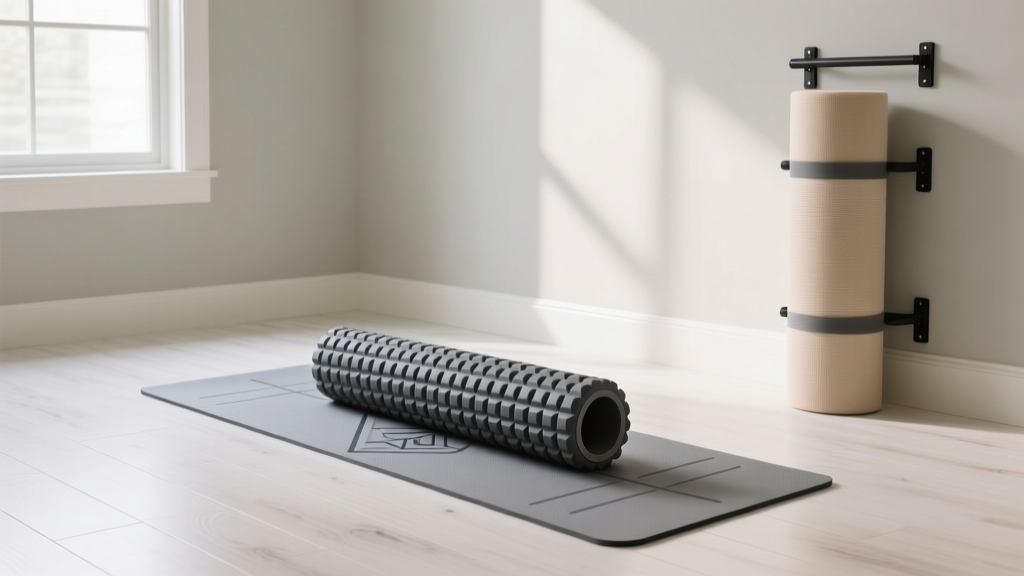
Mobility Zone Setup: Foam Roller Density & Yoga Mat Dimensions

Jump Rope Types: Speed, Weighted, Beaded & Normal Yoga Mat Thickness
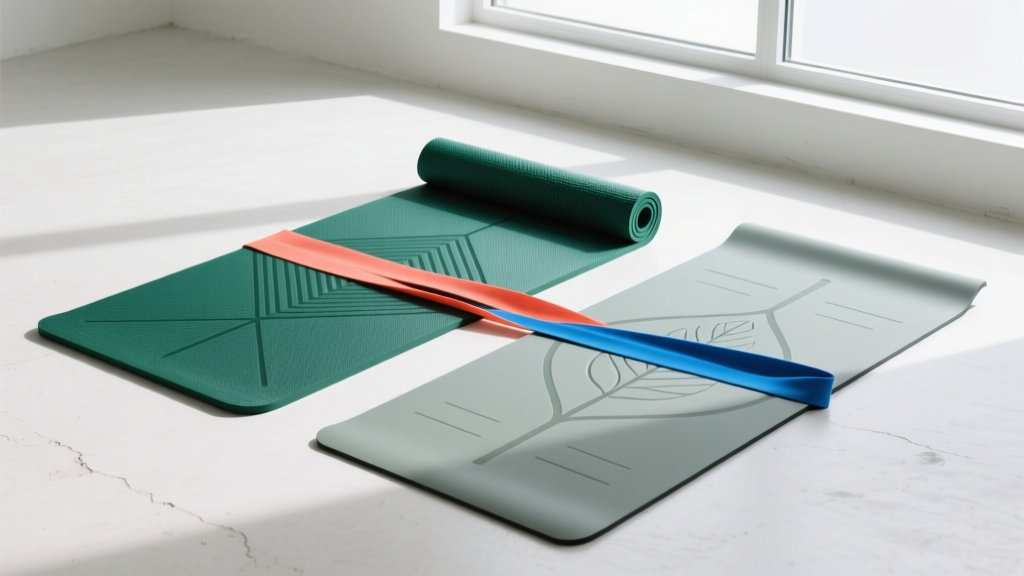
Pilates Mat vs Yoga Mat: Grip, Thickness & Material Compared

Resistance Band Setup: Levels, Anchors & Hot Pink Yoga Mat

Medicine Ball Weight Selection Guide & Equa Yoga Mat Towel Tips
