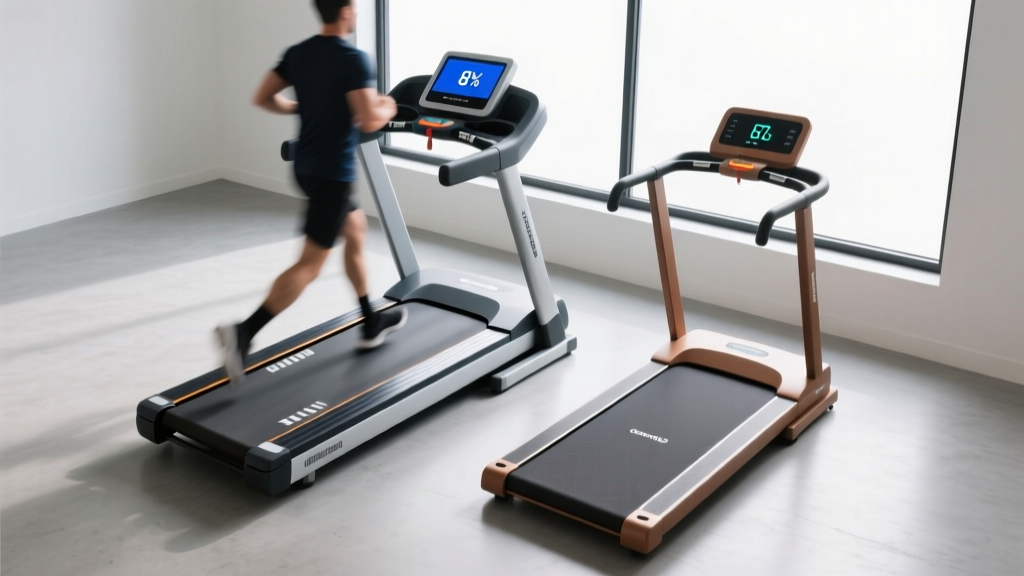
ProForm Sport 5.0 Treadmill vs Curved Manuals: Troubleshooting Guide
Compare curved manual treadmills and the ProForm Sport 5.0 treadmill. Learn common mistakes, maintenance tips, and troubleshooting fixes for both types.

The Biomechanical Divide: Motorized vs. Curved Treadmills
As home gym setups evolve in 2026, the debate between traditional motorized decks and self-powered curved manual treadmills continues to dominate fitness forums. Motorized models like the ProForm Sport 5.0 treadmill remain staples for their affordability, digital tracking, and consistent pacing. Conversely, curved manual treadmills (such as the TrueForm or AssaultRunner) have surged in popularity for their high-intensity interval training (HIIT) capabilities and joint-friendly biomechanics. However, transitioning between these two fundamentally different machines—or maintaining them over years of heavy use—introduces a unique set of common mistakes and mechanical failures.
This guide dissects the biomechanical errors users make when switching between motorized and curved decks, followed by a deep-dive troubleshooting matrix for the ProForm Sport 5.0 and standard urethane-slat curved models.
Core Physics Difference
On the ProForm Sport 5.0, a 2.5 CHP motor pulls the belt beneath you at a predetermined speed, requiring you to simply keep up. On a curved manual treadmill, you are the motor. The concave slat belt requires you to drive downward and backward using your hamstrings and glutes to overcome the inertia of the flywheel and your own body weight.
Common Biomechanical Mistakes When Transitioning
1. Overstriding on Curved Decks
Users accustomed to the 18-inch by 55-inch running surface of the ProForm Sport 5.0 often carry a heel-strike, overextended stride over to a curved treadmill. Because curved decks lack a motorized pull, reaching too far forward forces your center of mass behind the apex of the curve. This acts as a braking mechanism, causing abrupt deceleration and severe shin splints. The Fix: Shorten your stride by 10-15%, focus on a mid-foot strike directly under your hips, and drive the slats backward.
2. Handrail Dependency on Motorized Models
According to physical therapy guidelines referenced by the American Heart Association, maintaining natural arm swing is critical for cardiovascular efficiency and spinal alignment. Gripping the handrails of the ProForm Sport 5.0 while walking at an incline ruins your natural gait, shifts the workload away from your core, and can lead to lower back impingement. If you must hold on, you are walking too fast or at too steep an incline for your current fitness level.
Troubleshooting the ProForm Sport 5.0 Treadmill
The ProForm Sport 5.0 is a reliable entry-to-mid-level motorized treadmill, but its high-friction deck and entry-level electronics are prone to specific failure modes if maintenance is neglected. Below are the most frequent issues and their exact mechanical fixes.
Symptom: Belt Hesitation or 'Slipping' Underfoot
- The Cause: The walking belt has stretched, or the drive belt connecting the motor to the front roller has lost tension.
- The Fix: First, check the walking belt. You should be able to lift the center of the belt 2 to 3 inches off the deck. If it is tighter, it will overheat the motor. If it is looser, it will slip. Locate the two rear roller adjustment bolts at the back of the treadmill. Using the provided Allen wrench, turn both bolts exactly one-quarter (1/4) turn clockwise. Test the belt. Never adjust one side more than the other, or the belt will track off-center and fray against the side rails.
Symptom: 'E1' Error Code on Console
- The Cause: The console is not receiving a speed signal from the motor controller. This is almost always a speed sensor issue, not a dead motor.
- The Fix: Unplug the machine and remove the front motor hood. Locate the optical or magnetic speed sensor near the motor flywheel. If it is an optical sensor, use compressed air to blow out dust accumulation blocking the infrared beam. If it is a magnetic reed switch, ensure the gap between the magnet on the flywheel and the sensor is exactly 1/8 inch. According to Icon Health & Fitness Support documentation, misalignment of this sensor is the leading cause of E1 errors in the Sport series.
Symptom: Thermal Overload Shutdown (Stops after 15-20 mins)
- The Cause: Excessive friction between the walking belt and the wooden deck forces the 2.5 HP motor to draw too many amps, triggering the internal thermal breaker.
- The Fix: You must lubricate the deck. Do not use WD-40 or petroleum-based oils, which will destroy the belt backing. Purchase a 100% silicone treadmill lubricant. Loosen the belt, apply a zigzag pattern of silicone directly onto the deck, re-tension the belt, and walk at 1.0 MPH for 3 minutes to distribute the fluid.
Troubleshooting Curved Manual Treadmills
Curved treadmills eliminate the motor and control board, shifting the maintenance burden to the physical track, slats, and bearings.
Symptom: Slat 'Dead Spots' or Track Catching
- The Cause: Urethane slats have worn unevenly, or debris has lodged in the side-rail guide tracks.
- The Fix: Inspect the side rails where the slat bearings glide. Use a vacuum with a crevice tool to remove chalk, dust, and rubber particulate. If a specific slat catches, inspect the rubber guide wheels on the underside of the slat. If the urethane has flat-spotted, you must order a replacement slat kit from the manufacturer (typically costing $150-$250 in 2026).
Symptom: High-Pitched Squealing or Grinding Noise
- The Cause: The sealed ball bearings inside the slat guides or the main front/rear axles have dried out or suffered seal failure.
- The Fix: Identify the noisy slat by spinning the belt slowly by hand and listening. Pop the slat guide wheel out of the track. Most premium curved treadmills use standard 608zz sealed bearings. Instead of paying a technician $200 for a service call, you can press out the old bearing and press in a new 608zz bearing (available for roughly $3 to $5 each online) using a simple bench vise.
Maintenance & Cost Matrix: Motorized vs. Curved
| Component | ProForm Sport 5.0 (Motorized) | Curved Manual Treadmill |
|---|---|---|
| Running Surface | PVC Belt (Replace every 3-5 years; ~$60) | Urethane Slats (Replace individual slats as needed; ~$20/slat) |
| Drive System | Motor & Drive Belt (Lubricate deck monthly; Motor replacement ~$250) | Gravity & Inertia (No motor; replace 608zz bearings ~$5 each) |
| Electronics | Console & Controller (Prone to power surge damage; ~$150+) | Optional magnetic resistance/HR sensors (Minimal failure rate) |
| Primary User Error | Ignoring deck lubrication (Causes motor burnout) | Overstriding (Causes joint pain and slat track wear) |
Safety Considerations and Injury Prevention
Treadmills account for tens of thousands of emergency room visits annually. The Consumer Product Safety Commission (CPSC) emphasizes that friction burns from motorized belts and crushing injuries from rear rollers are primary hazards. Always utilize the magnetic safety clip on motorized models like the ProForm Sport 5.0, and ensure curved treadmills are placed at least 3 feet away from walls to prevent entrapment in the event of a backward fall.
Frequently Asked Questions (FAQ)
Can I use a curved manual treadmill for low-intensity walking?
Yes, but it requires a learning curve. Because the belt only moves when you push it, walking at slow speeds (under 2.0 MPH) on a curved deck can feel 'choppy' as you must overcome the static inertia of the heavy slat belt with every single step. For pure walking, a motorized deck like the ProForm Sport 5.0 provides a much smoother, more consistent experience.
How often should I lubricate the ProForm Sport 5.0 deck?
Under normal use (3-4 hours per week), you should apply 100% silicone lubricant to the deck every 3 months or every 130 miles. If you live in a high-humidity environment or run heavily, check the friction levels monthly. A quick test: slide your hand under the belt. If it feels completely dry, it is time to lubricate.
Do curved treadmills actually burn more calories?
Peer-reviewed sports science studies indicate that running on a curved manual treadmill increases caloric expenditure and heart rate by roughly 15% to 20% compared to a motorized treadmill at the exact same perceived pace. This is due to the lack of motorized assistance and the increased activation of the posterior chain (glutes and hamstrings) required to drive the concave belt.
More gear to consider
All reviews
Space Layout: Stationary Bikes vs Urevo Spacewalk E4W Treadmill
Folding Treadmill Review: 2026 Treadmill Conversion Chart

Air Bike vs Assault Bike Guide & Ancheer Treadmill Manual Tips
NordicTrack C850i Treadmill & Stationary Bikes: Maintenance Guide

NordicTrack A2550 Pro Treadmill Review: Belt Maintenance and Care