
ProForm Pro Treadmill vs Curved Manual: 2026 Showdown
We compare the motorized ProForm Pro treadmill lineup against premium curved manual decks. Discover biomechanics, costs, and failure modes for 2026.

The Great Treadmill Divide: Motorized vs. Self-Powered
The home fitness equipment market in 2026 is defined by a distinct philosophical split in cardiovascular training: the automated precision of motorized decks versus the raw, self-paced biomechanics of curved manual treadmills. For buyers researching the ProForm Pro treadmill series, the decision often comes down to whether they want the guided, tech-heavy experience of a motorized workhorse or the unassisted, high-output nature of a curved slat belt.
To settle this debate, we are putting the benchmark motorized model—the ProForm Pro 9000—head-to-head against a premium curved manual competitor, the AssaultRunner Elite. This is not a superficial spec-sheet comparison; we are analyzing ground reaction forces, long-term failure modes, true caloric expenditure, and the total cost of ownership over a five-year lifecycle.
The Contenders: Spec Sheet Breakdown
Before diving into biomechanics, we must establish the hardware baseline. The ProForm Pro 9000 represents the pinnacle of consumer-grade motorized fitness, while the AssaultRunner Elite represents commercial-grade manual engineering.
- ProForm Pro 9000 (Motorized): 3.6 CHP Mach Z Commercial Plus Motor, 22-inch smart HD touchscreen, 0-12 MPH top speed, -3% to 12% incline/decline, 20' x 60' tread belt. Retail price: ~$1,199 - $1,499.
- AssaultRunner Elite (Curved Manual): Zero-horsepower self-powered drive, 72 vulcanized rubber slats, Bluetooth FTMS connectivity, max speed limited only by user output, 350 lb weight capacity. Retail price: ~$2,999.
Biomechanics and Muscle Activation
The most critical difference between these two machines lies in the gait cycle. On a motorized treadmill like the ProForm Pro 9000, the belt pulls your foot backward. This artificial assistance reduces the activation of your posterior chain (hamstrings and glutes) and encourages a heel-strike running pattern, especially at speeds below 6.0 MPH.
Conversely, a curved manual treadmill forces you to drive the belt yourself. The 15-degree downward curve of the AssaultRunner Elite naturally encourages a mid-foot or forefoot strike. This shift in biomechanics drastically increases the engagement of the glutes, hamstrings, and calves. According to kinesiology data, pushing the curved belt requires an estimated 20% more horizontal force generation per stride compared to a motorized deck. If your goal is sprint mechanics and posterior chain development, the curved manual deck is vastly superior.
Caloric Expenditure: The 30% Myth vs. Reality
Marketing materials for curved treadmills frequently claim a '30% increase in calorie burn' compared to motorized treadmills. As domain experts, we must contextualize this data point.
Data Highlight: True Metabolic Demand
The 30% figure originates from studies comparing curved treadmills to overground running or motorized treadmills at a flat 0% incline. When you compare a curved manual treadmill to a motorized treadmill set at a 5% to 8% incline, the caloric expenditure gap narrows to roughly 8% to 12%. However, because the curved treadmill achieves this higher metabolic demand without the joint impact of a steep motorized incline, it remains a highly efficient tool for time-crunched workouts.
For general cardiovascular health, the World Health Organization recommends at least 150 minutes of moderate-intensity or 75 minutes of vigorous-intensity aerobic activity per week. Because curved treadmills elevate the heart rate faster at lower absolute speeds, users often hit the vigorous-intensity threshold defined by the American Heart Association in significantly less time.
Tech, Interactivity, and Programming
This is where the ProForm Pro treadmill series completely dominates the manual category. The Pro 9000 features a 22-inch pivoting HD touchscreen powered by iFIT. The software automatically adjusts the speed and incline/decline based on global terrain mapping and trainer-led workouts. The -3% decline feature is particularly valuable for eccentric quad loading and downhill running preparation, a physical impossibility on a manual curved deck.
The AssaultRunner Elite, by contrast, relies on Bluetooth FTMS to connect to third-party apps like Zwift or Kinomap. However, because there is no magnetic or motorized resistance, the app cannot 'force' you to run faster or simulate a hill by increasing belt drag. You must manually generate the power to match the virtual avatar's demands. For users who require external motivation and automated pacing, the manual treadmill's self-governed nature can lead to sub-maximal effort during solo sessions.
Maintenance, Failure Modes, and Longevity
Every piece of fitness equipment has specific mechanical vulnerabilities. Understanding these failure modes is crucial for long-term ownership.
| Feature | ProForm Pro 9000 (Motorized) | AssaultRunner Elite (Curved) |
|---|---|---|
| Primary Drive | 3.6 CHP Motor & Drive Belt | Front/Rear Roller Bearings & Slat Belt |
| Common Failure Mode | Motor controller board overheating during sustained low-speed, high-incline walking by users over 220 lbs. | Lateral slat drift caused by asymmetrical foot strikes, requiring manual hex-key tensioning. |
| Routine Maintenance | 100% silicone belt lubrication every 150 miles; drive belt tension checks annually. | Vacuuming debris from slat hinges; wiping rubber slats with non-petroleum cleaner. |
| Electrical Risk | Screen bricking if Wi-Fi drops during firmware updates; requires dedicated 15-amp circuit. | None (Zero electrical draw for the drive mechanism). |
Spatial Footprint and Noise Profiles
Home gym spatial planning heavily favors the curved manual treadmill. The AssaultRunner Elite measures roughly 69' x 33' and requires zero clearance behind the machine for a motor housing or power cord routing. Furthermore, because there is no motor, the acoustic footprint is limited entirely to the sound of your footfalls on the rubber slats and the hum of the bearings.
The ProForm Pro 9000 requires a larger footprint (approx. 80' x 36') and necessitates a dedicated 15-amp electrical circuit to prevent tripping breakers when the motor surges during incline transitions. The acoustic profile includes the whir of the Mach Z motor and the rhythmic thud of the deck absorbing impact, which can transmit low-frequency vibrations to floors below in multi-story homes.
The Final Verdict: Which Should You Buy?
The choice between a motorized ProForm Pro treadmill and a curved manual deck is not about which machine is objectively 'better,' but rather which machine aligns with your specific physiological goals and lifestyle constraints.
Buy the ProForm Pro 9000 If:
- You rely on guided programming, interactive global routes, and automated pacing to maintain consistency.
- You require downhill decline training (-3%) for specific sport preparation or eccentric rehabilitation.
- Your budget is strictly capped under $1,500 (excluding the mandatory iFIT subscription).
- You prefer walking at steep inclines (12%) at slow speeds for low-impact Zone 2 cardio.
Buy the AssaultRunner Elite If:
- Your primary focus is high-intensity interval training (HIIT), sprint mechanics, and athletic conditioning.
- You want to eliminate electrical dependencies, subscription fees, and complex motor maintenance.
- You have a budget approaching $3,000 and prioritize commercial-grade hardware longevity.
- You suffer from knee pain exacerbated by the repetitive heel-strike mechanics of traditional motorized belts.
Frequently Asked Questions
Can I use a curved manual treadmill for walking?
Yes, but it requires more effort. Walking on a curved treadmill at 3.0 MPH feels significantly more strenuous than walking at the same speed on a motorized deck because you must overcome the static friction of the slat belt and the upward curve of the deck with every step. It is excellent for high-calorie-burn walking, but less ideal for casual, low-heart-rate recovery strolls.
Does the ProForm Pro treadmill require a subscription?
Out of the box, the ProForm Pro 9000 operates in manual mode, allowing you to control speed and incline via physical buttons. However, to access the 22-inch touchscreen's interactive workouts, global terrain maps, and automated trainer controls, an active iFIT subscription (typically around $15/month or $396/year) is strictly required in 2026.
Which treadmill is safer for seniors?
Motorized treadmills with handrails and automated, gradual speed transitions (like the ProForm Pro series) are generally safer for seniors or individuals with balance impairments. Curved manual treadmills require a high degree of proprioception and core stability to maintain the belt's momentum, and sudden stops can cause the user to lose balance if they do not step off the side rails correctly.
More gear to consider
All reviews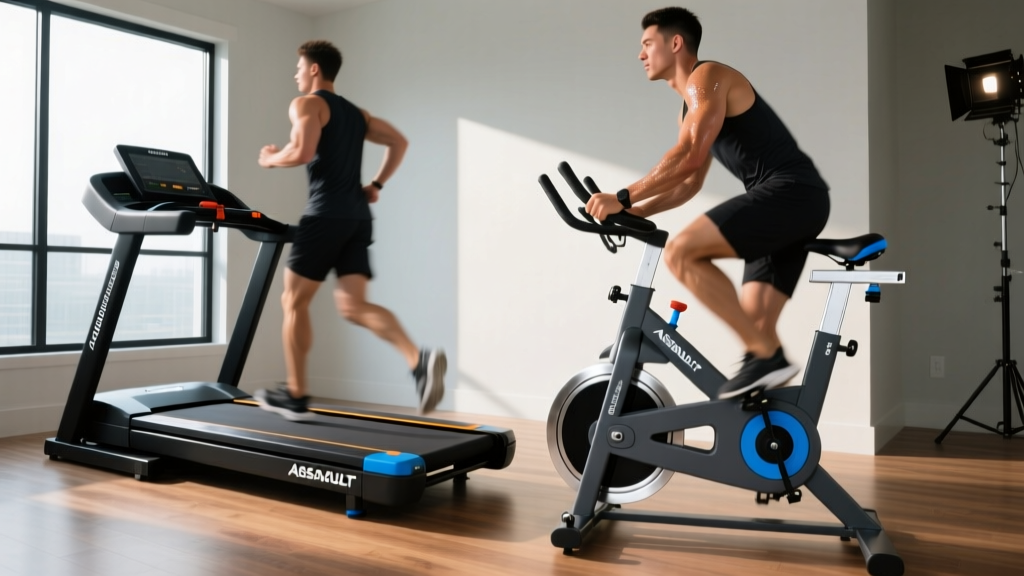
Confidence Fitness Treadmill vs Air Bike: Assault Guide

Cardiologist Treadmill Test Rehab: 2026 Portable Cardio Gear

iFIT Compatible Treadmills: Buying Mistakes & Fixes
Rowing Buying Guide & Technique: Calibrate NordicTrack Treadmill
Home Stair Climber Guide: How to Sell a Used Treadmill to Fund It
