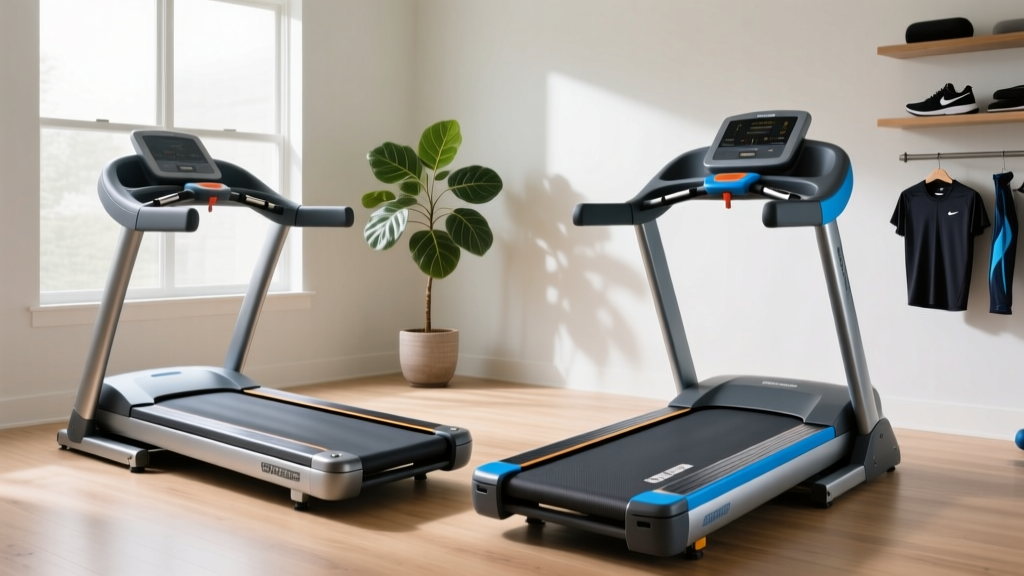
Sprinting 100m on Treadmill: Curved vs Motorized Mistakes
Master the 100m on treadmill sprints. We troubleshoot common form mistakes and compare curved manual vs motorized treadmill mechanics for max speed.

Executing a 100m on treadmill is a highly specific, high-velocity drill utilized by off-season track athletes, field sport competitors, and speed-focused fitness enthusiasts. Unlike a steady-state jog, a 100-meter sprint demands explosive acceleration, precise transition mechanics, and max-velocity maintenance. However, the biomechanical execution of this drill changes drastically depending on whether you are using a curved manual treadmill or a traditional motorized unit. According to the National Strength and Conditioning Association (NSCA), sprint mechanics require optimal ground reaction forces and precise strike angles—variables that are easily compromised by the wrong equipment or poor treadmill-specific technique. In this 2026 troubleshooting guide, we break down the most common mistakes runners make when attempting a 100m sprint on both curved and motorized treadmills, providing actionable fixes, mechanical insights, and safety protocols.
The Biomechanics of the 100m Treadmill Sprint
Before troubleshooting, it is critical to understand the three phases of a 100m sprint and how a treadmill belt interacts with them:
- Acceleration Phase (0-30m): Characterized by a steep forward lean, powerful piston-like leg drives, and a rear-foot to mid-foot strike pattern.
- Transition Phase (30-60m): The torso gradually rises to an upright posture, and stride length begins to maximize.
- Max Velocity Phase (60-100m): The runner is fully upright, focusing on rapid ground contact times, high knee drive, and front-side mechanics.
When you attempt this sequence on a treadmill, the lack of air resistance and the moving ( or self-propelled) belt alter your neuromuscular firing patterns. Failing to adapt to the specific machine type leads to the errors detailed below.
Curved Manual Treadmills: Mistakes & Troubleshooting
Curved manual treadmills (such as the TrueForm Runner, Woodway Curve, and AssaultRunner Pro) are currently the gold standard for indoor sprint work. Because you are the motor, there is no artificial speed cap. However, as of 2026, these units typically range from $3,500 to $7,500, and their unique slat-belt geometry introduces specific troubleshooting challenges.
Mistake 1: Apex Positioning Errors During Max Velocity
The most frequent error on a curved treadmill is failing to shift your position on the belt as you transition from acceleration to max velocity. The steep back-curve is designed for acceleration. If you remain on the steep incline during the 60-100m phase, you are effectively running a hill sprint, not a flat 100m dash. This ruins your upright posture and artificially shortens your stride.
🛠️ Troubleshooting Fix: By meter 25, consciously drive your hips forward and shift your foot strike to the flatter 'apex' of the curve. Your visual focal point should remain dead ahead, not down at the console. If the treadmill feels like it is 'fighting' you in the final 40 meters, you are likely stuck on the front or back slope rather than riding the flat center.Mistake 2: Belt Slippage and Slat Dehydration
When pushing 18+ mph on a curved treadmill, the friction between the polyurethane slats and the track guides is immense. A common mechanical failure is 'belt stutter' or micro-slippage during the max velocity phase, which can cause a runner to clip their toe and fall.
- The Cause: Slat belts dehydrate and accumulate micro-dust over time, reducing the coefficient of friction on the guide rails.
- The Fix: Every 90 days, clean the track guides with isopropyl alcohol and apply a 100% silicone-based treadmill lubricant. Never use petroleum-based products, which will degrade the vulcanized rubber slats.
Motorized Treadmills: Mistakes & Troubleshooting
Motorized treadmills (like the NordicTrack 2450 or Peloton Tread+) dictate the pace for you. Most high-end home models cap out between 12 mph and 15 mph (a 4:00 to 5:00 per mile pace). While this is a sub-maximal 'flying sprint' for elite athletes, it represents a true 100m max-effort sprint for the general population.
Mistake 1: The 'Motor Lag' Stutter
When a 200lb runner strikes the deck at 12 mph, the impact force can exceed 3 to 4 times their body weight. On motorized treadmills with underpowered DC motors (under 3.0 Continuous Horsepower), this impact causes the motor RPMs to momentarily drop. The belt 'lags' or stutters for a fraction of a second before the motor catches up. This micro-deceleration forces the runner to over-stride to maintain balance, heavily straining the hamstring.
⚠️ Expert Insight: If you are doing serious 100m speed work on a motorized unit, you must verify the Continuous Horsepower (CHP), not the 'Peak Horsepower' marketed on the box. For sprint work, a minimum of 4.0 CHP or a commercial-grade AC motor (found in $8,000+ units like the Life Fitness Integrity Series) is required to maintain belt velocity under heavy impact.Mistake 2: Anticipating the Belt and Cowling Strikes
Because the motorized belt pulls your feet backward, runners often 'jump the gun' during the acceleration phase, reaching forward with their lead leg. This over-striding not only acts as a braking mechanism but drastically increases the risk of your lead foot catching the front plastic cowling (motor cover), resulting in a catastrophic fall.
- The Fix: Start your 100m sprint at least 18 inches behind your normal standing position on the belt. Focus on driving your knees up and down (piston action) rather than reaching forward. The American Council on Exercise (ACE) emphasizes that maintaining a high stride frequency over a long stride length is the safest way to manage high-velocity treadmill running.
Head-to-Head: Curved vs. Motorized for 100m Speed Work
How do the two machine types actually compare when the stopwatch starts? Below is a structural comparison based on current 2026 commercial and home fitness equipment standards.
| Metric | Curved Manual (e.g., TrueForm) | Motorized (e.g., 4.0 CHP Home Unit) |
|---|---|---|
| Top Speed Limit | None (User-dependent, 20+ mph) | Hardware capped (Usually 12-15 mph) |
| Acceleration Mechanics | Natural; user controls incline via position | Artificial; user must wait for motor ramp-up |
| Motor Lag Risk | Zero (No motor) | High on units under 4.0 CHP |
| Deceleration Zone | Instant; user simply slows leg turnover | Requires 15-20m of active braking |
| Avg. Price Range (2026) | $3,500 - $7,500 | $2,000 - $4,500 (for sprint-capable) |
Safety Protocols and the Deceleration Zone
A 100m sprint does not end at the 100-meter mark; it ends when the runner has safely returned to a walking pace. The USA Track & Field (USATF) coaching guidelines dictate that athletes need a 'run-out' or deceleration zone of at least 15 to 20 meters after crossing the finish line.
The Motorized Deceleration Problem
On a motorized treadmill, you cannot simply stop running at 12 mph. If you attempt to jump off the belt or grab the handrails at max velocity, you risk severe joint shearing and friction burns. The Protocol: Program your treadmill to automatically drop speed by 1 mph every 10 seconds after your 100m rep concludes. Never use the emergency stop clip for planned deceleration; reserve the magnetic safety key strictly for catastrophic bail-outs.
The Curved Treadmill Bail-Out
Because curved treadmills stop when you stop, they are inherently safer for max-velocity failures. If you feel a hamstring tweak at meter 70, you simply cease driving the belt and grab the side rails. However, ensure your treadmill is placed with at least 3 feet of clearance behind it. If you lose your balance and fall backward off the rear of a curved treadmill, you need a clear landing zone free of dumbbells, kettlebells, or hard flooring edges.
Final Verdict: Which is Right for Your 100m Drill?
If your goal is true max-velocity biomechanics, unrestricted speed, and immediate deceleration, the curved manual treadmill is the undisputed champion for the 100m sprint. It forces proper front-side mechanics and eliminates the danger of motor lag. However, if you are utilizing the 100m distance for sub-maximal tempo runs, flying 30s, or controlled acceleration drills, a high-quality motorized treadmill with a 4.0+ CHP motor remains a highly effective, cost-efficient tool—provided you respect the spatial limitations and ramp-up mechanics of the machine.
More gear to consider
All reviews
Home Stair Climbers & CPT Code for Nuclear Treadmill Stress Test
Air Bike vs Assault Bike: Space Layouts & Half Moon Treadmill Fits
Hydro Treadmill Motor Sizing: Horsepower Mistakes & Fixes

Does Holding On to the Treadmill Increase Noise? Quiet Cardio Guide

Quiet High Intensity Interval Training Treadmill & Noise Guide 2026