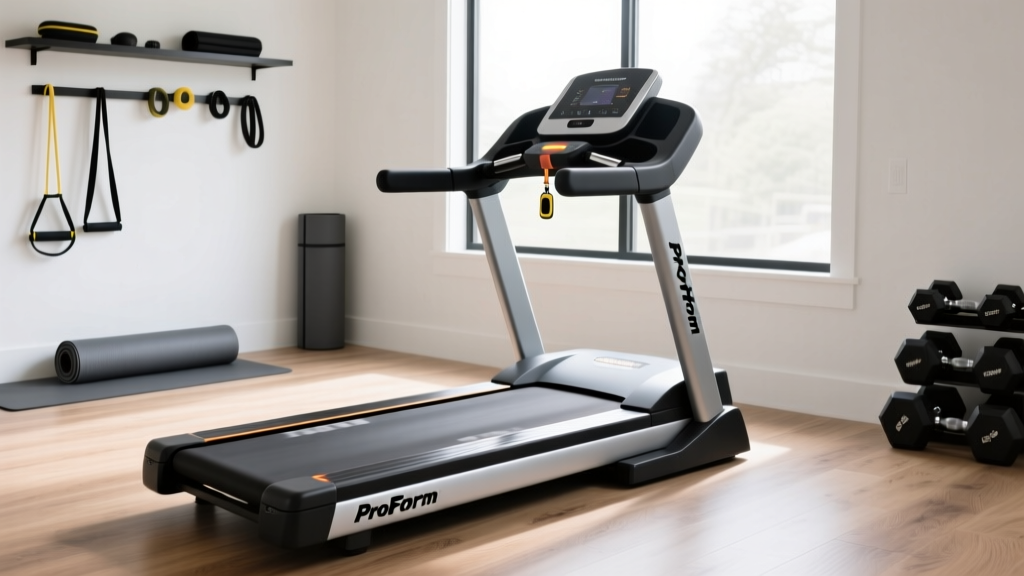
Treadmill Horsepower Guide: ProForm Premier 1300 Treadmill Explained
Learn how to choose the right treadmill motor size. We break down CHP, weight limits, and heat using the ProForm Premier 1300 treadmill as a real-world guide.

Why Treadmill Motor Size Dictates Your Machine's Lifespan
When shopping for home cardio equipment, the console features and folding mechanisms often steal the spotlight. However, the true heartbeat of any running machine is its motor. A weak motor will overheat, stutter during sprints, and ultimately burn out, turning a $800 investment into an oversized clothes rack. In the current 2026 fitness market, understanding motor specifications is non-negotiable for beginners and veterans alike.
To make this technical topic accessible, we are going to use a highly popular, real-world benchmark: the ProForm Premier 1300 treadmill. By dissecting the motor architecture of this specific model, you will learn a universal framework for evaluating any treadmill motor on the market.
Core Concept: HP vs. CHP
Peak Horsepower (HP): The absolute maximum power the motor can generate for a few seconds before failing. This is largely a marketing gimmick.
Continuous Horsepower (CHP): The power the motor can sustain indefinitely during a normal workout without overheating. Always base your purchasing decisions on CHP.
Step 1: Decoding the Spec Sheet (The ProForm Premier 1300 Case Study)
The ProForm Premier 1300 treadmill is equipped with a 2.75 CHP Mach Z commercial motor. Let us break down exactly what this terminology means for your daily workouts and how it applies to motor sizing broadly.
What Does '2.75 CHP' Actually Mean?
A 2.75 CHP rating indicates that the motor can continuously deliver 2.75 horsepower to the drive belt while maintaining a consistent speed, even under the load of a user's body weight. According to Consumer Reports' treadmill buying guidelines, a motor in the 2.5 to 3.0 CHP range is the 'sweet spot' for residential joggers and light runners. It provides enough torque to handle incline changes without bogging down.
The 'Mach Z' Designation and Flywheel Mass
ProForm uses the 'Mach Z' label to denote a motor with a larger internal flywheel and upgraded cooling components. A heavier flywheel stores more kinetic energy, which smooths out the belt's motion and reduces the electrical strain on the motor's pulse width modulation (PWM) controller. When evaluating any treadmill, look for mentions of 'commercial-grade' or 'heavy-duty' flywheels, as these directly correlate to motor longevity.
Step 2: Matching Horsepower to Your Workout Intensity
Not every user needs a massive 4.0 CHP motor. Overspending on horsepower you will never use is a common beginner mistake. Conversely, underestimating your needs will lead to premature motor failure. Use the matrix below to find your baseline requirement.
| Primary Activity | Minimum CHP Required | How the Premier 1300 (2.75 CHP) Compares |
|---|---|---|
| Walking (Under 4.0 mph) | 2.0 CHP | Overkill; will run exceptionally cool and quiet. |
| Jogging (4.0 - 6.0 mph) | 2.5 CHP | Ideal match; handles sustained loads effortlessly. |
| Running (6.0 - 8.5 mph) | 3.0 CHP | Acceptable for lighter users, but may run warm during long sessions. |
| Sprinting / HIIT (9.0+ mph) | 3.5+ CHP | Not recommended; rapid acceleration strains the 2.75 CHP motor. |
The ProForm Premier 1300 features a top speed of 12 mph. While the motor can reach this speed, sustaining 12 mph on a 2.75 CHP motor generates significant heat. As noted by Runner's World equipment experts, if your primary goal is high-speed interval training, you should look for machines with a minimum of 3.25 CHP to handle the rapid torque demands.
Step 3: The Hidden Variables (Weight, Friction, and Heat)
Motor size does not exist in a vacuum. The actual strain placed on the ProForm Premier 1300's 2.75 CHP motor is heavily dictated by two external factors: user weight and belt friction.
The User Weight Multiplier
Every time your foot strikes the 20-inch by 55-inch belt of the Premier 1300, the motor must overcome your downward force to keep the belt moving. If you weigh over 200 pounds, you effectively increase the continuous load on the motor by 15% to 25%. Rule of Thumb: If you weigh over 200 lbs, add 0.5 CHP to your minimum requirement. Therefore, a 220 lb runner should treat the 2.75 CHP motor as a 'jogging' motor, not a 'running' motor.
Belt Friction and Amperage Draw
A dry, unlubricated treadmill belt creates massive friction against the deck. This friction forces the motor to draw higher amperage to maintain speed. Under severe friction, a 2.75 CHP motor that normally draws 8 amps might spike to 14 amps. This excess current generates intense heat, which degrades the copper windings and eventually melts the solder joints on the motor control board.
- The 3-Inch Lift Test: With the machine off, reach under the center of the belt and pull up. You should be able to lift it exactly 2 to 3 inches off the deck. If it is tighter, the friction is too high; if looser, the belt will slip.
- Lubrication Schedule: Apply 100% silicone treadmill lubricant every 150 miles or every 3 months. Never use WD-40 or petroleum-based products, which will destroy the belt's PVC backing.
Step 4: Evaluating Motor Cooling and Warranties
Even a perfectly sized motor will fail if it cannot shed heat. The ProForm Premier 1300 utilizes an internal fan attached to the motor shaft. As the motor spins, the fan pulls ambient air through the casing.
Critical Placement Warning: Never place your treadmill directly on thick, high-pile carpet. The carpet fibers will choke the motor's air intake, leading to thermal shutdown. Always use a high-density PVC treadmill mat to ensure proper clearance and dust prevention.Reading Between the Lines of Motor Warranties
Manufacturers use warranties to signal their confidence in a motor's lifespan. Mid-tier models like the Premier 1300 typically carry a 1-year to 5-year motor warranty, while the frame is guaranteed for life. In contrast, premium models with 3.5+ CHP motors often feature lifetime motor warranties. When reviewing spec sheets, a lifetime motor warranty is a strong indicator of a heavy-duty, oversized motor designed to run well below its maximum thermal threshold.
Frequently Asked Questions
Can I upgrade the motor on my ProForm Premier 1300 later?
No. Treadmill motors are matched to specific PWM control boards and drive belts. Attempting to install a 3.5 CHP motor into a chassis wired for a 2.75 CHP motor will instantly blow the machine's internal fuses and void all warranties.
Is a DC motor better than an AC motor for home use?
Yes, for residential machines like the ProForm Premier 1300. DC (Direct Current) motors are quieter, lighter, and allow for precise speed adjustments at low walking paces. AC (Alternating Current) motors are found in commercial gym treadmills; they are incredibly durable but loud and require a much higher starting voltage.
How do I know if my treadmill motor is failing?
Early signs of motor failure include a distinct 'burning plastic' odor (indicating overheating windings), sudden speed drops when your foot strikes the belt (indicating torque loss), and a high-pitched whining noise from the motor hood. If you experience these, stop using the machine immediately and check the belt tension before calling a technician.
By understanding the relationship between continuous horsepower, user weight, and mechanical friction, you can accurately assess whether a machine like the ProForm Premier 1300 treadmill fits your specific biomechanical needs, ensuring years of reliable, injury-free cardio.
More gear to consider
All reviews
Sunny Treadmill Reviews vs. Rowers: Head-to-Head Cardio Guide

Elliptical vs Treadmill Upkeep: Technogym Curved Treadmill Care
Care for Stationary Bikes & Light Weight Treadmill for Home

Is Walking on a Treadmill the Same as Walking Outside? (Noise Guide)

Under Desk Treadmill vs Walking Outside: Which Burns More Calories?
