ProForm CC500 Treadmill vs Ellipticals: Home Space Layout Guide
Compare the ProForm CC500 treadmill and compact ellipticals for home space optimization. Expert layout tips, clearance rules, and footprint analysis.

The Spatial Dilemma: Treadmill vs. Elliptical Footprints
As urban living spaces shrink and remote work solidifies its place in 2026, the home gym has evolved from a spare bedroom luxury to a highly optimized micro-environment. When designing a layout for cardiovascular training, the two most popular contenders—the treadmill and the elliptical—present vastly different spatial challenges. It is not just about the raw square footage the machine occupies; it is about dynamic clearance, visual weight, acoustic footprints, and structural floor loading.
According to the Mayo Clinic's guidelines on home gym setups, safety clearances and ergonomic flow are just as critical as the equipment's physical dimensions. A machine that technically fits in a corner may render the room unusable if it violates traffic flow or requires excessive safety buffers.
ASTM Safety Clearance Baselines
Before comparing specific models, understand the American Society for Testing and Materials (ASTM) mandates for home cardio equipment:
- Treadmills: Require a minimum of 20 inches of lateral clearance on both sides and up to 78 inches of rear clearance to prevent severe injury in the event of a fall.
- Ellipticals: Generally require 15 inches of lateral clearance and 20 inches of rear clearance, as the user remains tethered to the pedal path.
Evaluating the ProForm CC500 Treadmill for Tight Layouts
The ProForm CC500 treadmill is frequently brought into the space-optimization debate because it represents the ultra-compact, folding treadmill category. Priced typically between $499 and $599, it targets apartment dwellers and those converting small dens into dual-purpose offices.
Dimensions and the 'Visual Weight' Factor
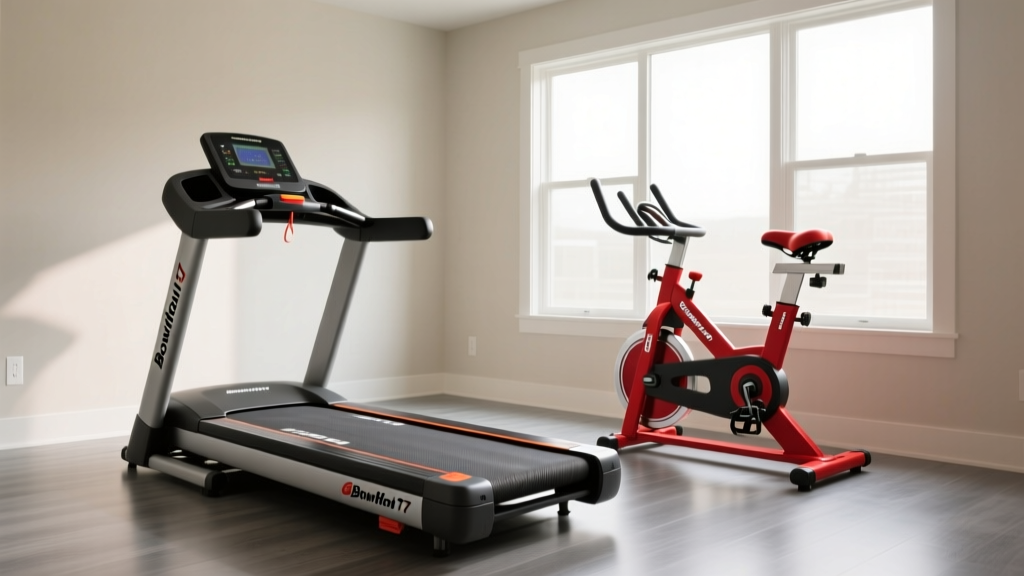
When deployed, the ProForm CC500 treadmill measures approximately 63 inches long by 28 inches wide, with a deck height of about 8 inches. The running belt is a compact 18 x 50 inches, which restricts high-speed sprinting but perfectly accommodates walking, jogging, and incline training. However, its true spatial advantage lies in its hydraulic folding mechanism.
When folded vertically, the footprint shrinks to roughly 63 x 28 inches, but the visual profile changes dramatically. A folded treadmill acts as a vertical monolith. In a small room, a 58-inch tall folded machine can block window sightlines and disrupt natural light, increasing the 'visual weight' of the room. Interior design principles dictate that vertical obstacles in rooms under 150 square feet can make the space feel claustrophobic, even if the physical floor space is technically free.
Compact Ellipticals: The Vertical Space Trade-Off
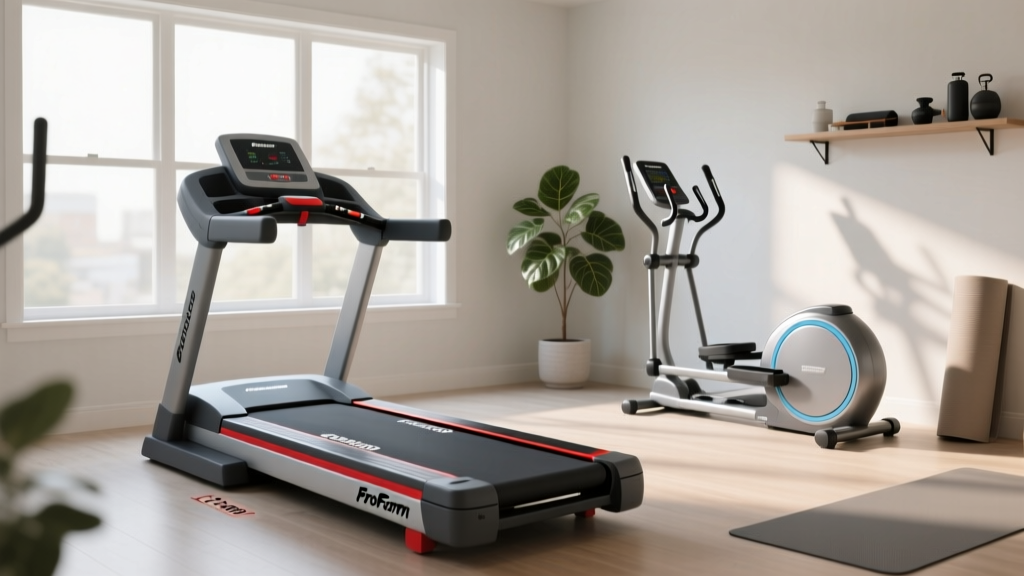
Ellipticals approach space optimization from a different angle. Unlike the ProForm CC500 treadmill, most standard ellipticals do not fold. However, their static footprints are often smaller, and they eliminate the massive rear-clearance safety zone required by treadmills.
Consider a compact elliptical like the Horizon EX-59 or the Bowflex Max M9. The Bowflex Max series, for instance, boasts a footprint of just 49 x 30 inches. Because the user's feet never leave the pedals, the rear clearance requirement drops to a mere 20 inches. This allows you to push an elliptical much closer to a wall or a piece of furniture, reclaiming up to 40 square feet of usable floor space compared to a treadmill layout.
The Ceiling Height Constraint
The hidden spatial cost of an elliptical is verticality. While the ProForm CC500 treadmill adds only 8 inches of deck height to your stature, an elliptical's pedal clearance can elevate the user by 12 to 18 inches. If you are designing a layout in a basement with a 7-foot (84-inch) ceiling, a 6-foot-tall user on an elliptical will have their head within inches of the joists, creating a severe psychological and physical hazard. Treadmills are vastly superior for low-ceiling environments.
Footprint & Clearance Matrix: 2026 Comparison
| Machine Model | Active Footprint (L x W) | Total Safety Zone Required | Vertical User Addition | Foldable? |
|---|---|---|---|---|
| ProForm CC500 Treadmill | 63' x 28' | ~105 sq ft (inc. 78' rear) | +8 inches | Yes (Vertical) |
| Horizon EX-59 Elliptical | 66' x 25' | ~45 sq ft (inc. 20' rear) | +14 inches | No |
| Bowflex Max M9 | 49' x 30' | ~35 sq ft (inc. 20' rear) | +16 inches | No |
Acoustic and Vibration Footprints
Space optimization is not purely visual; it is also acoustic. In multi-family dwellings or shared homes, the 'noise footprint' dictates where a machine can be placed. The American Council on Exercise (ACE) frequently highlights the importance of considering environmental impact when integrating fitness into shared living spaces.
The ProForm CC500 treadmill utilizes a 2.0 CHP motor and a standard belt-deck friction system. Every footstrike generates structure-borne impact noise. Even with a 3/8-inch vulcanized rubber mat, low-frequency vibrations will travel through floor joists, making upper-floor placement in apartments highly problematic. Conversely, ellipticals utilize magnetic resistance and smooth rotational bearings. They generate almost zero structure-borne impact, producing only a low-decibel, air-borne magnetic hum. This allows ellipticals to be placed on upper levels or directly adjacent to shared walls without triggering noise complaints.
Strategic Layout Frameworks for Small Rooms
When integrating either the ProForm CC500 treadmill or a compact elliptical into a room under 200 square feet, apply these spatial design frameworks:
1. The Diagonal Sightline Rule
Never place a tall, non-folding elliptical directly across from the room's entry door. It creates an immediate visual barrier that makes the room feel half its actual size. Instead, place the elliptical in the far corner, angled at 45 degrees toward the center of the room. This draws the eye along the longest dimension of the space.
2. The Window-Anchor Strategy (Treadmills)
If utilizing the ProForm CC500 treadmill, position it facing a window or a primary light source. When folded vertically, the machine will act as a subtle room divider rather than a dark wall. Furthermore, facing a window reduces the psychological confinement of indoor running, a crucial factor for mental endurance during long cardio sessions.
3. Dual-Purpose Zone Integration
Because the ProForm CC500 treadmill folds, it pairs exceptionally well with Murphy beds or fold-down desks. However, you must account for the 'swing radius.' The hydraulic lift requires you to stand to the side and pull the deck down. Ensure at least 30 inches of lateral clearance on the hinge side of the treadmill to safely deploy the machine without striking adjacent furniture.
Expert Warning: Never rely on the hydraulic piston of a folding treadmill to hold the deck up indefinitely without the safety latch engaged. In small, multi-use rooms where children or pets may be present, an unsecured folded treadmill deck is a severe crushing hazard. Always engage the manual locking pin when the ProForm CC500 is in storage mode.
Final Verdict: Which Wins the Space War?
The decision between the ProForm CC500 treadmill and a compact elliptical ultimately hinges on your specific architectural constraints. If your primary limitations are low ceilings and a need for temporary floor reclamation (e.g., converting a living room to a gym for one hour a day), the folding capability of the ProForm CC500 treadmill makes it the undisputed champion. It allows you to hide the equipment entirely when not in use.
However, if your space limitation is defined by narrow room widths, upper-floor noise restrictions, and a lack of safe rear-fall clearance, a compact elliptical like the Bowflex Max series is vastly superior. It requires less than half the total safety square footage and eliminates the structural vibration issues inherent to treadmills. By mapping your room's exact dimensions against the ASTM safety matrices provided above, you can confidently select the machine that optimizes both your workout and your living space.
More gear to consider
All reviews
Stair Climber Guide: What Speed to Walk on Treadmill to Lose Weight

What Is the Curved Treadmill Called? Compact Portable Cardio Picks

2026 Performance Treadmill Noise Comparison: Quietest Models

Treadmill Keeps Shocking Me? Air Bike vs Assault Bike Value Guide
How to Unfold a NordicTrack Treadmill & Rower Guide