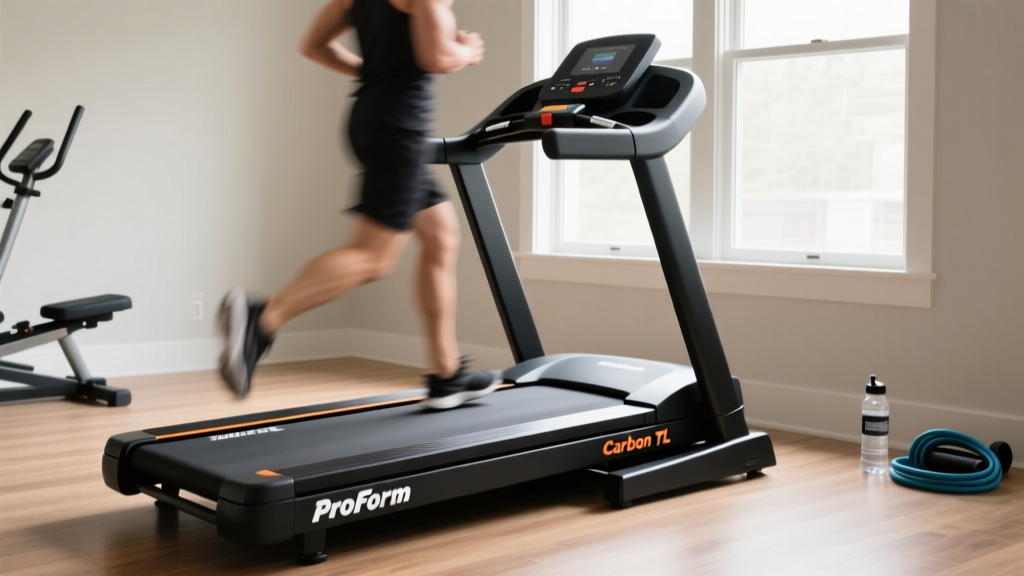
ProForm Carbon TL Treadmill Review: Belt Maintenance Trends
Analyzing the ProForm Carbon TL treadmill's belt maintenance needs against 2026 market trends. Learn exact lubrication protocols and long-term cost data.

The 2026 Shift in Budget Treadmill Belt Technology
As we navigate the 2026 home fitness equipment market, a distinct bifurcation has emerged in treadmill manufacturing. Premium models (priced above $1,200) are increasingly adopting wax-impregnated, zero-maintenance belts. However, the high-volume budget and mid-tier segments—specifically the $400 to $700 range—still rely on traditional PVC belts that demand rigorous user maintenance. Understanding this divide is critical for consumers evaluating long-term ownership costs. In this analytical ProForm Carbon TL treadmill review, we pivot away from basic console features to focus entirely on the machine's mechanical longevity, specifically its belt maintenance requirements, friction management, and how it compares to broader industry trends.
Quick Specs: ProForm Carbon TL Belt Architecture
- Running Surface: 55 inches (L) x 18 inches (W)
- Belt Thickness: 1.6mm (Standard 2-ply PVC)
- Deck Material: Phenolic-coated MDF (Medium-Density Fiberboard)
- Motor: 1.5 Continuous Horsepower (CHP)
- Required Lubricant: 100% Liquid Silicone (Non-aerosol, non-petroleum)
Market Comparison: Manual vs. Pre-Lubricated Systems
According to Consumer Reports' 2026 Treadmill Buying Guide, neglected belt maintenance is the number one cause of premature motor and control board failure in budget treadmills. To contextualize the Carbon TL's position in the market, we analyzed the 5-year maintenance costs and friction profiles of three top-selling treadmills in the entry-level category.
| Model | Belt Technology | Lube Interval | 5-Yr Maint. Cost | Motor Strain Risk |
|---|---|---|---|---|
| ProForm Carbon TL | Standard PVC / Phenolic Deck | Every 130 miles / 3 months | ~$45 (Silicone) | Moderate (if neglected) |
| Horizon T101 | Pre-waxed Impregnated | N/A (Lifetime) | $0 | Low |
| Sunny Health SF-T7515 | Standard PVC / Wood Deck | Every 90 miles / 2 months | ~$65 (Silicone) | High |
The Carbon TL strikes a middle ground. While it does not feature the zero-maintenance wax-impregnated belt of the slightly pricier Horizon T101, its phenolic-coated deck is significantly more durable and friction-resistant than the raw MDF decks found in ultra-budget alternatives like the Sunny Health SF-T7515. However, this durability is entirely contingent upon strict adherence to a manual lubrication schedule.
Precision Lubrication Protocol for the Carbon TL
The most common error owners make is over-lubricating or using the wrong chemical compound. Petroleum-based products (like WD-40) will instantly dissolve the phenolic coating on the Carbon TL’s deck, causing catastrophic delamination. Based on Treadmill Doctor's Lubrication Guidelines, you must use only 100% liquid silicone. Here is the exact, step-by-step protocol to maintain the Carbon TL’s optimal friction coefficient:
- Power Down and Unplug: Always disconnect the Carbon TL from the wall outlet to prevent accidental startup and protect the lower control board from power surges during maintenance.
- Verify Belt Tension: Before lubricating, check the rear roller bolts. You should be able to lift the center of the belt exactly 2 to 3 inches off the deck. If it lifts higher than 3 inches, tighten the rear bolts by a quarter-turn; if less than 2 inches, loosen them.
- Apply the Silicone: Lift the left edge of the belt and squeeze exactly 0.5 ounces of 100% liquid silicone in a zig-zag pattern across the width of the deck. Repeat on the right side, totaling 1.0 ounce per application.
- Distribute the Lubricant: Plug the machine in, start it at 2.0 MPH, and walk on the belt for 3 minutes. This allows the silicone to distribute evenly across the phenolic deck without generating excess heat.
Warning: Never use aerosol silicone sprays. The propellants in aerosol cans contain volatile organic compounds (VOCs) that degrade the PVC belt backing and can leave a residue that actually increases friction over time.
Amp Draw Diagnostics: Preventing Motor & Board Failure
How do you know if your Carbon TL actually needs lubrication before the 3-month mark? The most professional method is measuring the motor's amp draw. The ProForm Carbon TL utilizes a 1.5 CHP motor. Under normal, well-lubricated conditions with a 175 lb user, the motor should draw between 4 to 6 amps at a 3.0 MPH walking pace.
Identifying Failure Modes
As the silicone breaks down, friction between the PVC belt and the MDF deck increases exponentially. This forces the 1.5 CHP motor to work harder, driving the amp draw up to 10 to 14 amps. If the amp draw consistently exceeds 15 amps, the motor's internal thermal breaker will trip, or worse, the excess current will fry the lower control board (Part # ProForm 364173 or equivalent). Replacing a blown control board costs between $120 and $160, entirely negating the value proposition of a budget treadmill.
The Amp Draw Testing Framework
To test this at home, purchase a standard plug-in watt/amp meter (available for ~$15 online). Plug the meter into the wall, and the treadmill into the meter. Have a user walk at 3.0 MPH for two minutes. Record the peak amperage:
- 4A - 6A: Optimal lubrication. No action needed.
- 7A - 9A: Friction is building. Schedule lubrication within the next 14 days.
- 10A - 14A: Critical friction. Lubricate immediately before the next extended use.
- 15A+: Danger zone. Do not use. Lubricate and test again; if amps remain high, the belt/deck may be permanently damaged and require replacement.
Edge Cases: Climate and Humidity Impacts
Market analysis reveals that geographic location heavily influences maintenance intervals. According to WIRED's 2026 Treadmill Market Analysis, environmental factors are rarely addressed in standard user manuals but drastically alter belt physics. If your Carbon TL is located in a high-humidity environment (e.g., a basement in the American Southeast or a garage in a coastal region), the MDF deck can absorb ambient moisture. This causes the deck to swell slightly, increasing the surface area contact with the belt and artificially inflating friction. In these environments, we recommend reducing the lubrication interval to every 90 miles, regardless of the time elapsed.
Conversely, in arid, climate-controlled environments, the primary threat is not friction but static electricity buildup. A dry PVC belt rubbing against a phenolic deck generates significant static charge, which can discharge into the Carbon TL’s console, causing the LED display to flicker or the heart-rate monitor to return erratic data. Applying the precise 1 oz of silicone not only reduces mechanical friction but also acts as an antistatic barrier, protecting the console's sensitive PCBs.
Final Verdict on Long-Term Ownership
The ProForm Carbon TL remains a highly competitive entry in the 2026 budget cardio market, offering a reliable 1.5 CHP motor and a functional 0-10% incline for under $600. However, its affordability is subsidized by transferring the burden of mechanical upkeep to the user. If you are willing to commit 15 minutes every three months to perform the precise liquid silicone lubrication protocol outlined above, and if you monitor the amp draw to protect the control board, the Carbon TL’s belt and deck assembly will easily exceed its 3-year warranty window. If you prefer a 'plug-and-play' appliance with zero mechanical intervention, you will need to increase your budget by at least $300 to access the pre-waxed belt technologies found in higher-tier market segments.
More gear to consider
All reviews
Setup Guide: Fat Burning Interval Training Treadmill vs. Walking Pad

NordicTrack T Series Treadmill Review vs Under-Desk Office Budgets

How to Lubricate a Horizon Treadmill: Budget & Value Guide

Folding Treadmill Review: Space Safety and the Corey Treadmill Death
Stationary Bike vs Outdoor Treadmills: Maintenance & Longevity Guide
