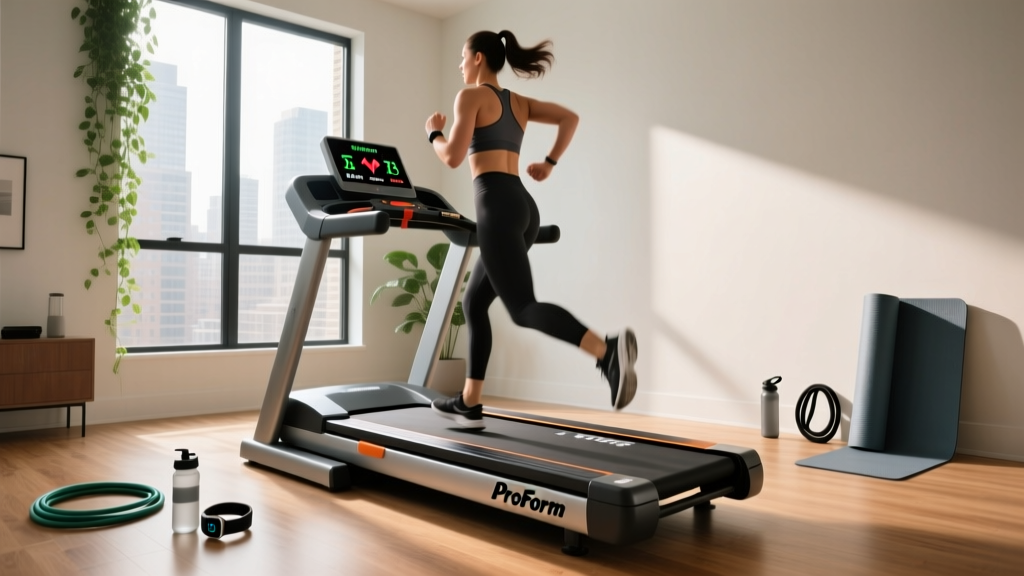
ProForm 675E Treadmill Feature Comparison & Troubleshooting Mistakes
Evaluate the ProForm 675E treadmill against 2026 standards. Discover common buying mistakes, feature comparisons, and expert troubleshooting steps.

The ProForm 675E Treadmill in 2026: A Feature Baseline
When navigating the secondary fitness equipment market or evaluating legacy models against modern releases, the ProForm 675E treadmill remains a frequent point of reference. Originally positioned as a budget-friendly, entry-level running machine, the 675E features a 2.5 Continuous Horsepower (CHP) Mach Z motor, a 20-inch by 55-inch running belt, and a 300-pound user weight capacity. While it served as a reliable walking and light-jogging station for years, comparing its feature set against 2026 entry-level standards reveals critical insights into how treadmill technology has evolved—and where buyers frequently make costly mistakes.
Understanding the exact specifications and common failure modes of the ProForm 675E is essential. Whether you are maintaining an existing unit, considering a secondhand purchase, or using it as a baseline to avoid feature-related buying mistakes with newer models, this guide provides the deep technical context and troubleshooting frameworks required to make informed decisions.
Common Buying Mistakes: Comparing the 675E to Modern Standards
One of the most pervasive mistakes in treadmill purchasing is evaluating machines based on peak marketing claims rather than continuous duty metrics and biomechanical requirements. According to the Consumer Reports Treadmill Buying Guide, belt dimensions and motor thermal thresholds are the primary predictors of long-term satisfaction and machine longevity.
| Feature Metric | ProForm 675E (Legacy Baseline) | 2026 Entry-Level Standard | The Buying Mistake to Avoid |
|---|---|---|---|
| Motor Output | 2.5 CHP | 3.0 CHP (Minimum for runners) | Confusing 'Peak HP' with 'Continuous HP'. A 2.5 CHP motor will overheat and trigger thermal shutoffs during sustained 8+ MPH runs for users over 200 lbs. |
| Belt Dimensions | 20' x 55' | 22' x 60' | Ignoring stride length. A 55-inch belt forces runners over 5'10' to artificially shorten their stride, altering biomechanics and increasing joint impact. |
| Deck Cushioning | Basic ProShox elastomers | Multi-zone variable durometer | Assuming all shock absorption is equal. Basic elastomers compress permanently after 1,500 miles, transferring shock directly to the knees. |
| Console Tech | Basic LCD, Aux/Bluetooth audio | HD Touchscreens with auto-adjust | Overpaying for outdated proprietary connectivity that no longer supports modern third-party fitness apps. |
Troubleshooting the ProForm 675E: Known Failure Modes
If you currently own or are refurbishing a ProForm 675E, you must be prepared for specific mechanical and electronic failure modes inherent to its generation of iFIT-compatible hardware. Below is a technical troubleshooting guide for the most common issues.
1. Diagnosing Console Error Codes (E1, E2, E3)
The 675E console relies on a reed switch (speed sensor) and an optical incline sensor. When these fail, the motor control board halts operation to prevent runaway speeds.
- Error 1 (E1 - Speed Sensor): The console is not receiving RPM data from the front roller. Fix: Unplug the machine, remove the motor hood (using a Phillips head screwdriver), and locate the magnetic reed switch on the left side of the front roller. Ensure the gap between the magnet and the sensor is exactly 1/8 inch (3mm). Clean the sensor with isopropyl alcohol.
- Error 2 / Error 3 (Incline Sensor / Board Failure): The machine cannot calibrate the incline motor. Fix: Enter calibration mode by pressing and holding the 'Speed Up' and 'Incline Up' buttons simultaneously while inserting the safety key. If the incline motor does not move during the self-test, the incline motor or the main motor control board (MCB) has failed.
2. Walk Belt Slipping and Friction Burns
A slipping belt underfoot is not just annoying; it is a severe safety hazard. On the 675E, this is almost always caused by a lack of lubrication increasing the coefficient of friction, which in turn overworks the drive motor and stretches the belt.
Expert Warning: Never use WD-40 or petroleum-based lubricants on your treadmill belt. These will destroy the PVC backing of the belt and ruin the MDF deck. According to Treadmill Doctor, you must use only 100% silicone-based treadmill lubricant, applying exactly 1 ounce under the center of the belt every 150 miles or 3 months.3. Step-by-Step Belt Tension and Alignment Fix
If the belt slips but is properly lubricated, it requires tensioning via the rear roller adjustment bolts.
- Locate the two idler roller adjustment bolts at the very rear of the treadmill frame (typically requiring an 8mm Allen wrench).
- Turn both the left and right bolts clockwise by exactly one-quarter (1/4) turn. Never adjust one side more than the other, or the belt will track off-center and shred against the side rails.
- Test the belt at 3 MPH. If slipping persists, repeat the 1/4 turn adjustment.
- The Clearance Test: With the machine off, reach under the center of the walking belt and lift. You should achieve exactly 2 to 3 inches of lift. More than 3 inches means it is too loose; less than 2 inches means you are over-tensioning, which will destroy the front roller bearings and strain the drive motor.
When to Repair vs. Replace: A Cost-Benefit Framework
Because the ProForm 675E is a discontinued model, sourcing parts requires navigating the secondary market or utilizing direct OEM suppliers like ICON Service & Parts. Here is a realistic 2026 cost-benefit framework to help you decide whether to repair your 675E or invest in a modern alternative.
| Component Failure | Estimated Part Cost | Labor / Difficulty | Verdict |
|---|---|---|---|
| Walking Belt & Deck Kit | $75 - $110 | Moderate (45 mins) | Repair. Essential maintenance; cost-effective compared to a new machine. |
| Motor Control Board (MCB) | $95 - $140 | Easy (15 mins, plug-and-play) | Repair. A straightforward fix that extends the machine's life by 3-5 years. |
| Drive Motor (Mach Z 2.5) | $180 - $240 | Hard (Requires belt removal & wiring) | Replace Machine. The combined cost of a new motor and labor approaches the price of a modern entry-level treadmill with a superior 60-inch belt and better warranty. |
| Console / Display PCB | $120 - $160 | Moderate | Replace Machine. Outdated software architecture makes this a poor long-term investment. |
Final Takeaways for the Educated Buyer
Using the ProForm 675E as a comparative baseline highlights a crucial lesson in cardio equipment purchasing: initial savings on a machine with a 55-inch belt and a 2.5 CHP motor often result in higher long-term costs due to accelerated deck wear, motor thermal shutoffs, and biomechanical compromises. If you are maintaining a 675E, strict adherence to 100% silicone lubrication schedules and precise 1/4-turn belt tensioning protocols will maximize its lifespan. However, if you are shopping for a new treadmill in 2026, use the 675E's limitations as a checklist of what to avoid, ensuring your next purchase features a minimum 60-inch running surface, a true 3.0 CHP motor, and modern multi-zone shock absorption.
More gear to consider
All reviews
Paragon Sports Gait Analysis Treadmill Video & Stationary Bike Types
Multi Directional Treadmill Motor Size & Horsepower Troubleshooting
LifeSpan TR3000i Treadmill Review: Compact Cardio 2026

SuperRun Treadmill Care: Longevity Tips for Compact Portable Cardio

ProForm 8 Trainer Treadmill Setup & Noise Comparison
