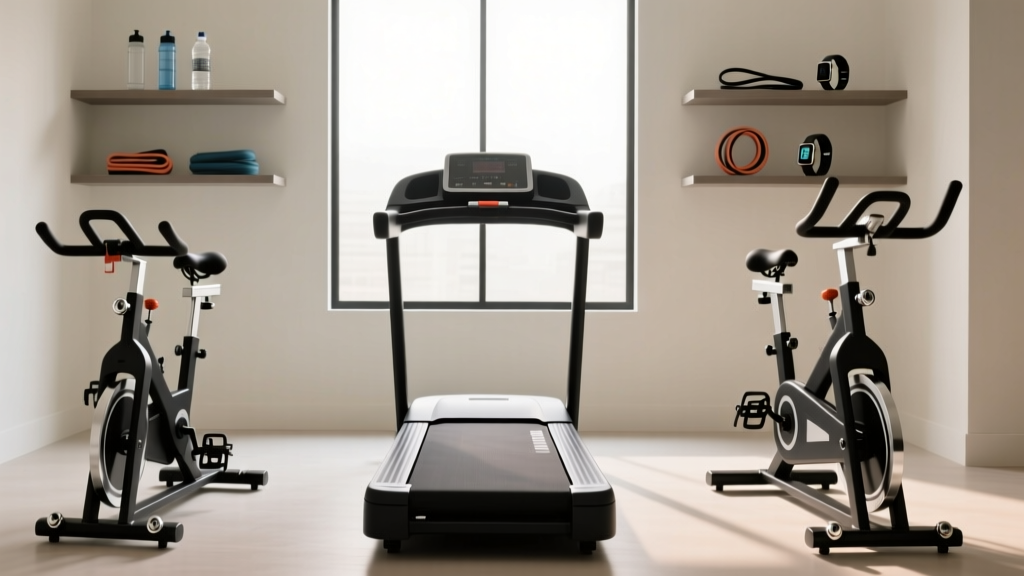
Air Bike vs Assault Bike Space: Running on Treadmill vs Outside
Compare Rogue Echo and AssaultBike Pro X footprints. Optimize your home gym layout and weigh running on a treadmill vs running outside for small spaces.

The Spatial Economics of High-Intensity Home Cardio
As home gym design evolves in 2026, spatial efficiency has become the primary driver of equipment selection. The era of dedicating entire two-car garages to single-purpose machines is fading, replaced by micro-gyms and multi-use fitness corners. When outfitting a compact space for high-intensity interval training (HIIT), the air bike remains an undisputed king of metabolic conditioning. However, choosing between the two market leaders—the Rogue Echo Bike and the Assault Fitness AssaultBike Pro X—requires more than just comparing resistance curves; it demands a rigorous analysis of spatial footprints, clearance requirements, and environmental airflow.
Furthermore, spatial constraints often force a critical programming decision for endurance athletes: the debate of running on a treadmill vs running outside. While treadmills offer controlled pacing, their massive physical footprint frequently dictates that runners take their miles outdoors, utilizing indoor space exclusively for compact, high-yield cardio alternatives like the air bike. This guide dissects the exact spatial layouts required for top-tier air bikes, helping you optimize your floor plan without sacrificing performance.
The Footprint Face-Off: Rogue Echo vs. AssaultBike Pro X
At a glance, both machines appear to occupy a similar volume, but a granular look at their stabilizer bars, fan housings, and drive systems reveals distinct layout requirements. The Rogue Echo Bike utilizes a pure belt-drive system and a rear-mounted fan housing that slightly extends its rear profile, while the AssaultBike Pro X features a more centralized mass with a heavy-duty chain-and-belt hybrid drive.
| Specification | Rogue Echo Bike (Belt) | AssaultBike Pro X | Standard Motorized Treadmill |
|---|---|---|---|
| Machine Footprint (L x W) | 53" x 30" (11 sq ft) | 51" x 29" (10.2 sq ft) | 78" x 35" (19 sq ft) |
| Max Height (Console) | 53.5" | 53.1" | 65"+ |
| Lateral Clearance Needed | 18" per side | 15" per side | 12" per side |
| Rear Safety Buffer | 12" (Air Intake) | 10" | 72" (Fall Zone) |
| Total Functional Area | ~36 sq ft | ~32 sq ft | ~75+ sq ft |
| Current Retail Price (Approx) | $1,250 - $1,400 | $999 - $1,199 | $1,500 - $3,500+ |
Resolving the Treadmill Dilemma: Indoor Space vs. Outdoor Miles
When mapping out a home gym, the spatial reality of a treadmill often breaks the layout. A standard treadmill requires roughly 19 square feet of static floor space, but safety guidelines from the American College of Sports Medicine (ACSM) and physical therapists mandate an additional 6-foot (72-inch) fall clearance zone behind the deck. This pushes the total functional footprint of a treadmill well over 75 square feet.
The Spatial Compromise
Many fitness enthusiasts agonize over running on a treadmill vs running outside, especially when square footage is at a premium. If your designated fitness room is under 150 square feet, housing a treadmill, a squat rack, and free weights is mathematically unfeasible without compromising safety. The optimal 2026 layout strategy involves taking your steady-state runs outdoors and dedicating your limited indoor footprint to an air bike. An air bike consumes less than half the functional area of a treadmill while delivering superior anaerobic threshold conditioning and joint-friendly HIIT capabilities.
Designing the Optimal Air Bike Zone
Placing an air bike in the corner of a room is the most common layout mistake in home gym design. Air bikes are essentially massive, human-powered wind tunnels. Their spatial requirements are dictated not just by the steel frame, but by thermodynamics and biomechanics.
1. Airflow and Fan Starvation
The Rogue Echo Bike pulls air from the rear and sides to generate resistance and cool the internal belt-drive mechanism. If you push the rear stabilizer flush against a wall, you restrict the air intake. This causes 'fan starvation,' which leads to two critical failure modes:
- Resistance Inconsistency: The bike cannot generate peak wattage at high RPMs because the fan blades are starved of ambient air.
- Thermal Throttling & Dust Ingestion: Restricted airflow causes the internal console electronics to overheat, while creating a low-pressure vortex that pulls heavy dust bunnies directly into the belt-drive housing.
Layout Rule: Always maintain a minimum 12-inch rear clearance and 18-inch lateral clearance to allow for proper air exhaust and elbow flare during maximum-effort sprints.
2. Ceiling Height and Arm Extension
While the consoles top out around 53 inches, you must account for the user's biomechanics. During a standing sprint or an aggressive seated pull, a user's hands can easily reach 75 to 80 inches above the floor. If you are designing a basement gym with drop ceilings, ductwork, or low-hanging pendant lights, ensure a minimum 9-foot (108-inch) vertical clearance directly above the bike's footprint to prevent catastrophic hand impacts during high-cadence intervals.
Maintenance Clearances and Edge Cases
Space optimization must also account for the physical space required to maintain the machine over its lifespan. The two flagship models handle maintenance very differently, which impacts how close you can place them to adjacent walls or racks.
⚠️ Maintenance Space Warning
AssaultBike Pro X: While the Pro X has vastly improved upon older chain-drive models, the hybrid drivetrain still requires periodic inspection of the chain tensioner and idler sprockets. You will need at least 24 inches of lateral clearance on the drive-side (right side) to comfortably kneel, remove the plastic guard, and apply chain lubricant without scraping your knuckles against a wall.
Rogue Echo Bike: The pure belt-drive system is virtually maintenance-free. However, if the internal fan cage becomes clogged with pet hair or drywall dust (common in garage gyms), you must remove the side panels. This requires moving the entire 125-lb machine away from the wall, as the panels cannot be slid off if the bike is wedged into a tight alcove.
Step-by-Step Layout Integration
Follow this sequence to seamlessly integrate an air bike into a multi-use home gym layout:
- Identify the Air Corridor: Position the bike so the fan exhaust blows toward the center of the room or an open garage door, never toward a wall where the hot air will bounce back onto the rider.
- Anchor the Front Stabilizer: If placing the bike on rubber horse-stall mats, ensure the front stabilizer bar rests entirely on a single, flat mat. Straddling the gap between two mats will cause the bike to rock violently during standing arm-pulls, accelerating wear on the bottom bracket bearings.
- Establish the Dismount Zone: Leave a 3-foot semi-circle clear on the left (non-drive) side of the bike. When dismounting after a max-effort Tabata interval, users are often fatigued and disoriented; they need a clear, unobstructed path to step off and collapse onto the floor without tripping over kettlebells or dumbbell racks.
- Lighting Placement: Avoid placing overhead lights directly in the user's forward line of sight. Staring into a ceiling fixture while tracking RPMs on the console leads to severe eye strain and headaches.
Final Verdict for Compact Home Gyms
When space is the ultimate luxury, both the Rogue Echo and the AssaultBike Pro X offer unparalleled metabolic conditioning in a relatively compact package. The AssaultBike Pro X wins slightly on pure static footprint and budget-friendliness, making it ideal for tight apartment corners or small basement alcoves. The Rogue Echo demands a slightly larger footprint and a higher price point but rewards the user with a smoother belt-drive feel and zero chain-maintenance requirements.
Ultimately, by recognizing the spatial realities of running on a treadmill vs running outside, you can reclaim up to 40 square feet of valuable floor space. Swapping the treadmill for outdoor miles and an indoor air bike allows you to build a comprehensive, high-performance training facility in a footprint small enough to leave room for a power rack, a set of adjustable dumbbells, and enough open floor space to actually enjoy your workouts.
More gear to consider
All reviews
Managing Treadmill Weight in Compact Home Gym Layouts

Busty Ema Treadmill Motor Size: Step-by-Step Guide

LifeSpan TR1200 DT Treadmill Belt Maintenance & 2026 Care Trends

High Intensity Treadmill: Folding Small Space Review & Care

Top Apps for Running on a Treadmill: 2026 Feature Buying Guide