Power Rack vs Squat Stand: Is Dumbbell Bench Press on Floor Better?
Compare power racks, squat racks, and stands. Learn if the dumbbell bench press on floor is a viable alternative, with step-by-step setup and gear tips.

The Home Gym Dilemma: Floor Pressing vs. Buying a Rack
When building a home gym, beginners often hit a major crossroads regarding chest training. You know you need to press heavy weight, but dropping $500 to $1,200 on steel infrastructure feels daunting. This leads to a common question: Can you simply rely on the dumbbell bench press on floor to build your chest, or do you need to invest in a power rack, squat rack, or squat stand?
As a beginner, choosing the right equipment dictates your safety, progression, and long-term gains. In this step-by-step guide, we will break down the biomechanics of floor pressing, compare the three main rack categories available in 2026, and provide a concrete decision framework to help you spend your money wisely.
Beginner Callout: The Core Difference
Floor Pressing: Zero equipment cost, highly shoulder-friendly, but limits range of motion (ROM) and makes getting heavy dumbbells into position dangerous.
Rack Pressing: Requires financial investment and space, but unlocks full ROM, barbell training, and crucial safety spotter arms.
Step 1: Evaluate the Dumbbell Bench Press on Floor
Before spending money on steel, you must understand what you are sacrificing—and gaining—by staying on the floor. The dumbbell floor press is a staple in powerlifting and bodybuilding circles, primarily because the floor acts as a natural physical stop, preventing the elbows from traveling past the torso.
The Biomechanical Reality
According to exercise biomechanics data from ExRx.net, the floor press significantly reduces the stretch placed on the pectoralis major at the bottom of the movement. This shifts the mechanical tension heavily onto the triceps brachii and the anterior deltoids. For beginners with a history of shoulder impingement, this limited range of motion is highly therapeutic. However, if your primary goal is maximum chest hypertrophy (muscle growth), the lack of a deep stretch makes it an inferior standalone movement compared to a full-ROM bench press.
Step 2: Compare Power Rack vs Squat Rack vs Squat Stand
If you decide the floor press isn't enough, you must choose your steel. The terms are often used interchangeably by big-box retailers, but in the fitness industry, they represent three distinct pieces of equipment with varying footprints, safety profiles, and 2026 price points.
1. The Power Rack (Full Cage)
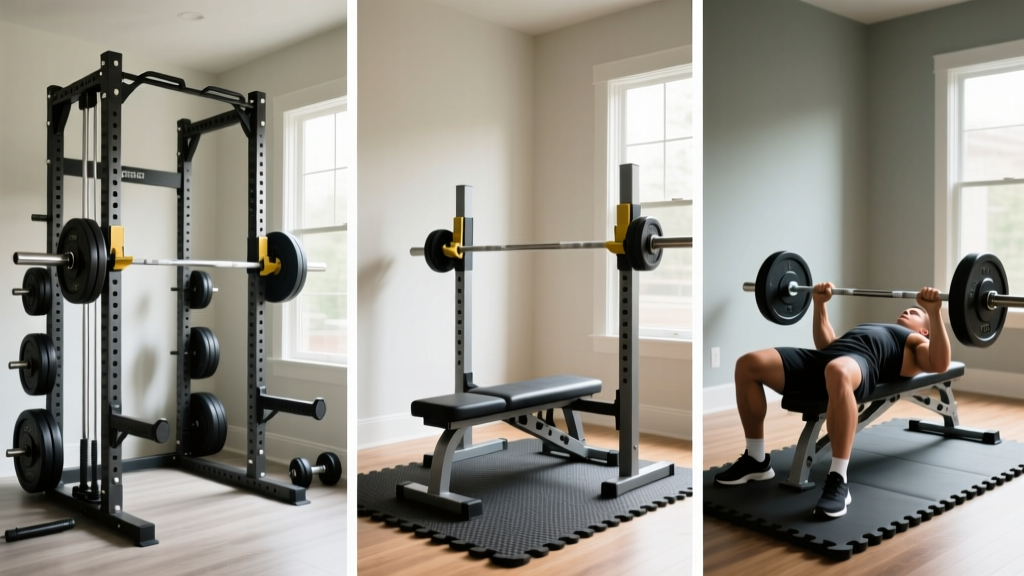
A power rack consists of four vertical uprights connected by crossmembers, creating a fully enclosed 'cage.'
- Top 2026 Model: Titan Fitness T-2 Series Power Rack.
- Footprint: 48" x 49" (requires significant floor space).
- Average Cost: $450 - $600.
- Best For: Beginners training alone. The enclosed safety straps or pin-pipe safeties mean if you fail a rep, the barbell is caught securely inside the cage.
2. The Squat Rack (Open-Top / Half Rack)
A squat rack typically features two main front uprights and two shorter rear uprights, offering an open front for easy barbell entry.
- Top 2026 Model: REP Fitness PR-1100 Home Gym Rack.
- Footprint: 48" x 43".
- Average Cost: $300 - $400.
- Best For: Lifters with low ceilings or tight spaces who still want the stability of four points of ground contact and rear weight storage.
3. The Squat Stand (Minimalist Uprights)
Squat stands are just two independent, heavy-duty steel posts with J-cups and spotter arms.
- Top 2026 Model: Rogue Fitness SML-1 Monster Lite Squat Stand.
- Footprint: 48" x 48" (but entirely open in the middle).
- Average Cost: $395 - $450.
- Best For: Garage gyms where the equipment needs to be pushed against a wall or folded away. Warning: Because they only have two base points, they are prone to tipping if you re-rack the barbell aggressively. Bolt-down or sandbagging is highly recommended.
Step 3: Equipment Comparison Matrix
Use this matrix to map your specific home gym constraints against the available options.
| Feature | Power Rack | Squat Rack | Squat Stand | Floor (No Rack) |
|---|---|---|---|---|
| Safety for Solo Lifting | Excellent (Enclosed) | Very Good (Spotter Arms) | Moderate (Tipping Risk) | High (No barbell crush risk) |
| Exercise Versatility | High (Pull-ups, cables) | High (Pull-ups, storage) | Low (Presses/Squats only) | Low (Dumbbell only) |
| 2026 Entry Price | ~$450+ | ~$300+ | ~$395+ | $0 |
| Ceiling Height Needed | 84" - 90"+ | 84"+ | 72" - 84" | N/A |
Step 4: How to Execute the Dumbbell Bench Press on Floor Safely
If you are delaying your rack purchase or using the floor press as an accessory movement, proper setup is non-negotiable. The National Strength and Conditioning Association (NSCA) emphasizes that joint alignment and controlled eccentric phases are critical when lifting without a spotter.
- The Pickup: Sit on the floor with your knees bent. Rest the dumbbells on your thighs, just above the knees. Do not attempt to lift them straight from the floor with straight arms, as this invites lower back and bicep tendon strain.
- The Kick-Back: Lean backward, using your legs to 'kick' the dumbbells up and over your chest in one fluid motion. Keep your wrists stacked directly over your elbows.
- The Brace: Plant your feet flat on the floor. Squeeze your shoulder blades together (retraction) and press your upper back firmly into the ground to create a stable arch.
- The Descent: Lower the weights at a 45-degree angle from your torso. Stop the exact millisecond your triceps make contact with the floor. Do not bounce your elbows off the ground.
- The Press: Drive the weights up and slightly inward, focusing on tricep lockout.
- The Dismount: Do not drop the weights to your sides. Bring them to your chest, tuck your chin, and roll forward onto your knees to safely deposit the dumbbells on the floor.
Step 5: The "Heavy Dumbbell" Failure Mode
There is a hard ceiling to the dumbbell bench press on floor. As a beginner, you might start with 25 lb or 35 lb dumbbells. But within 6 to 12 months of consistent progressive overload, you will likely be pressing 60 lb to 80 lb dumbbells.
According to physical therapy guidelines highlighted by the Mayo Clinic, maintaining proper joint mechanics under heavy, unstable loads is vital for injury prevention. Kicking 80 lb dumbbells off your knees into the starting position places immense shearing force on the knee joints and risks severe shoulder strain if one arm lags behind the other during the kick-back. Once you cross the 60 lb threshold per hand, the floor press transitions from a safe beginner movement to a high-risk liability. This is the exact moment a rack becomes mandatory.
Your 2026 Buying Decision Framework
Use this quick checklist to make your final equipment choice:
- Choose the Floor Press (For Now) If: Your budget is strictly under $200, you are in a temporary living situation (like an apartment), or you are recovering from a shoulder injury and need limited ROM.
- Choose a Squat Stand If: You have low basement ceilings (under 84 inches), need to push the gear into a corner when not in use, and primarily train with a spotter or use dumbbells on a bench.
- Choose a Squat Rack If: You want a balanced home gym on a budget (~$350) that offers rear weight plate storage and a pull-up bar, but you lack the 50 square feet required for a full cage.
- Choose a Power Rack If: You train alone at odd hours, plan to barbell bench press heavy, and want the absolute highest safety margin via enclosed spotter straps.
Frequently Asked Questions
Can I build a big chest just doing the dumbbell bench press on floor?
You can build a solid foundation, but you will eventually plateau. The floor cuts off the bottom third of the pressing motion, which is where the pectoral muscles experience the most mechanical stretch and subsequent hypertrophy stimulus. To maximize chest growth, you eventually need a rack and an adjustable bench to achieve a full range of motion.
Are squat stands safe for solo bench pressing?
They carry inherent risks. Because squat stands lack the front-to-rear structural crossmembers of a power rack, an aggressive or off-center re-rack can tip the stand forward. If you use squat stands for solo benching, you must either bolt them to a wooden platform, use heavy sandbags on the base feet, or ensure your spotter arms are set just one inch below your chest clearance.
What is the best dumbbell weight to start floor pressing with?
Most male beginners should start with 20 lb to 30 lb dumbbells, while most female beginners should start with 10 lb to 15 lb dumbbells. Focus entirely on mastering the 'kick-back' and 'roll-up' dismount techniques before increasing the weight. The coordination required to stabilize two independent weights on the floor is significantly higher than using a fixed barbell.
More gear to consider
All reviews
Beyond the Dumbbell Workout PDF: Barbell Knurling & Weight Mistakes

Bumper vs Iron Plate Care: Beyond Dumbbell Max Bench Calculators
Best Adjustable Weights for a Workout Routine With Dumbbells (2026)

Single Arm Dumbbell Row Exercise Errors & Barbell Knurling Guide

EZ Curl Bar vs Straight Bar Storage & One Arm Dumbbell Row Exercise