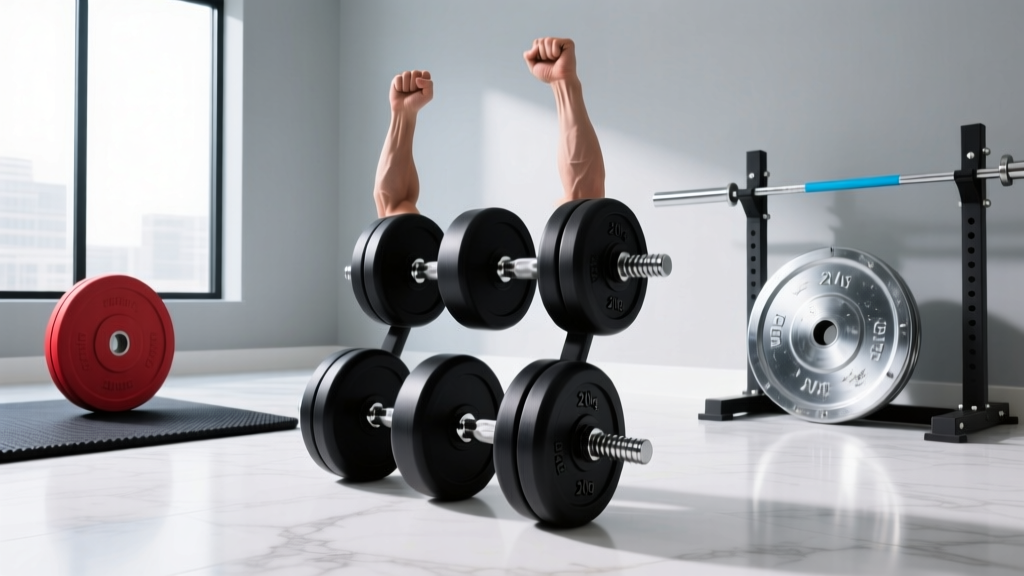
Olympic Barbell Guide & Dumbbell Spotter Stands Compared
Compare Olympic barbell setups and dumbbell spotter stands. Plus, our 2026 guide to barbell weight tolerances, PSI, and knurling profiles for home gyms.

The Home Gym Pressing Dilemma: Barbell vs. Dumbbell Safety
Building a safe, effective pressing station in a home gym has historically required a massive footprint: a full power rack, an Olympic barbell, and hundreds of pounds of bumper plates. However, as adjustable dumbbell technology has advanced in 2026, a new space-saving alternative has emerged. Today, we are putting the traditional Olympic barbell setup head-to-head against heavy-duty adjustable dumbbells paired with dumbbell spotter stands.
Before we compare the safety and biomechanics of these two pressing methods, we must address the core of the barbell side of this equation. If you are investing in an Olympic barbell, understanding the metallurgy, weight tolerances, and knurling geometry is non-negotiable. This guide will serve as your definitive resource for barbell specs, followed by a rigorous comparison of barbell racks versus dumbbell spotter stands.
Olympic Barbell Buying Guide: Weight, Tolerances, and Knurling
Not all steel is created equal. A $150 big-box store barbell and a $1,100 competition barbell may look identical to the untrained eye, but their behavior under a 300-pound bench press is vastly different. According to Garage Gym Reviews' extensive barbell testing methodology, the three most critical factors in barbell selection are knurling profile, tensile strength, and weight tolerance.
Decoding Knurling Profiles: Hill, Mountain, and Volcano
Knurling is the cross-hatched pattern machined into the steel shaft to provide grip. As detailed in BarBend's comprehensive knurling guide, the geometry of the knurl dictates how the bar feels in your hands, especially when sweat and chalk are introduced.
- Hill Knurling: Characterized by shallow, rounded peaks. This is common on budget bars ($150–$250). It feels smooth and comfortable but fails catastrophically during heavy, high-rep sets when your hands sweat, leading to dangerous bar slippage on the bench press.
- Mountain Knurling: Features sharp, aggressive, pointed peaks. Found on elite powerlifting bars like the Eleiko OP ($1,100+). It bites aggressively into the skin, providing unparalleled grip but requiring rigorous callus maintenance to prevent tearing.
- Volcano Knurling: The gold standard for home gyms. Machined with deep valleys and flattened, crater-like peaks. It provides massive surface area for grip without acting like a cheese grater on your palms. The Rogue Ohio Bar ($295) popularized this profile, making it the most sought-after knurl in 2026.
Weight Specifications, Yield Strength, and PSI
The International Weightlifting Federation (IWF) mandates that a standard men's Olympic barbell must weigh exactly 20kg (44.09 lbs) with a tolerance of just +/- 10 grams. However, many US commercial bars are marketed as "45 lbs." When buying, always look for bars calibrated in kilograms for higher precision.
Beyond weight, you must check the Tensile Strength, measured in PSI (pounds per square inch). This dictates how much load the bar can take before it permanently bends.
💡 The PSI Rule of Thumb:- Under 165,000 PSI: Avoid. The bar will permanently bend if dropped on the safety pins.
- 190,000 PSI: The sweet spot for home gyms. Offers excellent whip and durability.
- 215,000+ PSI: Elite powerlifting spec. Extremely stiff, designed for massive squat and deadlift loads.
Head-to-Head: Olympic Barbell Racks vs. Dumbbell Spotter Stands
Now that we understand the barbell, let's address the spatial and safety dilemma. A traditional bench press requires a power rack or squat stand with safety spotter arms. But what if your home gym is in a cramped spare bedroom? Enter the heavy-duty adjustable dumbbell and the dumbbell spotter stand.
The Case for the Olympic Barbell Setup
The barbell remains the undisputed king of progressive overload. Because the bar stabilizes the two weights as a single unit, you can push closer to absolute muscular failure with a lower risk of unilateral imbalance. Furthermore, micro-loading is superior; you can add 2.5 lb fractional plates to a barbell, whereas adjustable dumbbells usually jump in 5 lb increments per hand.
The Catch: A safe barbell bench press requires a power rack with spotter arms set exactly one inch below your chest arch. If you fail a rep, you simply drop the bar onto the pins. The footprint, however, is massive—often requiring a 4x8 foot dedicated zone.
The Rise of Dumbbell Spotter Stands
Adjustable dumbbells like the Nüobell (up to 80 lbs) or PowerBlock Elite (up to 120 lbs) have revolutionized small-space training. But pressing heavy dumbbells to failure alone is inherently dangerous; if your right arm fails, the dumbbell can crush your ribcage or tear a rotator cuff as you try to dump it.
Dumbbell spotter stands solve this. These are freestanding, adjustable-height catch platforms (such as the SpotMe system or specialized adjustable dumbbell catch-arms) placed directly under your elbows or wrists during the press. If you fail, you simply open your hands or drop your elbows onto the padded catch platforms, allowing the dumbbells to fall safely to the floor or rest on the stand.
"The integration of dedicated dumbbell spotter stands has finally made solo heavy dumbbell pressing viable for home gym owners who lack the square footage for a full power rack." — Home Gym Engineering Review, 2025
Comparison Matrix: Space, Cost, and Safety
| Feature | Olympic Barbell + Power Rack | Adjustable Dumbbells + Spotter Stands |
|---|---|---|
| Footprint | ~32 sq. ft. (Requires dedicated floor space) | ~12 sq. ft. (Stands tuck away easily) |
| Equipment Cost (2026) | $800 - $1,500 (Bar, plates, rack, bench) | $450 - $900 (Dumbbells, stands, bench) |
| Safety Mechanism | Steel spotter arms catch the barbell | Padded platforms catch wrists/elbows or dumbbells |
| Progressive Overload | Excellent (Micro-loading down to 0.5 lbs) | Good (Typically 5 lb jumps per hand) |
| Biomechanical Freedom | Limited (Fixed hand path, stress on AC joints) | High (Allows natural wrist rotation and arch) |
Real-World Failure Modes and Edge Cases
When evaluating safety, we must look at how these systems fail in the real world.
Barbell Failure Modes
- Incorrect Spotter Arm Height: The most common cause of home gym injury. If the pins are set too high, they limit your range of motion. If set too low, your chest cavity compresses before the bar hits the pins, leading to asphyxiation or rib fractures.
- Bar Whip and Bounce: If you drop a 300 lb barbell from chest height onto thin steel pins, a bar with high "whip" (lower PSI) can bounce unpredictably, potentially rolling off the rack if not secured with UHMW plastic liners.
Dumbbell Spotter Stand Failure Modes
- Base Stability: Freestanding dumbbell spotter stands must have a wide, weighted base. If a user drops a 90 lb PowerBlock dumbbell from a height of two feet onto a lightweight stand, the kinetic energy can tip the stand over. Always look for stands with a minimum 20 lb base weight or those that bolt directly to your bench frame.
- Unilateral Dumping: If one arm fails before the other, the user must have the presence of mind to drop the working dumbbell while safely controlling the other. Spotter stands require more cognitive awareness during a max-effort set than a simple barbell drop.
Final Verdict: Building Your Pressing Station in 2026
The choice between an Olympic barbell setup and adjustable dumbbells with dumbbell spotter stands ultimately comes down to your spatial constraints and training goals.
If you are a powerlifter, a strength athlete focused on 1-rep maxes, or you have a dedicated two-car garage gym, the Olympic barbell is mandatory. Invest in a 190k PSI bar with a volcano knurl (like the Rogue Ohio Bar) and pair it with a rack featuring UHMW-lined safety straps rather than steel pins to protect both your barbell and your joints.
However, if you are a hypertrophy-focused lifter, suffer from shoulder impingements, or are building a gym in an apartment or spare bedroom, the dumbbell spotter stand route is a revelation. The biomechanical freedom of dumbbells, combined with the safety net of modern catch-stands, allows you to train to absolute failure safely, without sacrificing your living space to a massive steel power rack. Just ensure your spotter stands are rated for the kinetic impact of your heaviest dumbbells, and never skip the warm-up sets.
More gear to consider
All reviews
Master the Seated Dumbbell Clean with Space-Saving Loadable Plates
Bumper vs Iron Plates: Budgeting for a Dumbbell Weight Routine

Budget Dumbbell Racks for the Single-Leg RDL With Dumbbell

Power Rack vs Squat Rack: Space for Side Plank Dumbbell Raises?

Top Neoprene Dumbbells for Home Use & Dumbbell Hex Press (2026)