Power Rack vs Squat Rack vs Stand: Dumbbell Triceps & Heavy Lifts
Compare power racks, squat racks, and squat stands for 2026. Discover which setup best supports heavy compounds and dumbbell triceps isolation work.

The Home Gym Dilemma: Heavy Compounds vs. Isolation Precision
When outfitting a home gym in 2026, most lifters obsess over the primary power movements: squats, bench presses, and deadlifts. Consequently, the purchasing decision usually boils down to a classic debate: power rack vs squat rack vs squat stand. However, a well-rounded hypertrophy or strength program dedicates up to 40% of its volume to accessory and isolation work. If your rack footprint and upright placement do not accommodate exercises like lying or overhead dumbbell triceps extensions, you will quickly find your expensive equipment acting as an obstacle rather than an asset.
Choosing the right enclosure is not just about safety during a heavy 1-rep max squat; it is about spatial geometry. The clearance required to perform a full range-of-motion dumbbell triceps skull crusher without clanging 80-pound hex dumbbells against 3x3-inch steel uprights is a critical, yet frequently overlooked, buying factor. This guide breaks down the structural differences, spatial requirements, and real-world failure modes of the three primary rack types to help you build a gym that supports both heavy compounds and precise isolation work.
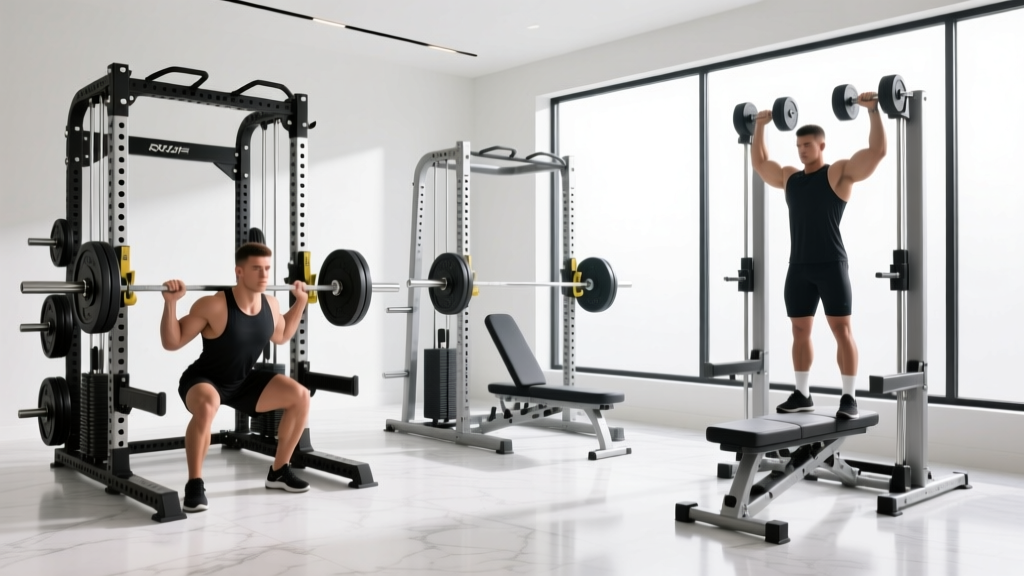
Quick Definitions:Power Rack (Full Rack): Four uprights creating a fully enclosed cage. Maximum safety, highest footprint.
Squat Rack (Half Rack): Two main front uprights with rear weight-storage horns for counterbalance. Open front, moderate footprint.
Squat Stand: Two independent or lightly connected uprights. Minimalist, highly space-efficient, lowest safety margin.
Spatial Clearance: Why Your Rack Dictates Dumbbell Triceps Mechanics
To understand why rack selection impacts isolation work, we must look at biomechanics. According to ExRx's biomechanical breakdown of the lying dumbbell triceps extension, maximizing the stretch on the long head of the triceps requires the lifter to position their head near the very edge of the bench, allowing the dumbbells to travel slightly behind the skull at the bottom of the movement.
The Overhead Extension Interference Test
If you are utilizing a standard 30-inch deep power rack and place an adjustable bench inside, the front uprights sit roughly 30 inches away from the rear crossmember. For a lifter over 6 feet tall performing seated overhead dumbbell triceps extensions, the elbows naturally track outward and backward. In a shallow rack, the dumbbells will physically strike the rear crossmembers or the pull-up bar at the bottom of the eccentric phase. This forces the lifter to compromise their form, flaring the elbows unnaturally or limiting the stretch, thereby reducing muscle fiber recruitment.
Conversely, squat stands offer infinite rear clearance because there is no rear cage structure. You can slide a bench out as far as needed to perform seated overhead dumbbell triceps work without spatial restriction, provided you have the floor space in your garage or basement.
Head-to-Head Comparison Matrix
| Feature | Power Rack (4 Uprights) | Half Rack (2 Uprights + Horns) | Squat Stand (2 Uprights) |
|---|---|---|---|
| 2026 Avg. Price | $1,499 - $1,850+ | $799 - $1,199 | $349 - $550 |
| Footprint (Depth) | 30" to 43" (Exterior) | 48" to 53" (Including Horns) | 24" to 32" |
| Bench Compatibility | High (Internal benching) | High (Bench pulled into horns) | Moderate (Spotter arms required) |
| Dumbbell Triceps Clearance | Restricted (Risk of hitting uprights) | Moderate (Open front helps) | Excellent (Unrestricted rear) |
| Spotter Safety | Maximum (Full cage + straps/pins) | High (Sandbag counterbalance needed) | Low (Tipping risk on failure) |
Power Racks: The Ultimate Enclosure (But At What Cost?)
Power racks, such as the REP Fitness PR-4000 (approx. $1,699) or the Rogue R-3 Power Rack (approx. $1,850), are the gold standard for safety. Constructed from 3x3-inch 11-gauge steel tubing, these cages can withstand over 1,000 pounds of static load. They feature Westside hole spacing (1-inch gaps in the bench press zone), allowing for micro-adjustments of spotter arms and J-cups.
The Accessory Trade-Off
While unparalleled for heavy barbell work, the enclosed nature of a power rack creates distinct edge cases for isolation movements. If you are performing lying dumbbell triceps extensions on a flat bench positioned inside the cage, the width of the bench plus the natural outward flare of your elbows during the eccentric phase leaves very little margin for error. A standard flat bench is roughly 10 to 12 inches wide. Inside a 49-inch wide interior cage, you have about 18 inches of clearance on either side. While sufficient for most, aggressive heavy dumbbell triceps dropsets can result in knuckle-scrapes against the uprights if the bench shifts even slightly off-center.
"The safest rack for a heavy barbell bench press is often the most restrictive rack for deep-stretch dumbbell isolation work. Always map your bench dimensions inside the rack's interior footprint before purchasing."
Squat Racks (Half Racks): The Middle Ground
Half racks, like the Titan Fitness T-3 Half Rack ($899), utilize two front uprights and extend backward into weight-storage horns. These horns serve a dual purpose: storing bumper plates and acting as a counterbalance to prevent the rack from tipping forward when a loaded barbell is racked slightly off-center.
Optimizing for Triceps Isolation
Half racks solve many of the spatial issues inherent to full power racks. Because the front is open and the bench is usually pulled in so the lifter's head is near the front uprights, the lifter's upper body extends outward toward the open floor. When doing seated dumbbell triceps extensions, the lifter can simply straddle the bench, leaning back slightly without fear of hitting a rear crossmember. Furthermore, the Rogue Monster Lite series half racks offer extensive attachment ecosystems, including lat pulldown towers that can be swapped out for triceps rope pushdowns, consolidating your cable and free-weight isolation stations into one footprint.
Squat Stands: Minimalist, But Are They Safe for Bench Accessories?
Squat stands, such as the Titan T-2 Folding Squat Stand ($349) or the Rogue SML-1 Monster Lite Squat Stands ($495), are essentially two heavy-duty metal posts. They are ideal for garage gyms with severe space constraints or low ceilings (under 84 inches).
Failure Modes and Edge Cases
The primary failure mode of squat stands is lateral instability. While they are perfectly adequate for racking dumbbells to perform standing overhead presses or goblet squats, benching inside them requires separate, adjustable spotter arms. When transitioning to lying dumbbell triceps extensions, the spotter arms become irrelevant, but the psychological comfort of an enclosed space is gone. More importantly, if you are using a lightweight, foldable bench to save space, the combination of a narrow bench base and heavy dumbbells can create a tipping hazard if you shift your weight too far to one side during a unilateral triceps extension. Squat stands demand strict form and high-quality, wide-base benches to remain safe during heavy accessory work.
The 2026 Buyer’s Decision Framework
To select the right equipment for your specific needs, follow this step-by-step diagnostic framework:
- Measure Ceiling & Depth: If your ceiling is under 84 inches, a power rack is likely out of the question unless you opt for a specialized short rack. If your room depth is under 6 feet, squat stands are your only viable option.
- The Bench Test: Take your current adjustable bench and measure its length. Add 12 inches for head clearance and 12 inches for foot placement. If this total exceeds the interior depth of a power rack, you will be forced to bench and do triceps work with the bench sticking out of the front of the cage, negating the safety benefits of the enclosure.
- Isolation Volume Assessment: If your programming heavily features lying dumbbell triceps extensions, cable pushdowns, and overhead dumbbell work, a Half Rack offers the best compromise. It provides the storage and counterbalance safety of a larger rig while leaving the rear and sides open for unrestricted dumbbell travel.
- Budget Allocation: If your budget is capped at $500, buy high-quality squat stands and invest the remaining capital into a premium, wide-base adjustable bench and a set of urethane hex dumbbells. Urethane is critical here; if you accidentally clip a squat stand upright during a triceps extension, urethane will bounce and protect the steel, whereas cast iron or rubber will chip or crack.
Final Verdict
There is no universally perfect rack; there is only the right rack for your specific biomechanics, space constraints, and programming. Power racks remain the undisputed kings of heavy, unspotted barbell lifting, but their enclosed geometry can actively hinder deep-stretch dumbbell triceps isolation work. Half racks provide the optimal middle ground for lifters who demand safety on the squat but require open-air clearance for high-volume dumbbell accessories. Squat stands serve the minimalist well, provided you pair them with a heavy-duty, wide-footprint bench to maintain stability during lateral movements. Evaluate your space, respect the geometry of your isolation lifts, and build a 2026 home gym that supports every phase of your training.
More gear to consider
All reviews
Bumper vs Iron Plates: Rack Setup for Overhead Dumbbell Extension

How to Maintain Loadable Dumbbells for Dumbbell Oblique Crunches

Leg Workouts With Only Dumbbells: Troubleshooting Neoprene Mistakes

Power Rack vs Squat Rack vs Squat Stand for Incline Dumbbell Flys

Adjustable Dumbbell Review: Perfecting Dumbbell Rear Delt Raises