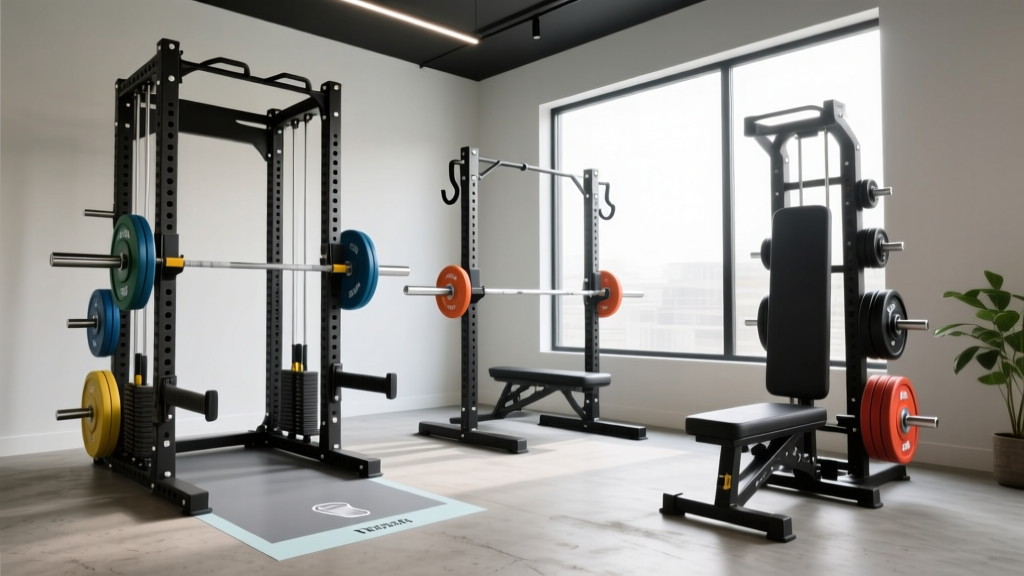
Power Rack vs Squat Rack vs Squat Stand & Dumbbell SVG
Compare power racks, squat racks, and squat stands for your 2026 home gym. Includes footprints, safety specs, and layout tips for custom SVG decals.

The Home Gym Blueprint: Form, Function, and Footprints
Setting up a dedicated home gym in 2026 requires balancing spatial geometry, load-bearing physics, and aesthetic personalization. Before you fire up your laser cutter to etch custom weight plates or use a dumbbell SVG file to cut vinyl wall decals for your lifting zones, you must anchor the room with the right barbell station. The debate between a power rack, a squat rack, and a squat stand dictates your ceiling height clearance, floor anchoring needs, and ultimate safety when failing a heavy rep.
Choosing the wrong rack isn't just an inconvenience; it's a safety hazard. A forward-tipping squat stand or a spotter arm that fails to catch a bounced barbell can lead to catastrophic injury. In this head-to-head comparison, we break down the exact metallurgy, footprint dimensions, and failure modes of the three primary barbell stations to help you engineer the perfect lifting space.
Contender Profiles: Dimensions and Steel Gauges
Metallurgy Matters: In 2026, the industry standard for heavy-duty home gym racks is 11-gauge steel. Anything thinner (like 14-gauge) is prone to warping under dynamic loads exceeding 400 lbs. Always look for 3x3-inch uprights with 5/8-inch hardware holes for maximum attachment compatibility.Head-to-Head Comparison Matrix
| Feature | Power Rack (Full Cage) | Squat Rack (Half Rack) | Squat Stand (2-Post) |
|---|---|---|---|
| Footprint | 49" x 49" to 53" x 53" | 48" x 24" to 49" x 34" | 24" x 24" to 30" x 30" |
| Upright Profile | 3x3" (11-Gauge) | 2x3" or 3x3" (11-Gauge) | 2x2" or 2x3" (12 to 14-Gauge) |
| Safety Mechanism | Strap safeties or pin-pipes (inside) | External spotter arms | External spotter arms (short) |
| Avg. Weight Capacity | 1,000 - 1,500+ lbs | 600 - 1,000 lbs | 350 - 800 lbs |
| 2026 Price Range | $650 - $1,400+ | $400 - $800 | $180 - $350 |
| Best Use Case | Heavy solo lifting, kipping, pull-ups | Openness, Olympic lifts, garage gyms | Small apartments, strict budgets |
Power Racks: The Ultimate Enclosed Fortress
A power rack (or power cage) consists of four to six vertical posts connected by top and bottom crossmembers. The defining feature is that the safety mechanisms (strap safeties, pin pipes, or flip-downs) are housed inside the uprights. This means if you fail a squat or bench press, the barbell drops vertically onto the safeties without the risk of tipping the entire rig forward.
Top 2026 Models: REP PR-4000 vs. Rogue R-3
- REP Fitness PR-4000 Power Rack: Featuring 3x3" 11-gauge steel and 5/8" holes, the PR-4000 utilizes a bolt-together design with integrated laser-cut numbering. The standout feature is the compatibility with the Rogue Monster attachment ecosystem via specific adapters, allowing for belt squat carriages and lat pulldowns. Pricing sits around $899 for the base 3.0 model.
- Rogue R-3 Power Rack: The gold standard for garage gyms. It features Rogue's proprietary Infinity or Monster Lite hole spacing (Westside spacing in the bench zone for precise micro-adjustments). The UHMW plastic-lined J-cups protect your barbell's knurling from steel-on-steel degradation. Expect to pay $1,150+ with shipping.
Squat Racks: The Open-Concept Compromise
Squat racks (often called half racks) typically feature two front uprights and a rear base stabilizer, or four uprights that are not fully enclosed by top crossmembers. They offer a more open feel, which is ideal for Olympic weightlifting variations like power cleans, where you might need to bail the bar forward or backward without hitting a cage.
Failure Modes and Edge Cases
The primary danger of a squat rack lies in its external spotter arms. If you are using a squat rack with 18-inch spotter arms and you fail a heavy back squat, the barbell will hit the arms outside the rack's center of gravity. If the rack is not bolted to the floor or heavily loaded with weight storage on the rear pegs, the dynamic force of a dropped 400 lb barbell can cause the entire rack to tip forward onto the lifter.
Expert Warning: Never use external spotter arms on a half-rack without first securing the rear base. According to biomechanics data reviewed by experts at Garage Gym Reviews, the forward torque generated by a bouncing barbell on extended spotter arms easily exceeds the counter-weight of an unloaded 150 lb steel rack.
Squat Stands: Minimalist but High-Risk
Squat stands are two independent posts designed solely to get the barbell off the floor. They are the most space-efficient option, easily pushed into a corner when not in use. Models like the Titan Fitness T-2 or X-2 squat stands are popular entry points for beginners.
The Physics of Tipping
Squat stands have a notoriously small base of support. When you re-rack a heavy barbell, the horizontal force applied to the J-cups transfers down the uprights. If the stand is not bolted into concrete, it will walk forward or tip.
The Fix: If you must use squat stands in a rented space where concrete drilling is prohibited, you must purchase stands with extended rear weight-storage pegs. You must then load at least 150-200 lbs of bumper plates onto the rear pegs to act as a counterbalance before attempting heavy squats.
Space Planning & Aesthetic Integration
Once you have selected your rack, the next phase of gym building is spatial mapping and aesthetic integration. Many modern home gym owners use vector design software to plan their floor layouts to scale.
Furthermore, personalizing your gym space boosts motivation. Whether you are cutting custom motivational vinyl quotes for your mirror, or downloading a dumbbell SVG blueprint to create custom silhouette wall art above your dumbbell rack, knowing your exact equipment dimensions ensures your decals and layouts fit perfectly without overlapping the rack's swing zone or barbell path.
The 2026 Buyer’s Decision Framework
Use this step-by-step framework to finalize your purchase:
- Measure Ceiling Clearance: Standard pull-up bars on power racks sit at 84" or 90". If your ceiling is 84" (7 feet), you must buy a "short" power rack (72" uprights) or a squat stand to allow for pull-ups and overhead pressing.
- Assess Floor Anchoring: Do you own your home and have exposed concrete? If yes, you can safely bolt down a squat rack or stand. If you are on a rubber mat over wood subfloor, a freestanding power rack is mandatory for heavy solo lifting.
- Calculate Attachment Needs: If you plan to add a lat pulldown, low row, or monolift in the future, invest in a 3x3" power rack with 5/8" holes now. Upgrading later will cost you double.
Frequently Asked Questions
Can I use a squat stand for bench pressing?
Yes, but it is highly discouraged for heavy lifting. Squat stands rarely come with safeties wide enough to catch a barbell if you roll it off your chest. If you must bench on squat stands, use a spotter or limit the weight to what you can lift without safeties.
What is Westside hole spacing?
Westside spacing refers to a hole pattern where the distance between holes is 1 inch in the bench press and squat zones, and 2 inches higher up. This allows for micro-adjustments of J-cups and safeties, ensuring you don't have to alter your range of motion just to match the rack's hardware.
Are strap safeties better than pin pipes?
For home gyms, yes. Nylon strap safeties absorb the kinetic energy of a dropped barbell, reducing the bounce and protecting the barbell's knurling and ceramic coatings. Steel pin pipes can dent your barbell and cause excessive noise in a residential garage.
More gear to consider
All reviews
Rack vs Stand Troubleshooting: Squats and the Dumbbell French Curl

Beyond Dumbbell Kick Backs: Power Rack vs Squat Rack vs Squat Stand

Bumper Plate vs Iron Plate: EZ Bar Curl vs Dumbbell Curl Setups

Dumbbell Back Extensions: Top Adjustable Dumbbells Compared

Adjustable Dumbbell Review: Dumbbell Shaped Crystals in Urine Guide
