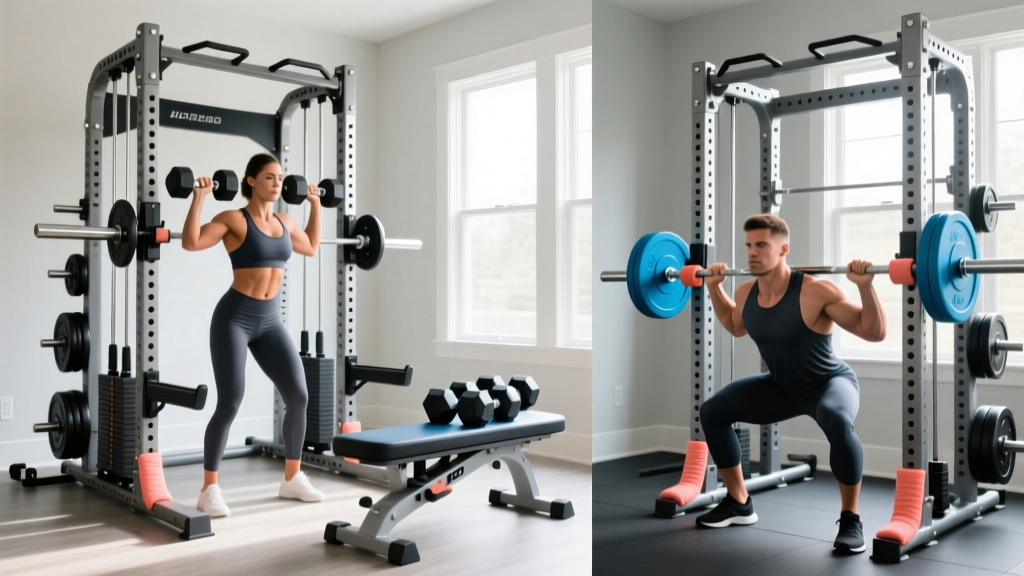
Power Rack vs Squat Stand: Squats & Dumbbell Flyes for Upper Chest
Compare power racks, squat racks, and stands for 2026. Learn how rig choice impacts heavy squats and safety during dumbbell flyes for upper chest.

The Home Gym Rig Dilemma: More Than Just Heavy Squats
When beginners start building a home gym in 2026, the primary focus is almost always on the barbell back squat. You look for J-cups, weight capacity, and pull-up bars. However, a squat rack is not just a place to park a barbell; it is the structural anchor for your adjustable FID (Flat/Incline/Decline) bench. This becomes critically important when you transition from heavy compound lifts to isolated movements.
Consider the biomechanics of targeting the clavicular pectoralis major. When you recline your bench to a 30-degree angle to perform dumbbell flyes for upper chest, your spatial awareness and center of gravity change entirely. You are no longer directly under the barbell J-cups. If your shoulder fatigues or you lose your grip at the bottom of the stretch, where do those 50 lb dumbbells go? Choosing between a power rack, a squat rack (half rack), and a squat stand dictates not only your safety during heavy squats but also your ability to safely fail a rep during incline dumbbell work without destroying your floors—or your rotator cuffs.
Power Rack vs. Squat Rack vs. Squat Stand: 2026 Comparison Matrix
Before we dive into the step-by-step setup, let us break down the three main categories of free weight enclosures. Prices and dimensions reflect standard 3x3 11-gauge steel models typical of the 2026 home gym market.
| Feature | Power Rack (e.g., Rogue R-3) | Half/Squat Rack (e.g., Titan T-2) | Squat Stand (e.g., Rogue SML-1) |
|---|---|---|---|
| Average Price | $850 - $1,200 | $450 - $650 | $250 - $500 |
| Footprint | 49' x 49' (Enclosed) | 48' x 24' (Open Front) | 48' x 48' (Minimalist) |
| Standard Height | 90 inches | 82 - 90 inches | 72 - 92 inches (Adjustable) |
| Bench Integration | Fully enclosed; bench sits inside | Bench slides in; open egress | Bench sits between independent stands |
| Safety for Dumbbell Flyes | Excellent (Contains dropped weights) | Good (Spotter arms catch some drops) | Poor (High risk of floor damage/injury) |
Step 1: Assessing Your Space and Bench Clearance
The first step in choosing your rig is measuring your available space, but beginners often forget to account for bench clearance. According to ExRx Kinesiology guidelines, proper incline bench work requires enough lateral space to fully extend the arms without hitting the uprights of the rack.
The Lateral Clearance Test
When performing dumbbell flyes for upper chest, your arms will extend outward and slightly backward at the bottom of the movement. If you buy a narrow squat stand or a half rack with inward-facing spotter arms, your dumbbells or your elbows will collide with the steel uprights before you reach a full pectoral stretch. A standard 49-inch interior width power rack provides exactly enough clearance for a lifter of average wingspan to execute a full range of motion on a 12-inch wide bench without striking the rack.
Step 2: Safety Mechanics and 'The Flye Test'
Spotter arms are designed to catch a cylindrical barbell. They are not designed to catch spherical or hex dumbbells dropped from an incline angle. This is where the 'Flye Test' comes in.
⚠️ The Dumbbell Flye Safety Hazard
When executing dumbbell flyes for upper chest on a 30-degree incline, gravity pulls the weights down and slightly toward your head. If you tear a pec or experience a sudden grip failure on a squat stand, the dumbbells will fall directly onto your floor, potentially bouncing into your shins or rolling under furniture. In a fully enclosed power rack, the weights drop inside the 49x49 footprint. While they may still hit the floor, the steel cage prevents them from bouncing outward into the room, and the psychological safety net allows you to push closer to true muscular failure.
To mitigate risks on a squat stand or half rack, you must utilize hex dumbbells (which do not roll) and invest in high-density rubber drop pads. However, for pure safety, the power rack remains the undisputed king of home gym isolation work.
Step 3: Configuring Your Rig for Upper Chest Isolation
Once you have selected your rack, follow this step-by-step guide to configure it specifically for upper chest development. As noted by biomechanics experts at ExRx, the clavicular head of the pectoralis major is optimally targeted at a 30 to 45-degree incline.
- Set the Bench Angle: Lock your adjustable bench at exactly 30 degrees. Going higher than 45 degrees shifts the load away from the upper chest and onto the anterior deltoids.
- Position the Bench: Slide the bench into the rack so that when you lay back, your eyes are directly aligned with the barbell J-cups. This ensures you are centered and your dumbbells won't clip the uprights during the flye stretch.
- Adjust the Spotter Arms: This is critical. Set the safety spotter arms one hole below your wrist level when your arms are fully extended outward in the bottom position of the flye. While spotter arms won't catch a dumbbell perfectly, they will prevent the dumbbell from crushing your torso if your arm collapses inward.
- Clear the Footprint: Ensure no weight plates or collars are stored on the floor directly beneath the drop zone of the dumbbells. A 50 lb dumbbell dropped on a steel bumper plate will cause severe floor damage.
Real-World Buying Scenarios for 2026
Which rig should you actually buy? Here are three common beginner profiles:
- The Garage Gym Athlete (Buy the Power Rack): If you have a 2-car garage, an 8-foot ceiling, and a budget of $1,000+, buy a 90-inch power rack like the Rogue R-3 or Titan T-3. The enclosed cage makes heavy squats, rack pulls, and dumbbell flyes for upper chest significantly safer when training alone.
- The Low-Ceiling Basement Lifter (Buy the Half Rack): If you have 7-foot ceilings, a standard power rack will not fit. Opt for a short half rack (82 inches). You lose the rear pull-up bar and full enclosure, but you retain front spotter arms for benching and squatting.
- The Apartment/Bedroom Lifter (Buy the Squat Stand): If space is at an absolute premium and you must fold your equipment away, adjustable squat stands are your only option. Warning: Stick to flat bench presses and standing overhead presses. Avoid heavy incline dumbbell flyes for upper chest on squat stands unless you are using very light weights and have specialized drop pads.
Frequently Asked Questions
Can I do dumbbell flyes for upper chest on the floor?
Yes, the floor flye is a valid variation, but it severely limits your range of motion. The floor stops your elbows before your pectorals reach a full stretch, reducing the hypertrophy stimulus on the clavicular head. An incline bench inside a power rack remains the gold standard for upper chest isolation.
Do I need a spotter for incline dumbbell flyes?
Unlike the barbell incline press, a spotter cannot easily assist you on a dumbbell flye without risking your shoulder joints. The spotter would have to grab your wrists, which alters the leverage and can cause injury. This is why relying on the structural safety of a power rack and proper spotter arm placement is vastly superior to relying on a human spotter for this specific movement.
What is the best dumbbell type for this movement?
Urethane or rubber-coated hex dumbbells are highly recommended. The hex shape prevents them from rolling off your thighs during the initial kick-up, and if you are forced to drop them inside a squat rack, the rubber coating minimizes the kinetic transfer to your subfloor.
The FitGearPulse Verdict: Never buy a squat rack based solely on your barbell lifts. Your rig must support your entire training ecosystem. By evaluating how a power rack, half rack, or squat stand handles the unique spatial and safety demands of dumbbell flyes for upper chest, you ensure your home gym is as safe as it is effective.
More gear to consider
All reviews
Best Dumbbell Racks to Organize Your Home Dumbbell Program (2026)

Dumbbell Bulgarian Split Squat Trends: Rubber Hex vs Urethane 2026
Kettlebell Guide: Cast Iron vs Competition & One-Arm Dumbbell Rows
Troubleshoot the Average Dumbbell Shoulder Press: Adjustable Dumbbells
Bumper vs Iron Plates: Gym Setup for Top Bicep Dumbbell Exercises
