Power Rack vs Squat Stand: Best Rig for Your Dumbbell Back Workout
Compare power racks, half racks, and squat stands. Find the best 2026 rig for heavy barbell lifts and your weekly dumbbell back workout routine.

The Home Gym Rig Dilemma: Beyond the Barbell Squat
When outfitting a home gym in 2026, the centerpiece is undeniably the lifting rig. However, most buyers make a critical error: they choose a rack based solely on its ability to hold a barbell for squats and bench presses. While safety during heavy compound lifts is paramount, your rig must also facilitate a comprehensive upper-body routine. Specifically, the architecture of your rack will heavily influence the effectiveness, safety, and flow of your dumbbell back workout.
Whether you are performing chest-supported dumbbell rows, heavy shrugs, or utilizing pull-up bar variations to target the lats and rhomboids, the footprint, upright spacing, and attachment ecosystem of your rig matter. In this head-to-head comparison, we break down the full power rack, the half rack, and the freestanding squat stand to help you decide which setup best supports both your heavy barbell ambitions and your hypertrophy-focused dumbbell back workout.
Contender 1: The Full Power Rack (The Fortress)
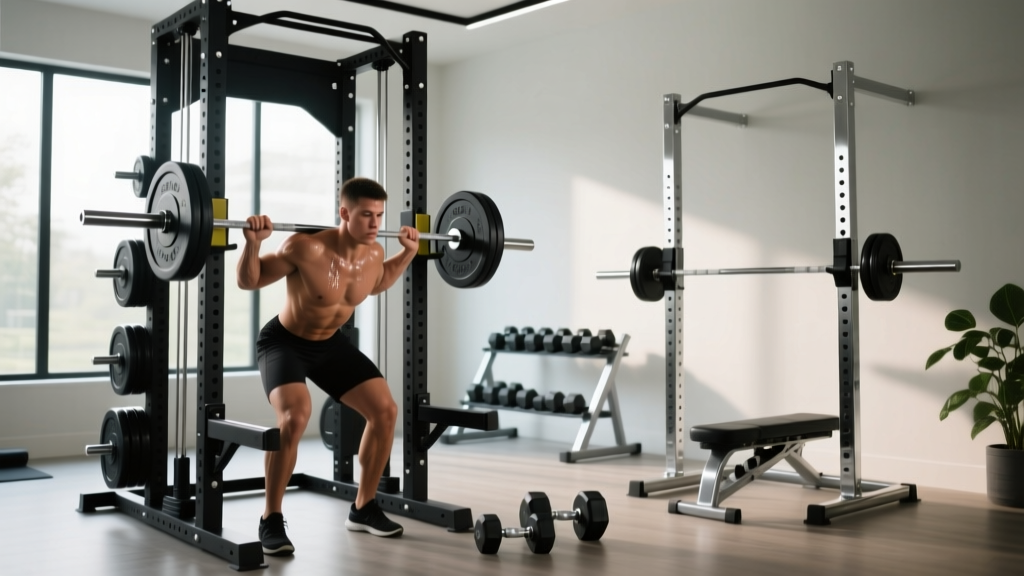
The full power rack (or full cage) features four vertical uprights connected by crossmembers, creating an enclosed lifting area. It is the gold standard for safety and versatility.
Top Models & 2026 Specifications
- Rep Fitness PR-4000: The benchmark for modular home gyms. Features 3x3-inch 11-gauge steel uprights, 5/8-inch hardware, and 1-inch Westside hole spacing in the bench press zone. Base price hovers around $699, but fully kitted with lat pulldown towers and safety spotter straps, it easily crosses $1,100.
- Rogue RM-6 Monster Rack: The commercial-grade titan. Built with 3x3-inch 11-gauge steel and 1-inch hole spacing throughout. Pricing starts at $1,250 and scales rapidly with custom colors and attachment packages.
Pros and Cons
- Pros: Unmatched safety (you can fail a rep anywhere inside the cage); massive attachment ecosystem (lat pulldowns, belt squat modules, multi-grip pull-up bars); integrated weight storage horns keep the gym floor clear.
- Cons: Massive footprint (typically 48x48 inches or larger); requires high ceilings (80 to 93 inches); higher entry cost.
Contender 2: The Half Rack (The Compromise)
Half racks typically feature two main front uprights and two shorter rear uprights that act as weight storage and stabilizers. They offer an open-front lifting experience while maintaining a degree of enclosed safety.
Top Models & 2026 Specifications
- Titan Fitness X-2 Half Rack: An aggressive budget option utilizing 2x2-inch uprights. It lacks the premium UHMW plastic lining found on higher-end models but delivers solid performance for under $500.
- Rogue SML-2 Monster Lite Half Rack: Features 3x3-inch uprights with 5/8-inch holes. Priced around $795, it offers the open-front feel of a squat stand but with the rear stabilizers necessary to safely rack heavy weights without tipping.
Pros and Cons
- Pros: Open front allows for easy entry/exit and accommodates longer benches; rear uprights provide excellent weight plate storage; generally more affordable than full cages.
- Cons: Spotter arms must be perfectly aligned; you cannot safely fail a lift 'inside' the rack like you can with a full cage; pull-up bars are usually straight or basic multi-grip, lacking the wide array of angles found on full cages.
Contender 3: The Squat Stand (The Minimalist)
Squat stands consist of two freestanding uprights. They are the ultimate space-savers but require strict attention to safety protocols and floor bolting.
Top Models & 2026 Specifications
- Rogue S-2 Squat Stand 2.0: Built with 2x3-inch 11-gauge steel. The wide base and optional bolt-down gussets provide surprising stability. Retails for $445.
- Rep Fitness PR-1100: A 2x2-inch upright stand that is incredibly budget-friendly (often under $299), though it sacrifices attachment compatibility and weight capacity compared to 3x3 systems.
Pros and Cons
- Pros: Minimal footprint (can be pushed against a wall or stored in a corner); highly affordable; unobstructed space for dynamic movements.
- Cons: High tipping risk if not bolted down or heavily loaded with plates; zero enclosed safety (must use spotter arms and always lift with a spotter or within arm's reach of the safeties); virtually no attachment ecosystem.
Head-to-Head Comparison Matrix
| Feature | Full Power Rack | Half Rack | Squat Stand |
|---|---|---|---|
| Avg. Footprint | 48" x 48" to 49" x 53" | 48" x 48" | 24" x 24" to 30" x 30" |
| Steel Gauge | 11-Gauge (Standard) | 11 to 14-Gauge | 11 to 14-Gauge |
| Attachment Ecosystem | Massive (Lat pulldown, belt squat, dip stations) | Moderate (Dip bars, basic lat towers) | Minimal (J-cups, spotter arms only) |
| Safety Profile | Maximum (Enclosed cage) | High (Spotter arms required) | Moderate (Tipping risk, spotter arms required) |
| 2026 Price Range | $699 - $1,500+ | $499 - $899 | $249 - $495 |
Rig Impact on Your Dumbbell Back Workout
According to kinesiology data mapped by ExRx.net, targeting the complex musculature of the back requires varied angles of shoulder extension, adduction, and scapular retraction. While barbell rows are a staple, a dedicated dumbbell back workout is crucial for isolating the lats, rhomboids, and rear delts while minimizing lumbar shear forces. Here is how your rack choice directly impacts these movements.
Chest-Supported Dumbbell Rows
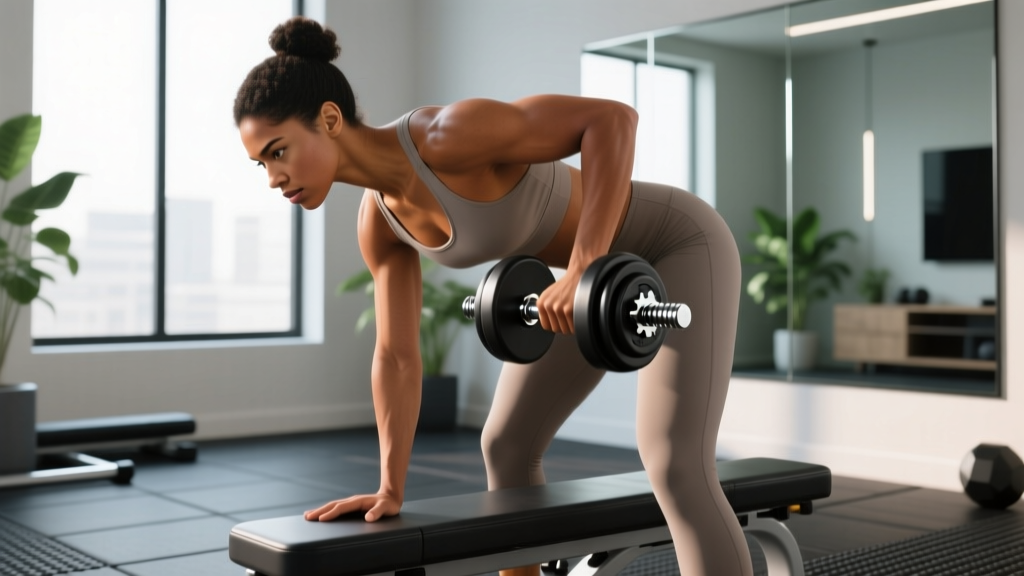
The chest-supported row is a cornerstone of any intelligent dumbbell back workout, as it removes the lower back from the equation, allowing for pure lat and rhomboid isolation. According to biomechanical research published in the National Institutes of Health, reducing lumbar flexion during heavy pulling movements significantly decreases the risk of disc herniation.
Pro Tip: In a full power rack, you can set an adjustable bench to a 30-degree incline and wedge it securely between the uprights. The enclosed space prevents the bench from sliding backward during heavy pulls. On a squat stand, the lack of lateral stability means the bench can shift, forcing you to use lighter dumbbells to maintain control.Pull-Up Bar Variations and Lat Targeting
No dumbbell back workout is complete without vertical pulling. Full power racks typically offer multi-grip pull-up bars with angled, neutral, and wide-grip handles. This allows you to target the teres major and lower lats effectively. Squat stands and half racks usually feature a single straight pull-up bar, limiting your biomechanical angles and forcing you to rely solely on dumbbell pullovers for vertical lat stimulation.
Heavy Dumbbell Shrugs and Rack Pulls
When overloading the traps with heavy dumbbell shrugs (often using 100+ lb dumbbells in each hand), grip fatigue is a real factor. A full power rack or half rack allows you to utilize lifting straps securely around the barbell for rack pulls, or safely drop heavy dumbbells onto the enclosed safety straps if your grip fails. The National Strength and Conditioning Association (NSCA) emphasizes that having a designated 'bail zone' is critical when lifting near maximal capacity, a feature only a full cage or securely bolted half rack can reliably provide.
The FitGearPulse Decision Framework
Use this three-step framework to finalize your purchase:
- Assess Your Space and Ceiling: If your ceiling is under 84 inches, a standard 90-inch power rack is out. Look at 72-inch squat stands or short-cage power racks. If floor space is under 40 square feet, the squat stand is your only viable option.
- Audit Your Attachment Needs: If your dumbbell back workout relies heavily on lat pulldowns (via a rack-mounted tower) or you plan to add a belt squat module in the future, you must buy a 3x3-inch upright power rack. Squat stands do not support these high-leverage attachments.
- Evaluate Your Safety Tolerance: If you train alone and frequently push to muscular failure on squats or bench presses, do not buy a squat stand. The tipping risk during a missed rep is a documented hazard. Invest in a full cage or, at minimum, a bolted-down half rack with UHMW-lined safety spotter arms.
Final Verdict
For the lifter who views their home gym as a complete performance center, the Full Power Rack (like the Rep PR-4000) is the undisputed winner. It provides the enclosed safety necessary for heavy solo lifting and the structural rigidity required to anchor an adjustable bench for a flawless, chest-supported dumbbell back workout. However, if you are outfitting a small apartment gym and prioritize open floor space over attachment versatility, a bolted-down Squat Stand paired with a standalone adjustable dumbbell set will still get the job done—provided you respect the safety limitations.
More gear to consider
All reviews
Beyond the Dumbbell: Olympic Barbell Knurling & Setup

EZ vs Straight Bar: Space Hacks for Full Body Dumbbell Workout Women
Best Neoprene Dumbbells for a Home Dumbbell Exercise Plan
EZ vs Straight Bar Care & Upper Back Exercises with Dumbbells
Bulgarian Split Squat One or Two Dumbbells: Neoprene Troubleshooting