
Optimizing Space: Power Cage & Force USA Leg Press Machine Layouts
Discover how to optimize your gym layout by pairing a power cage for squats with a Force USA leg press machine for maximum space efficiency and leg gains.

The Biomechanical Imperative: Why Two Separate Stations?
When designing a high-performance leg training zone in a space-constrained home, garage, or boutique commercial gym, the temptation to rely on a single all-in-one functional trainer is high. However, serious lower-body development requires addressing two distinct biomechanical demands: heavy axial loading and high-volume, lower-back-sparing hypertrophy. This is why pairing a dedicated power cage for squats with a standalone Force USA leg press machine remains the gold standard for space-optimized, uncompromised leg training.
According to research published in the Journal of Sports Science & Medicine, squats and leg presses are not strictly interchangeable. Squats demand immense core stabilization, erector spinae engagement, and glute/adductor stretch under axial load. Conversely, a 45-degree leg press removes the spinal stabilization bottleneck, allowing you to push the quadriceps to absolute mechanical failure safely. Combining a heavy-duty squat rack with a dedicated plate-loaded sled yields superior muscle fiber recruitment compared to combo-machines, which often compromise sled angles and bar paths to save a few square feet.
Dimensional Breakdown: Calculating the Footprint
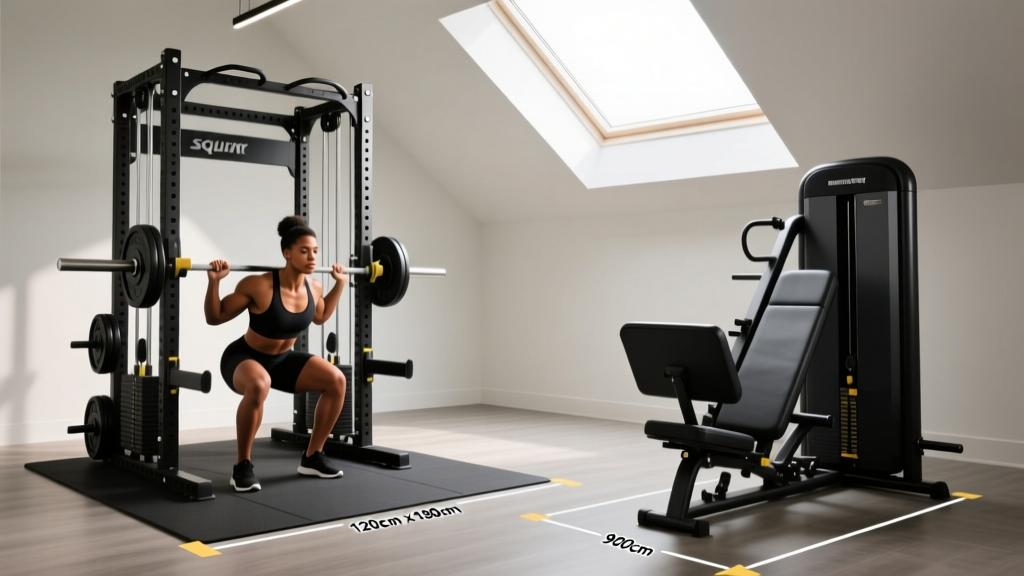
Space optimization begins with brutal honesty about dimensions and operational clearance. You cannot simply measure the steel footprint; you must calculate the 'active zone'—the space required to load plates, deploy spotter arms, and enter/exit the equipment safely.
| Equipment | Steel Footprint (W x D) | Operational Clearance Required | Total Active Zone |
|---|---|---|---|
| Rogue RML-390F Power Cage | 49' x 43' | 36' front, 24' sides | ~24 sq ft |
| Rep Fitness PR-4000 (47' Depth) | 52' x 47' | 40' front, 24' sides | ~27 sq ft |
| Force USA Leg Press / Calf Raise | 34' x 85' | 48' front (loading), 12' sides | ~38 sq ft |
| Shared Plate Storage Tree (6-Peg) | 28' x 28' | 36' 360-degree access | ~14 sq ft |
As the data illustrates, a dedicated Force USA leg press machine requires a significant longitudinal footprint (85 inches) due to the 45-degree sled track and the integrated calf raise block. However, by sharing a central plate storage tree between the squat rack and the leg press, you eliminate redundant storage zones, saving approximately 12 to 15 square feet of floor space.
Strategic Layout Configurations
How you arrange these two massive pieces of steel dictates the flow of your leg day. Here are the three most efficient layouts for rectangular spaces (e.g., a standard 2-car garage or basement room).
1. The Inline Corridor Flow (Best for Narrow Spaces)
If your space is long and narrow (e.g., 10 feet wide by 24 feet long), place the power cage at the far end against the wall. Position the Force USA leg press machine directly in front of it, leaving a 48-inch 'loading and transition' gap between the front of the squat rack uprights and the back of the leg press seat pad. This creates a single, unbroken corridor. Pro Tip: Mount your plate storage on the wall adjacent to the gap, allowing you to load both machines from a single standing position without crossing the gym floor.
2. The L-Shape Corner Tuck (Best for Square Rooms)
In a square room (e.g., 15x15 feet), push the power cage into the back-left corner, facing the center of the room. Place the leg press in the back-right corner, angled slightly inward so the sled tracks toward the center. This creates an L-shaped equipment perimeter, leaving a massive, unobstructed open floor space in the middle for lunges, sled pushes, or mobility work. This layout aligns with ExRx.net facility planning principles, which advocate for keeping high-traffic loading zones away from open floor areas to prevent tripping hazards.
3. Back-to-Back Plate Sharing (The Space Maximizer)
For the absolute tightest footprints, position the power cage and the leg press back-to-back, separated only by a low-profile, dual-sided plate storage rack. While this limits the ability to use the lat pulldown or low-row attachments on the back of a power cage, it creates a highly dense 'leg island' that requires only a 10x12 foot dedicated zone.
Expert Warning: Sled Shear Force & Anchoring
When loading 600+ lbs on a 45-degree Force USA leg press machine, the horizontal shear force generated against the floor is roughly 424 lbs (calculated via trigonometric vector resolution). While a 400 lb machine frame combined with a 200 lb user provides enough downward mass to generate friction on rubber mats, explosive reps can cause micro-sliding. If using the L-Shape or Inline layout on a smooth concrete garage floor, you must bolt the rear stabilizers of the leg press to the concrete using 3/8' wedge anchors. Relying solely on rubber mat friction is a critical safety failure point.
Flooring and Environmental Considerations
Space optimization is useless if the environment degrades your equipment or compromises safety. For a combined squat rack and leg press zone, standard interlocking foam tiles are entirely insufficient. You must install 3/4-inch thick vulcanized rubber horse stall mats (typically 4x6 feet, costing around $55-$65 each in 2026).
- Acoustic Dampening: Heavy squats and leg press drops generate low-frequency impact noise. A 3/4' rubber mat over a layer of 1/2' plywood (a 'floating platform' approach) reduces decibel transfer to adjacent rooms by up to 40%.
- Leveling the Sled: The linear bearings on the Force USA leg press require a perfectly level track to prevent binding. Garage floors often have a 1/4-inch per foot slope for drainage. Use steel shims under the front feet of the leg press to achieve a true 0-degree level before bolting down.
Cost vs. Space ROI Analysis for 2026
Is dedic 65 square feet to these two machines financially justified? Let us break down the investment versus the training ROI.
- Heavy-Duty Power Cage (Flat Foot, 3x3 11-Gauge): $1,100 - $1,400. Provides infinite exercise variability, safety spotting, and rackable pulling movements.
- Force USA Plate-Loaded Leg Press: $1,199 - $1,399. Delivers commercial-grade linear bearing smoothness, dual safety catches, and isolated quad overload.
- Total Equipment Investment: ~$2,500 - $2,800.
Compared to commercial 'all-in-one' functional trainers that include a cable-driven leg press attachment (often priced between $4,500 and $7,000), the dual-dedicated setup is significantly cheaper, offers vastly superior weight capacities (1000+ lbs vs 400 lb cable limits), and requires roughly the same total square footage when optimized with shared plate storage.
Final Blueprint Takeaways
Designing a leg training zone around a power cage and a Force USA leg press machine is an exercise in geometric discipline. By prioritizing operational clearance over raw steel dimensions, utilizing shared plate storage, and respecting the physics of horizontal shear forces, you can build a world-class lower-body facility in as little as 80 square feet. Do not sacrifice biomechanical integrity for the illusion of space-saving; with intelligent layout design, you never have to compromise.
More gear to consider
All reviews
Leg Press Without Machine: Leg Extension & Curl Buying Guide

The World Checklist: A Practical, Field-Tested Inventory for Global Equip Body Legs Deployment
Best Leg Press Machine for Glutes: 2026 Home Gym Showdown
Optimizing Gym Layouts: Squat Racks & Leg Press Workout Machines
