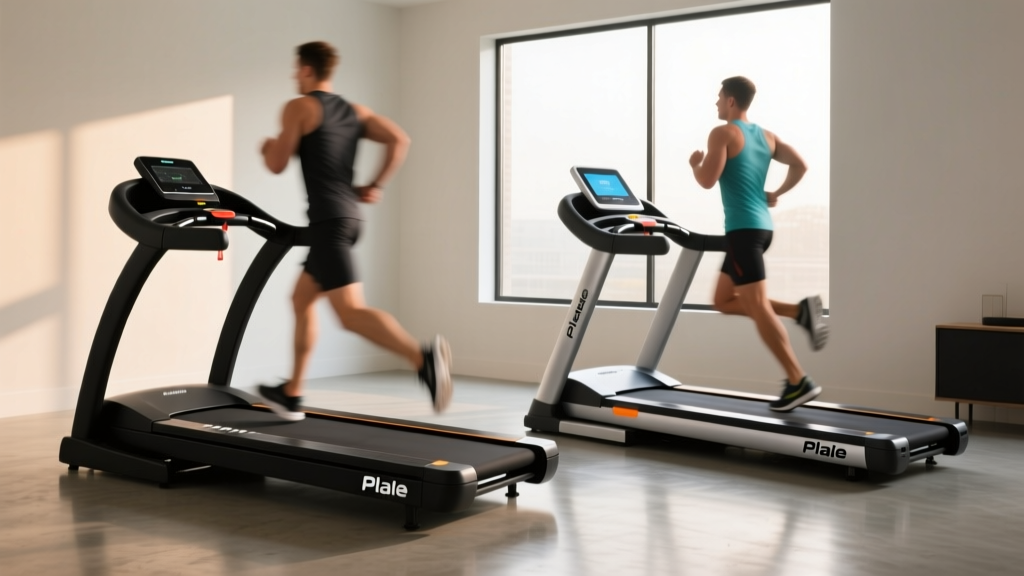
Plae Treadmill Showdown: Curved Manual vs Motorized
Compare curved manual and motorized treadmills. We break down biomechanics, pricing, and if a Plae treadmill fits your home gym.

When outfitting a home gym, the debate between curved manual treadmills and traditional motorized models is one of the most critical decisions you will make. If you have been researching niche or emerging manual runners, you may have encountered searches for the Plae treadmill or similar self-powered curved models. While the market is dominated by heavyweights like the TrueForm and AssaultRunner, understanding the fundamental mechanical divide between curved and motorized machines is essential before dropping thousands of dollars on equipment that might not match your biomechanical needs.
The Mechanical Divide: How They Actually Work
Curved manual treadmills operate entirely on human kinetics. The slatted belt rests on a concave track, meaning your foot strike pulls the belt down and back. There is no motor, no top speed limit, and no electrical outlet required. The resistance is generated purely by the friction of the bearings and the angle of the curve. Conversely, motorized treadmills rely on a continuous-duty horsepower (CHP) motor—typically ranging from 3.0 to 4.0 CHP in premium home models like the Sole F85 or NordicTrack Commercial 1750—to pull a continuous rubber belt over a rigid, cushioned deck.
Head-to-Head Specification Matrix
| Feature | Curved Manual (e.g., AssaultRunner) | Motorized (e.g., Sole F85) |
|---|---|---|
| Power Source | 100% Human Kinetic | 120V Wall Outlet (3.0 - 4.0 CHP) |
| Top Speed | Unlimited (User-dependent) | Capped (Usually 12 - 15 MPH) |
| Incline/Decline | Fixed Curve (Simulates 3-5% grade) | Adjustable (0% to 15% Incline) |
| Deck Cushioning | Minimal (Rubber slats on bearings) | High (Elastomer shock absorption) |
| Footprint | Compact (~65' L x 32' W) | Large (~80' L x 35' W) |
| Average Price | $3,499 - $5,995 | $1,899 - $2,999 |
Biomechanics and Caloric Expenditure
The most compelling argument for curved manual treadmills is the alteration of running biomechanics. According to research highlighted by the American College of Sports Medicine (ACSM), the concave shape of a manual treadmill naturally forces a forefoot or midfoot strike, reducing the heavy heel-strike impact common on motorized decks. This shift significantly decreases ground contact time (GCT) and vertical oscillation, promoting a more efficient running economy.
The 30% Calorie Burn Advantage
Multiple physiological studies indicate that running on a curved non-motorized treadmill increases energy expenditure by up to 30% compared to a motorized treadmill at the exact same perceived rate of exertion. This is because the user must not only support their body weight but also generate the kinetic force to move the heavy slatted belt. For athletes looking to maximize VO2 max in shorter time windows, this metabolic demand is a massive advantage.
However, motorized treadmills offer distinct biomechanical advantages for specific populations. The cushioned decks on models like the Sole F85 reduce joint impact by up to 40% compared to asphalt, making them the superior choice for heavy runners (over 220 lbs) or those recovering from lower-leg stress fractures. Furthermore, the American Council on Exercise (ACE) notes that motorized inclines (up to 15%) allow for targeted glute and hamstring activation without the sheer cardiovascular redline required on a flat curved machine.
Space, Footprint, and Placement Realities
One often-overlooked factor in the Plae treadmill search and broader curved vs. motorized debate is spatial footprint. Motorized treadmills require significant clearance. A standard commercial-grade motorized deck is 22 inches wide and 60 inches long, but the overall machine footprint often exceeds 80 inches in length and 35 inches in width, plus you must leave 24 inches of clearance behind the machine for safety. Curved manual treadmills, lacking a bulky motor housing and extended front console, typically measure around 65 inches long and 32 inches wide. This makes them vastly superior for apartment gyms, spare bedrooms, or garage setups where square footage is at a premium.
Total Cost of Ownership: Upfront Price vs. Maintenance
While a motorized treadmill often has a lower barrier to entry, the long-term cost of ownership tells a different story.
Curved Manual Maintenance
- Upfront Cost: High. Premium models like the TrueForm Runner cost around $5,995, while the AssaultRunner Elite sits at $3,499.
- Ongoing Costs: Near zero. No motor to burn out, no electronics to short-circuit. The primary maintenance involves occasionally replacing worn belt slats or re-greasing the track bearings every 2 to 3 years (a $50 DIY job).
Motorized Maintenance
- Upfront Cost: Moderate. High-end home models range from $1,899 to $2,999.
- Ongoing Costs: Moderate to High. Requires silicone belt lubrication every 150 miles. Motors and control boards are the most common failure points, with out-of-warranty replacements costing between $400 and $800. Interactive screens (like those on NordicTrack) may also require $396 to $468 annual subscription fees to access programming.
Troubleshooting Common Edge Cases
Edge Case 1: Heavy Runners on Curved Treadmills
Runners over 240 lbs often find the initial kinetic force required to 'break the inertia' of a curved belt exhausting. If you fall into this category, a high-CHP motorized treadmill with a 400 lb weight capacity is a safer, more comfortable starting point.Edge Case 2: Paced Endurance Training
If you are training for a marathon and need to hold an exact 8:15/mile pace for 18 miles, a curved treadmill is highly inefficient. The mental fatigue of manually regulating speed on a curve will degrade your form. Use a motorized treadmill to enforce the pace and let your brain focus on cadence and breathing.
For more in-depth analysis on how treadmill mechanics affect your stride, Runners Connect provides excellent breakdowns on how belt speed and deck stiffness alter your natural gait cycle over long distances.
The Decision Framework: Which Machine Matches Your Goals?
Choosing between a curved manual runner (whether you are looking at established brands or researching a Plae treadmill alternative) and a motorized unit comes down to your specific training demands and spatial constraints.
Buy a Curved Manual Treadmill If:
- You are a competitive runner looking to improve cadence, enforce a midfoot strike, and perform high-intensity interval training (HIIT) with zero motor lag.
- You want to place the machine in a room without convenient electrical outlets or where noise is a concern (curved treadmills are significantly quieter).
- You want a machine with a 10+ year lifespan and zero mandatory software subscription fees.
Buy a Motorized Treadmill If:
- You are training for specific paced endurance events (like a marathon) and need the machine to enforce an exact pace while you focus on form.
- You require joint-friendly cushioning for heavy walking, jogging, or physical rehabilitation.
- You rely on interactive programming, automated incline adjustments, and guided virtual runs to maintain daily motivation.
Final Verdict
The head-to-head comparison reveals that neither machine is universally superior; they are highly specialized tools. Curved manual treadmills are the ultimate biomechanical correctors and high-intensity engines, demanding more from the user but offering unparalleled longevity and calorie output. Motorized treadmills remain the kings of paced endurance training, joint preservation, and interactive engagement. Evaluate your specific training blocks, measure your floor space, and select the machine that aligns with your physiological needs.
More gear to consider
All reviews
2026 Market Analysis: Bike Types vs NordicTrack X9i Treadmill
Treadmill Hill Walking Workout Setup: Motor Size & Installation Guide

NordicTrack FlexSelect Treadmill: Small Space Review & Care Guide
2026 Market Trends: ProForm ProShox Treadmill Belt Maintenance

Curved vs Motorized Treadmill: How Long to Walk 10000 Steps?
