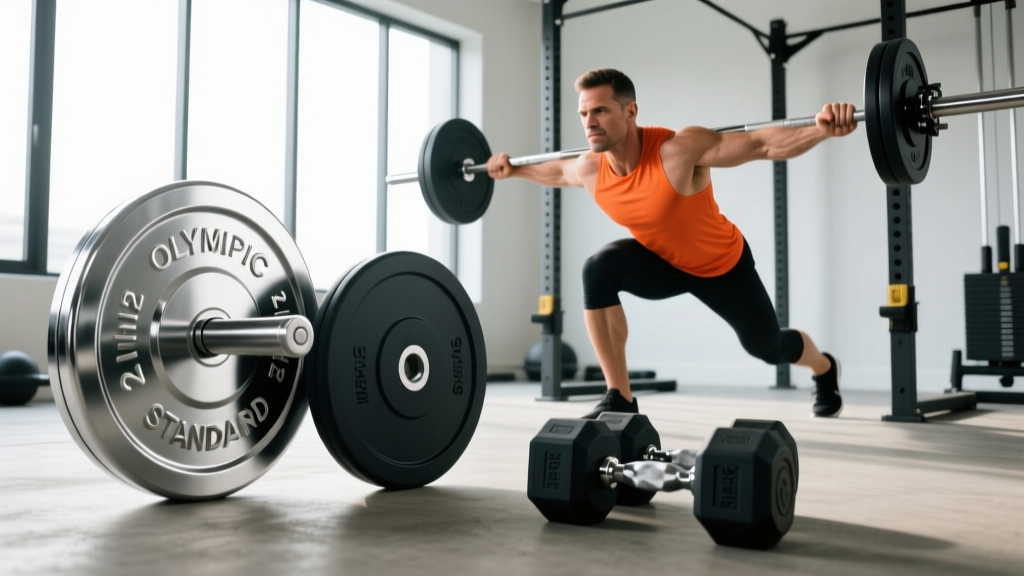
Olympic vs Standard Plates: Testing Pendlay Rows With Dumbbells
We pit standard 1-inch vs Olympic 2-inch weight plates head-to-head, testing loadable dumbbell handles for heavy Pendlay rows. Find your ideal setup.

Most lifters assume the debate between standard and Olympic weight plates only applies to barbell training. However, when you build a home gym and start performing Pendlay rows with dumbbells using loadable handles, the 1-inch vs. 2-inch plate ecosystem drastically changes your training outcomes. The Pendlay row is an uncompromising movement: it demands a strict horizontal torso, a dead-stop start from the floor, and an explosive concentric pull. This places immense rotational torque on the wrists and requires precise floor clearance.
In this head-to-head comparison, we are not just looking at the plates themselves. We are evaluating the entire loadable dumbbell ecosystem that these plates support, testing how standard (1-inch) and Olympic (2-inch) setups handle the biomechanical demands of heavy back training in 2026.
The Biomechanics Mandate: Unlike a standard bent-over row, the Pendlay row eliminates the stretch reflex. You must generate force from a dead stop. According to kinesiology data on horizontal pulling, this dead-stop requirement maximizes latissimus dorsi and rhomboid recruitment but heavily taxes the radioulnar joint if the equipment resists natural wrist rotation (ExRx.net).The Contenders: Standard (1") vs. Olympic (2") Ecosystems
Before we load up the handles, we must define the hardware. The Standard ecosystem relies on 1-inch diameter holes, typically utilizing cast iron or cement/vinyl-filled plates paired with budget-friendly spin-lock or spring-clip dumbbell handles (e.g., Yes4All or CAP Barbell). The Olympic ecosystem uses 2-inch holes, featuring high-density cast iron, urethane, or bumper plates paired with premium loadable dumbbell handles equipped with rotating sleeves (e.g., Rogue Fitness or Titan Fitness).
Head-to-Head Comparison Matrix
| Feature | Standard (1-Inch) Setup | Olympic (2-Inch) Setup |
|---|---|---|
| Handle Grip Diameter | 25mm - 28mm | 35mm - 40mm |
| Sleeve Rotation | Fixed (No rotation) | Bronze bushings or bearings |
| Max Load per Handle | ~45 lbs (limited by sleeve length) | 80 - 120+ lbs |
| 10lb Plate Profile | Thick (Vinyl/Cement) or Medium (Iron) | Slim (High-density Iron/Urethane) |
| Avg Cost per lb (2026) | $0.80 - $1.20 | $1.50 - $3.50 |
Test 1: Torque and Sleeve Rotation During the Pull
When you execute Pendlay rows with dumbbells, your hands naturally want to pronate or supinate slightly as you drive the elbows toward the ceiling. If the weight plates cannot rotate independently of the handle, that rotational force transfers directly into your wrists and elbows.
The Standard Failure Point
Standard 1-inch dumbbell handles almost universally feature fixed sleeves. When you load a 14-inch standard handle with 25-pound iron plates and pull explosively from the floor, the momentum of the plates creates severe torsional stress. Over a 4-set volume block, this fixed-sleeve torque leads to premature forearm fatigue and potential medial epicondylitis (golfer's elbow).
The Olympic Advantage
Premium Olympic loadable handles, such as the Rogue Loadable Dumbbell Handles (retailing around $175 per pair in 2026), utilize machined bronze bushings. This allows the 2-inch sleeve to spin freely during the concentric phase of the row. The plates absorb the rotational energy, keeping your wrists neutral and allowing you to focus entirely on scapular retraction and lat contraction.
Test 2: Grip Thickness and Forearm Fatigue
There is a hidden trade-off when upgrading to Olympic plates and handles: grip diameter. Standard handles mimic traditional dumbbells with a 25mm to 28mm grip. Olympic loadable handles are essentially scaled-down barbells, featuring a 35mm to 40mm grip diameter.
Expert Insight: A thicker 35mm grip drastically increases forearm and brachioradialis activation. While this is excellent for grip conditioning, it often becomes the limiting factor during heavy Pendlay rows. Your grip will fail before your lats reach true muscular failure.
The Fix: If you opt for the Olympic setup for its superior sleeve rotation and weight capacity, invest in a pair of figure-8 lifting straps or wrap-around cotton straps for your heaviest top sets. This bypasses the grip limitation and allows you to overload the back musculature safely.
Test 3: Floor Clearance and Plate Profile
The defining characteristic of the Pendlay row is the dead-stop start from the floor. The diameter and thickness of your weight plates dictate your starting torso angle.
- Standard Vinyl/Cement Plates: These are notoriously bulky. A standard 10-pound vinyl plate can have a diameter of over 11 inches. When loaded onto a dumbbell handle, this artificially raises the starting height of the row, forcing you to either round your upper back to reach the weight or alter your hip hinge, effectively turning the Pendlay row into a high-angle bent-over row.
- Olympic Cast Iron / Urethane Plates: Olympic iron plates are incredibly dense. A 10-pound Olympic plate (like the Rogue Deep Dish or standard machined iron) has a much smaller diameter and a slim profile. This keeps the center of gravity low and flush with the floor, ensuring a true horizontal pull and maximizing the range of motion at the bottom of the movement.
Test 4: Weight Capacity and Progressive Overload
Progressive overload is the engine of hypertrophy. The standard 1-inch ecosystem hits a hard ceiling very quickly. A typical 14-inch standard spin-lock handle has roughly 6 inches of loadable sleeve space per side. Because standard iron plates are thicker than Olympic equivalents, you will max out the sleeve at around 45 to 55 pounds per dumbbell.
Conversely, Olympic loadable dumbbell handles feature longer, thicker sleeves. Paired with thin-profile Olympic bumper plates or urethane fractional plates, you can easily load 80 to 120 pounds per hand. For intermediate and advanced lifters who can row heavy weight, the standard setup simply cannot support long-term progression.
The 2026 Market Reality: Cost vs. Longevity
As of 2026, global shipping costs for heavy cast iron have stabilized, but the price gap between standard and Olympic ecosystems remains significant. You can build a 100-pound standard plate set and buy a pair of spin-lock handles for under $120. An equivalent Olympic setup—factoring in the $175 handle investment and $2.00/lb iron plates—will push you past $350.
However, standard equipment suffers from poor resale value and rapid degradation (especially spin-lock collars that strip their threads). Olympic equipment holds its value exceptionally well on the secondary market and is built to withstand decades of being dropped on rubber mats.
The Verdict: Which Setup Wins for Back Day?
If your primary goal is performing Pendlay rows with dumbbells and other heavy, explosive loadable dumbbell movements, the Olympic ecosystem is the undisputed winner. The fixed sleeves and bulky profiles of standard plates actively work against the biomechanics of the Pendlay row, introducing unnecessary joint torque and limiting your starting position.
Who should buy Standard? Beginners on a strict budget who are focusing on higher-rep, lighter isolation movements (like lateral raises or bicep curls) and do not yet require loads exceeding 40 lbs per hand.
Who should buy Olympic? Intermediate to advanced lifters focused on strength, power, and hypertrophy. The investment in bushing-equipped Olympic handles and high-density plates will protect your wrists, allow for true dead-stop floor clearance, and provide the weight capacity needed for years of progressive overload.
Frequently Asked Questions
Can I use Olympic bumper plates for Pendlay rows?
Yes, but with a caveat. Bumper plates have a uniform 17.7-inch diameter regardless of weight. While this provides excellent floor clearance and protects your flooring from drops, the massive diameter can slightly alter your pulling path if you have a narrow stance. For Pendlay rows, machined cast iron or slim urethane Olympic plates are generally preferred over thick rubber bumpers.
Do I need lifting straps for loadable dumbbell rows?
Because Olympic loadable handles feature a thicker 35mm+ grip, lifting straps are highly recommended for your heaviest working sets. This ensures your back muscles reach failure before your grip gives out, which is crucial for maximizing hypertrophy during horizontal pulls.
More gear to consider
All reviews
Power Rack vs Squat Stand Setup & Cast Iron Dumbbell Storage

Barbell Knurling Guide: Weight Specs & Body Exercises with Dumbbells
Pull Exercises with Dumbbells: Adjustable Dumbbell Setup & Review

Barbell Collar & Clamp Types Comparison: Arnold Presses with Dumbbells

Olympic vs Standard Plates: Setup for Squats & Dumbbell Goblet Squats
