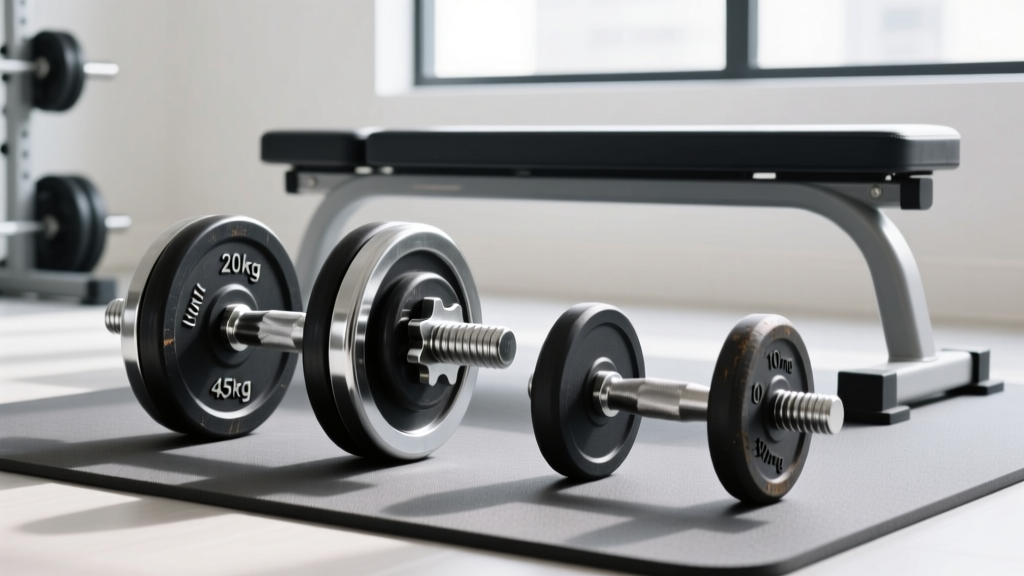
Choosing Standard vs Olympic Plates for Flat Dumbbell Bench Press
Compare Olympic vs standard plates for the flat dumbbell bench press. Discover handle limits, safety risks, and cost breakdowns for your home gym.

The Core Dilemma: 1-Inch Standard vs. 2-Inch Olympic
When outfitting a home gym in 2026, lifters are frequently confronted with a foundational equipment decision: should you invest in standard 1-inch weight plates or Olympic 2-inch plates? While this debate usually centers around barbells and power racks, it becomes uniquely critical when designing a setup for the flat dumbbell bench press. Unlike fixed-weight dumbbells, plate-loaded adjustable dumbbell handles offer unmatched versatility and cost-efficiency, but the axle diameter you choose dictates your safety, loading capacity, and biomechanical efficiency on the bench.
The flat dumbbell bench press requires immense stabilization, unilateral control, and a secure grip. If your plate-loaded handles fail under heavy loads, the consequences are severe. In this head-to-head comparison, we break down exactly how standard and Olympic plate systems perform specifically for dumbbell pressing, examining real-world failure modes, grip biomechanics, and long-term cost efficiency.
Head-to-Head Comparison Matrix
Before diving into the biomechanics and safety profiles, here is a direct specification comparison between standard and Olympic plate-loaded dumbbell systems as they apply to heavy pressing movements.
| Feature | Standard (1-Inch) System | Olympic (2-Inch) System |
|---|---|---|
| Plate Hole Diameter | 1 inch (25.4 mm) | 2 inches (50.8 mm) |
| Handle Grip Thickness | 1.0 inch to 1.1 inches | 1.25 inches to 1.5 inches |
| Max Safe Load Per Handle | 35 lbs - 45 lbs | 100 lbs - 150+ lbs |
| Collar Mechanism | Threaded Spin-Lock Nuts | Spring Collars / Pro Clamps |
| Average Handle Cost (Pair) | $25 - $40 | $90 - $160 |
| Plate Availability (Urethane) | Extremely Limited | Widely Available |
Standard 1-Inch Plates: The Budget Beginner Route
Standard weight plates feature a 1-inch center hole and are paired with inexpensive, typically 12-to-14-inch threaded dumbbell handles. Brands like Yes4All and CAP Barbell dominate this space, offering entry-level lifters a cheap way to perform the flat dumbbell bench press at home. For beginners pressing 15 to 25 pounds per hand, standard plates are perfectly adequate.
Real-World Limits and Failure Modes
The critical flaw of the standard system emerges once you progress past the novice stage. The 1-inch solid steel axles on budget handles are not designed for high lateral torque. When you load a standard handle with a 25-pound and a 10-pound cast iron plate, you max out the physical sleeve space.
Critical Safety Warning: The most common failure mode during a heavy flat dumbbell bench press with standard handles is the stripping or backing-off of the threaded spin-lock collar. As you lower the dumbbells during the eccentric phase, the rotational force can cause an under-tightened spin-lock nut to unthread. If the collar fails, the plates slide off the sleeve, dropping raw iron directly onto your chest, face, or the floor.Because of this inherent design limitation, standard 1-inch dumbbell handles are effectively capped at around 45 pounds per hand. Once your flat dumbbell bench press surpasses this weight, you must abandon standard plates and upgrade your entire system.
Olympic 2-Inch Plates: The Heavy Lifter's Standard
Olympic plates feature a 2-inch (50.8 mm) center hole, designed to fit over the thick, machined steel sleeves of Olympic dumbbell handles. Models like the Titan Fitness 20-Inch Olympic Dumbbell Handles or Rogue Fitness Loadable Dumbbells represent the gold standard for serious home gyms and commercial facilities alike.
Unmatched Loading Capacity and Security
An Olympic loadable dumbbell handle features a sleeve diameter of 1.96 inches, allowing you to use the exact same high-quality bumper or urethane plates you use on your barbell. More importantly, Olympic handles utilize smooth sleeves secured by heavy-duty spring collars or aluminum clamp collars. These collars apply hundreds of pounds of lateral clamping force, completely eliminating the risk of plates sliding off during the concentric or eccentric phases of the flat dumbbell bench press.
With sleeve lengths often exceeding 8 inches per side, a single Olympic dumbbell handle can comfortably hold over 120 pounds of plates. This future-proofs your equipment; you will never outgrow your handles, regardless of how strong your chest and triceps become.
Biomechanics: How Grip Thickness Alters the Press
One of the most overlooked aspects of choosing between standard and Olympic plates is how the corresponding handle thickness affects the biomechanics of the flat dumbbell bench press. Standard handles are exactly 1 inch thick. Olympic dumbbell handles typically feature a grip shaft ranging from 1.25 inches to 1.5 inches.
'A thicker grip shaft reduces the moment arm on the wrist joint, keeping the wrist in a more neutral, stacked position under heavy loads, which is crucial for maximizing pectoralis sternal recruitment without wrist pain.'
According to exercise mechanics documented by ExRx.net, maintaining a neutral wrist alignment is vital for transferring force directly from the forearm through the palm into the dumbbell. A 1-inch standard handle often forces lifters with larger hands to over-grip, causing the wrist to extend backward under heavy loads. This wrist extension leaks kinetic energy and places immense strain on the carpal tunnel.
Conversely, the 1.25-inch to 1.5-inch grip of an Olympic handle fills the palm, naturally stacking the radius and ulna bones directly under the load. While this thicker grip may initially cause forearm fatigue for those unaccustomed to it, it ultimately allows for safer, heavier, and more stable pressing over the long term. For a comprehensive look at how equipment dimensions affect lifting, BarBend's guide on standard vs. Olympic weights further highlights the durability and biomechanical superiority of the 2-inch standard in professional environments.
Cost Analysis: Building Your Plate-Loaded Dumbbell Set
In 2026, the price gap between standard and Olympic cast iron has narrowed slightly due to global shipping adjustments, but Olympic remains a premium investment. Here is a realistic cost breakdown for building a 100-pound total dumbbell set (two 50-lb dumbbells) for your flat bench press.
Standard 1-Inch Setup Cost
- Handles (Pair): $28.00 (14-inch threaded spin-lock)
- Cast Iron Plates: $1.20 per lb × 100 lbs = $120.00
- Total Investment: ~$148.00
- Longevity: 1-2 years before outgrowing the handles.
Olympic 2-Inch Setup Cost
- Handles (Pair): $110.00 (20-inch machined steel with snap rings)
- Cast Iron Plates: $1.80 per lb × 100 lbs = $180.00
- Heavy-Duty Spring Collars: $25.00
- Total Investment: ~$315.00
- Longevity: Lifetime. Handles will support up to 150+ lbs per hand if you eventually add more plates.
While the Olympic setup requires more than double the initial capital, it eliminates the 'beginner tax' of buying cheap standard handles only to replace them a year later when your flat dumbbell bench press stalls at 40 pounds.
Step-by-Step Safety Protocol for Plate-Loaded Pressing
Regardless of whether you are using standard or Olympic plates, loading a dumbbell for the flat bench press requires a strict safety protocol to prevent asymmetrical loading and sleeve damage.
- Load Symmetrically: Always alternate plates when building heavy dumbbells. Load one 25lb plate on the left, then one on the right. This prevents the handle from becoming severely off-balance, which can strip the internal snap-rings on Olympic handles or bend standard axles.
- Use Fractional Plates for Micro-Loading: The flat dumbbell bench press is highly sensitive to weight jumps. Instead of jumping from 50 lbs to 60 lbs per hand, use 1.25 lb or 2.5 lb Olympic fractional plates to bridge the gap safely.
- Secure Collars Before Lifting: Never perform a press without collars. For Olympic handles, push the spring collar completely flush against the outermost plate. For standard handles, use a star-pattern tightening sequence and ensure at least 4 threads are visible past the nut.
- The Knee-Kick Technique: When handling heavy plate-loaded dumbbells (60+ lbs), do not attempt to curl them into position. Rest the dumbbell heads on your thighs, use a forceful knee-kick to launch them to your shoulders, and lean back onto the flat bench simultaneously.
Expert Verdict: Which Setup Wins?
For the flat dumbbell bench press, the Olympic 2-inch plate and handle system is the undisputed winner for any lifter serious about progressive overload. The standard 1-inch system is a temporary toy that introduces severe safety risks—specifically spin-lock collar failure—once you approach intermediate strength levels.
The superior grip thickness of Olympic handles promotes better wrist stacking, the sleeve length allows for massive loading potential, and the compatibility with modern urethane and bumper plates makes it a cornerstone of any complete home gym. Invest in Olympic loadable handles from day one, and your chest development will never be bottlenecked by your equipment.
Frequently Asked Questions
Can I use Olympic plates on standard dumbbell handles?
No. Olympic plates have a 2-inch center hole, while standard handles have a 1-inch axle. The plates will simply slide right off the handle. There are no safe, reliable adapters to reduce a 2-inch hole to a 1-inch axle for heavy pressing movements.
Are Olympic dumbbell handles too heavy on their own?
Olympic loadable handles typically weigh between 5 and 10 pounds empty, compared to 2 to 4 pounds for standard handles. When calculating your total weight for the flat dumbbell bench press, remember to factor in the empty handle weight to accurately track your progressive overload.
Will thick Olympic handles limit my tricep isolation work?
While a 1.5-inch Olympic handle is excellent for the flat dumbbell bench press, it can make tight-movement isolation exercises like skull crushers or close-grip pressing slightly awkward. However, for primary compound chest movements, the stability benefits far outweigh the minor loss in range of motion.
More gear to consider
All reviews
Space-Saving Home Exercise With Dumbbells: Rubber Hex vs Urethane

Power Rack vs Squat Stand: SA Dumbbell Bench Press Setups
Barbell Collars vs Clamps: Squats & Lat Raises Dumbbells Safety Guide

Best Dumbbell Racks for Incline Dumbbell Fly Setups (2026)

Power Rack vs Squat Rack Setup: Dumbbell Shoulder Press Muscles Worked Clearance
