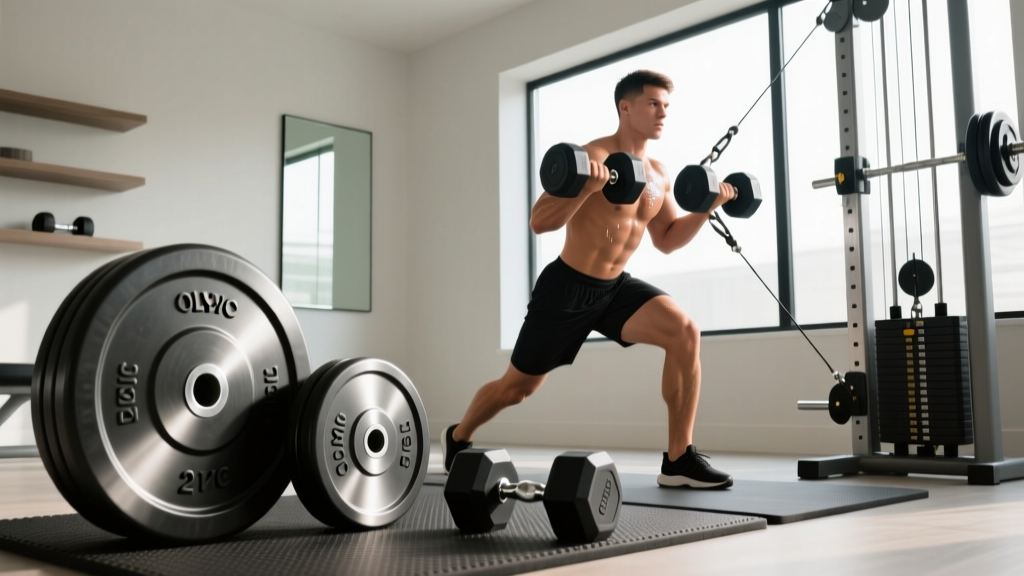
Olympic vs Standard Plates & York Rubber Hex Dumbbell Buying Guide
Compare Olympic vs standard weight plates and explore the York rubber hex dumbbell for your 2026 home gym. Expert specs, pricing, and failure modes.

The Foundation of Free Weights: Standard vs. Olympic Systems
When architecting a home or commercial gym in 2026, the most critical structural decision you will make is choosing your free weight ecosystem. The debate between standard (1-inch) and Olympic (2-inch) weight plate systems dictates not only your barbell compatibility but also your ceiling for progressive overload. However, a complete free weight setup extends far beyond barbells. To achieve true muscular symmetry and joint-friendly isolation, integrating high-quality fixed weights—like the industry-standard York rubber hex dumbbell—is non-negotiable. This comprehensive buying guide breaks down the metallurgy, pricing, and failure modes of plate systems while evaluating why York's hex dumbbells remain a staple in modern training facilities.
Executive Decision Matrix
- Choose Standard (1-Inch): If your budget is strictly under $300, you are exclusively doing light rehab or toning, and your max lifts will never exceed 200 lbs.
- Choose Olympic (2-Inch): If you plan to squat, deadlift, or bench press seriously. The 50mm sleeve standard supports 1,000+ lb loads without bar whip or sleeve failure.
- Add York Rubber Hex Dumbbells: Essential for unilateral isolation, drop sets, and stabilizer muscle recruitment that barbells cannot provide.
Standard Weight Plates (1-Inch System): The Budget Entry Point
Standard weight plates feature a 1-inch (25.4mm) center hole, designed to slide onto standard threaded or smooth spin-lock bars. While they dominate big-box sporting goods stores, their limitations in a serious training environment are rooted in basic physics.
Material Variants and Real-World Limitations
Standard plates typically come in two materials: cast iron and vinyl-cement. Vinyl-cement plates are bulky, prone to cracking if dropped, and suffer from severe weight calibration variances (often off by 5-10%). Cast iron standard plates are more durable but introduce a critical failure point: the barbell itself.
'The yield strength of a standard 1-inch solid steel barbell is generally capped around 250 to 300 pounds of distributed load. Beyond this threshold, the bar will permanently bend, and the welded collars are prone to snapping under dynamic stress.' — Garage Gym Reviews Equipment Testing Lab
Pricing in 2026: Standard cast iron plates average $1.20 to $1.60 per pound. Vinyl-cement sets can be found as low as $0.80 per pound during holiday sales.
Olympic Weight Plates (2-Inch System): The Commercial Standard
Olympic plates feature a 2.005-inch (51mm) center hole, mating perfectly with the 50mm sleeves of Olympic barbells. Governed by the International Weightlifting Federation (IWF), this system is the undisputed global standard for powerlifting, Olympic lifting, and general strength training.
Cast Iron vs. Bumper Plates: Which Do You Need?
Not all Olympic plates are created equal. Your choice between iron and rubber bumpers depends entirely on your training modality and flooring setup.
- Machined Cast Iron: Ideal for powerlifting (squats, bench, deadlifts). They are thin, allowing you to load over 800 lbs on a standard barbell sleeve. They feature raised lips for easy gripping. Failure mode: Rust if stored in unclimate-controlled garages; chipping paint.
- Virgin Rubber Bumpers: Essential for Olympic weightlifting (cleans, snatches) and CrossFit. They share a uniform diameter (450mm) regardless of weight, allowing you to drop the bar safely. Failure mode: Cheap recycled rubber bumpers suffer from 'dead bounce' (bouncing dangerously high) and hub-insert pop-outs. Always look for a durometer rating of 85A-90A for controlled dead-bounce.
Pricing in 2026: Olympic cast iron averages $1.80 to $2.50 per pound. High-quality competition bumpers range from $4.00 to $7.00+ per pound.
The Isolation Essential: York Rubber Hex Dumbbell Deep Dive
While plate-loaded barbells are the kings of compound movements, they lack the unilateral freedom required to fix muscle imbalances. This is where fixed-weight dumbbells enter the equation. Among the myriad options on the market, the York rubber hex dumbbell stands out as a premier choice for both commercial facilities and premium home gyms.
Engineering and Material Science
York Barbell has been a titan in the fitness industry for decades. Their Premium Rubber Hex Dumbbells are engineered to solve the common complaints associated with cheaper fixed weights:
- Virgin Rubber Coating: Unlike budget dumbbells that use recycled tire rubber (which off-gases a toxic, lingering odor and degrades under UV light), York uses premium virgin rubber. It is odorless, UV-resistant, and protects your flooring from impact damage.
- Hexagonal Anti-Roll Design: The flat edges of the hex head prevent the dumbbell from rolling away when set down, a crucial safety feature when performing heavy floor presses or renegade rows.
- Ergonomic Chrome Handles: The steel handles feature medium-depth diamond knurling. This provides adequate grip security for heavy shrugs and presses without tearing the calluses on your hands during high-rep hypertrophy work.
York Rubber Hex Pricing and Sizing Strategy
When purchasing York rubber hex dumbbells, be aware of the 'lightweight tax.' Manufacturing smaller dumbbells requires the same handle assembly labor as larger ones, resulting in a higher cost-per-pound for lighter weights.
- 5 lb - 20 lb pairs: Expect to pay $3.50 - $4.50 per pound.
- 25 lb - 50 lb pairs: The sweet spot for pricing, averaging $2.00 - $2.75 per pound.
- 55 lb - 100+ lb pairs: Heavy duty pairs hover around $1.80 - $2.20 per pound.
Comprehensive Free Weight Comparison Matrix
Use the table below to cross-reference your equipment needs based on structural integrity, cost, and application.
| Equipment Type | Hole / Grip Spec | Material Core | Avg. Cost / Lb (2026) | Max Load / Use Case |
|---|---|---|---|---|
| Standard Vinyl Plates | 1-Inch Hole | Cement / Sand | $0.80 - $1.00 | 150 lbs / Beginners |
| Standard Cast Iron | 1-Inch Hole | Solid Cast Iron | $1.20 - $1.60 | 250 lbs / Light Compounds |
| Olympic Cast Iron | 2.005-Inch (51mm) | Machined Iron | $1.80 - $2.50 | 1,000+ lbs / Powerlifting |
| Olympic Bumper Plates | 2.005-Inch (51mm) | Virgin Rubber / Steel Hub | $4.00 - $7.00 | Drops / Olympic Lifts |
| York Rubber Hex DB | Fixed Ergonomic Grip | Cast Iron / Virgin Rubber | $2.00 - $4.50 | Unilateral / Isolation |
2026 Purchasing Strategy: Avoiding Edge Cases and Scams
As global supply chains for cast iron and raw rubber have stabilized in 2026, prices have normalized, but the market is still flooded with deceptive 'commercial-grade' marketing. Here is how to protect your investment:
1. The 'Recycled Rubber' Trap
Many budget brands sell rubber-coated hex dumbbells and bumper plates made from recycled tires. While eco-friendly in theory, the vulcanization process used to bind recycled rubber to steel cores is often inferior. Failure mode: The rubber head snaps off the steel handle mid-curl. Always verify that products like the York rubber hex dumbbell explicitly state the use of virgin or premium rubber.
2. Barbell Sleeve Tolerances
If you buy Olympic plates, ensure your barbell sleeves are exactly 50mm (1.96 inches). Some cheap, offshore-manufactured 'Olympic' bars feature sleeves that are 51mm or 52mm thick. This causes plates to wobble, destroying the barbell's needle bearings and creating a dangerous shifting of mass during heavy squats. Refer to York Barbell's official specifications for proper tolerance matching between their plates, dumbbells, and barbells.
Frequently Asked Questions
Can I use a 1-inch standard plate on an Olympic barbell?
No. Standard plates have a 1-inch hole, while Olympic barbell sleeves are 2 inches (50mm) thick. While you can buy plastic adapter rings to make standard plates fit an Olympic bar, this is highly discouraged. The plastic adapters introduce 'slop' (lateral movement), which ruins the balance of the bar and can crack under heavy loads.
Why do York rubber hex dumbbells cost more per pound in lighter weights?
The manufacturing cost of the steel handle, knurling, and rubber molding process is relatively fixed regardless of the dumbbell's size. Therefore, a 10 lb dumbbell requires the same labor and handle materials as a 50 lb dumbbell, resulting in a higher cost-per-pound ratio for the lighter implements.
Do I need bumper plates if I have a rubber gym floor?
If you are performing dynamic Olympic lifts (cleans, snatches) or high-rep CrossFit workouts where the bar is dropped from overhead, yes. Rubber flooring protects your concrete subfloor, but it will not absorb the kinetic energy of a 300 lb barbell drop. Bumper plates are engineered to absorb and dissipate that shock, saving both your floor and your barbell's internal bearings.
More gear to consider
All reviews
Storing a 200 Pound Dumbbell: Heavy-Duty Rack Reviews 2026

Cap Barbell Hex Dumbbell vs Adjustables: Review & Mistakes

Power Rack vs Squat Rack vs Squat Stand: Best Setup for Back Exercises with One Dumbbell

Power Rack vs Squat Rack for Seated Dumbbell Shoulder Press Setup
Pull Exercises with Dumbbells: Adjustable Dumbbell Setup & Review