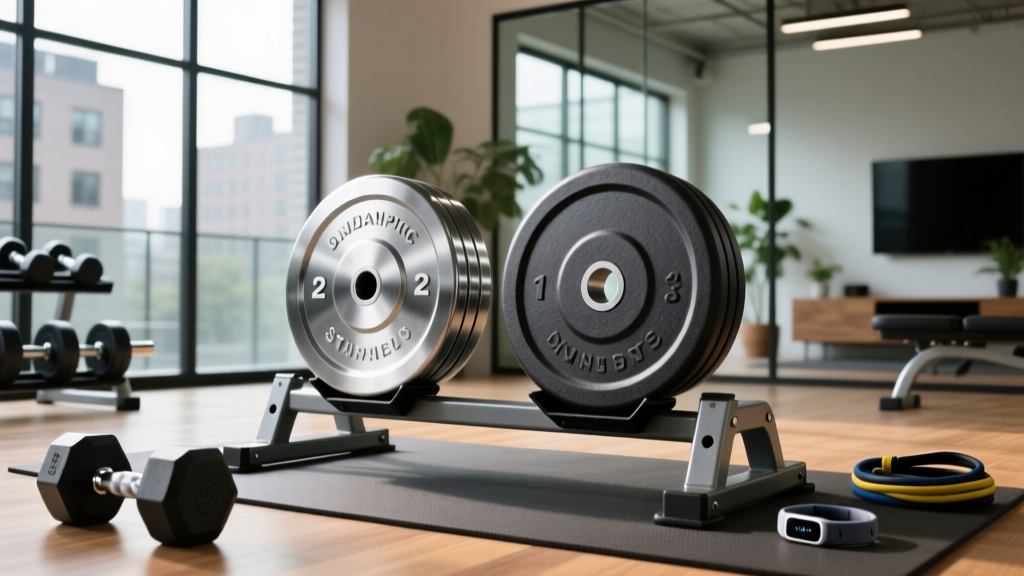
Olympic vs Standard Plates: Building the World's Heaviest Dumbbell
Discover the critical differences between Olympic and standard weight plates, and why Olympic gear is required to build the world's heaviest dumbbell.

The Great Divide: 1-Inch Standard vs. 2-Inch Olympic
When outfitting a home gym or upgrading a commercial facility, the choice between standard and Olympic weight plates is the foundational decision that dictates your entire equipment ecosystem. At first glance, the difference seems to be nothing more than the diameter of the center hole: 1 inch for standard plates and 2 inches (50mm) for Olympic plates. However, this single dimensional variance cascades into massive differences in metallurgy, rotational mechanics, spatial footprint, and maximum load capacity.
Many beginners are lured by the lower upfront cost of standard cast-iron or cement-filled plates. But as your strength progresses, the limitations of 1-inch equipment become glaringly obvious. To understand why the fitness industry universally standardizes around the 2-inch Olympic system, we have to look at the extreme end of the loading spectrum. What happens when you push unilateral lifting to its absolute limits? What if you wanted to engineer or lift a replica of the world's heaviest dumbbell? The answer reveals exactly why standard plates and bars fail, and why Olympic gear is a non-negotiable investment for serious lifters.
Comparison Matrix: Standard vs. Olympic Weight Plates
Before diving into the physics of heavy lifting, let's break down the raw specifications. The table below highlights the mechanical and economic differences between the two systems as of 2026.
| Feature | Standard Plates (1-Inch) | Olympic Plates (2-Inch / 50mm) |
|---|---|---|
| Center Hole Diameter | 1 inch (25.4mm) | 2 inches (50mm) |
| 45lb Plate Diameter | 14" - 15" (Cast Iron) / 19"+ (Vinyl) | 17.7" (450mm - IWF Standard) |
| Barbell Sleeve Length | 10" - 12" (Typically) | 15" - 16.5" |
| Max Barbell Tensile Strength | ~45,000 PSI (Low-Carbon Steel) | 165,000 - 215,000 PSI (Spring Steel) |
| Sleeve Rotation | Fixed / Solid Steel | Bushings or Needle Bearings |
| Average Cost Per Pound | $1.00 - $1.80 / lb | $2.00 - $8.00+ / lb |
| Ideal User Profile | Light rehab, extreme budget constraints | Powerlifting, Olympic lifting, Strongman, general fitness |
The "World's Heaviest Dumbbell" Stress Test
To truly understand the mechanical superiority of the Olympic system, we must examine extreme unilateral loading. In the lore of strength sports, the legendary Thomas Inch dumbbell remains a benchmark of grip and pressing power. The original implement weighed 172 lbs (78 kg) and featured a massive 2.38-inch thick handle. Today, modern strongmen and specialty gyms utilize loadable dumbbell handles to push this boundary even further, creating custom implements that exceed 300 lbs per hand.
Attempting to build the world's heaviest dumbbell using standard 1-inch equipment is not just impractical; it is a catastrophic safety hazard. Here is the engineering breakdown of why standard plates and bars physically cannot support extreme heavy dumbbell construction.
1. Shear Stress and Yield Strength
A standard 1-inch dumbbell handle is typically made from low-carbon steel with a tensile strength hovering around 45,000 to 60,000 PSI. When you load a standard handle with 100+ lbs of standard cast iron plates, the sheer force applied to the junction where the sleeve meets the handle (the weld or press-fit point) approaches the metal's yield strength. Under the dynamic force of a heavy dumbbell press or a farmer's walk, a 1-inch standard sleeve is highly prone to shearing off or permanently bending.
Conversely, Olympic loadable dumbbell handles (like those produced by Rogue or IronMind) are machined from high-tensile steel exceeding 190,000 PSI. The 2-inch sleeve diameter provides a vastly larger surface area for the weld or snap-ring retention system, distributing the shear stress and allowing the handle to safely support 300+ lbs of Olympic bumper or urethane plates.
2. Sleeve Length and Plate Volume
Standard plates, particularly the cheaper vinyl-encased cement varieties, suffer from a massive volume-to-weight ratio. A 45lb standard cement plate can be over 19 inches in diameter and 4 inches thick. Because standard dumbbell sleeves max out at around 10 to 12 inches in length, you physically run out of sleeve space before you can load a truly heavy weight.
Olympic plates are dense. A 55lb cast-iron Olympic plate is barely 1.5 inches thick. An Olympic loadable dumbbell handle features a 15-inch sleeve, allowing you to stack hundreds of pounds of dense iron or urethane plates while still leaving room for a heavy-duty spring clip or collar. As noted in comprehensive equipment guides by BarBend, the spatial efficiency of Olympic plates is critical for maintaining a manageable center of gravity on heavy implements.
3. Rotational Mechanics and Wrist Torque
When you lift a massive dumbbell, the plates want to spin due to the torque generated by your wrist and elbow joints. Standard plates are locked onto a fixed, solid steel 1-inch sleeve. If the plates cannot rotate independently of the handle, that rotational force is transferred directly into your wrist and elbow joints, leading to severe connective tissue strain.
Olympic dumbbell handles utilize internal bronze bushings or needle bearings. This allows the heavy plates to rotate freely around the 2-inch sleeve while the lifter maintains a secure grip on the handle. If you are attempting to press a 172lb Thomas Inch replica dumbbell, that independent sleeve rotation is the only thing keeping your wrists from snapping under the gyroscopic torque of the massive iron heads.
⚠️ SAFETY WARNING: The Vinyl Plate TrapMany budget-friendly standard plates are filled with cement and coated in vinyl. While cheap (often under $1.00/lb), these plates are notoriously inaccurate in weight, sometimes varying by 10-15% from their stated mass. Furthermore, their massive physical footprint severely limits your range of motion on exercises like dumbbell floor presses or barbell back squats, effectively robbing you of proper biomechanical development.
Real-World Pricing and Space Economics
While the Olympic system is mechanically superior, the financial and spatial realities of buying weight plates in 2026 require careful planning.
- Standard Cast Iron: You can typically find used or imported 1-inch cast iron plates for $1.00 to $1.50 per pound. A 300lb set will cost around $350 and take up minimal floor space.
- Olympic Cast Iron: New, machined Olympic iron plates (like the Rogue Machined Iron Plates) run between $2.00 and $2.50 per pound. A 300lb set will cost roughly $650.
- Olympic Urethane/Rubber: For commercial gyms or home gyms where noise and floor protection are priorities, virgin rubber or urethane Olympic plates cost between $3.50 and $8.00+ per pound. A 300lb set can easily exceed $1,500.
From a spatial perspective, standard plates are generally narrower, making them slightly easier to store on small A-frame racks. However, the 17.7-inch diameter of Olympic 45lb plates is a universal standard, meaning they align perfectly with the height of standard power rack J-cups (which sit roughly 16-17 inches off the floor). Standard 45lb iron plates are often only 14 inches in diameter, meaning you must perform a "deadlift" just to get the barbell into the starting position for a bench press or squat, completely altering the mechanics of the lift.
The Final Verdict: Future-Proofing Your Gym
The debate between standard and Olympic weight plates is ultimately a question of longevity. Standard 1-inch equipment serves a very narrow demographic: physical therapy clinics, ultra-budget temporary setups, or light-resistance isolation work.
If your goal is to build a comprehensive home gym, pursue progressive overload, or eventually test your mettle against legendary strongman implements like the world's heaviest dumbbell, the 2-inch Olympic system is the only viable path. The initial premium you pay for Olympic plates and bars buys you superior metallurgy, independent sleeve rotation, standardized dimensions, and an infinite ceiling for your strength potential. Do not bottleneck your physical progress by investing in a 1-inch ecosystem that you will inevitably outgrow and have to replace.
More gear to consider
All reviews
Reverse Grip Incline Dumbbell Press: Rubber Hex vs Urethane Value
Bumper Plate vs Iron Plate vs a Dumbbell That Changes Weight

EZ Bar vs Straight Bar & Chest Workouts With One Dumbbell Layouts
Olympic Barbell Knurling: Rogue vs Eleiko & Dumbbell Fly Exercises

2026 Rack Market: Storing Weights for the Close Dumbbell Press
