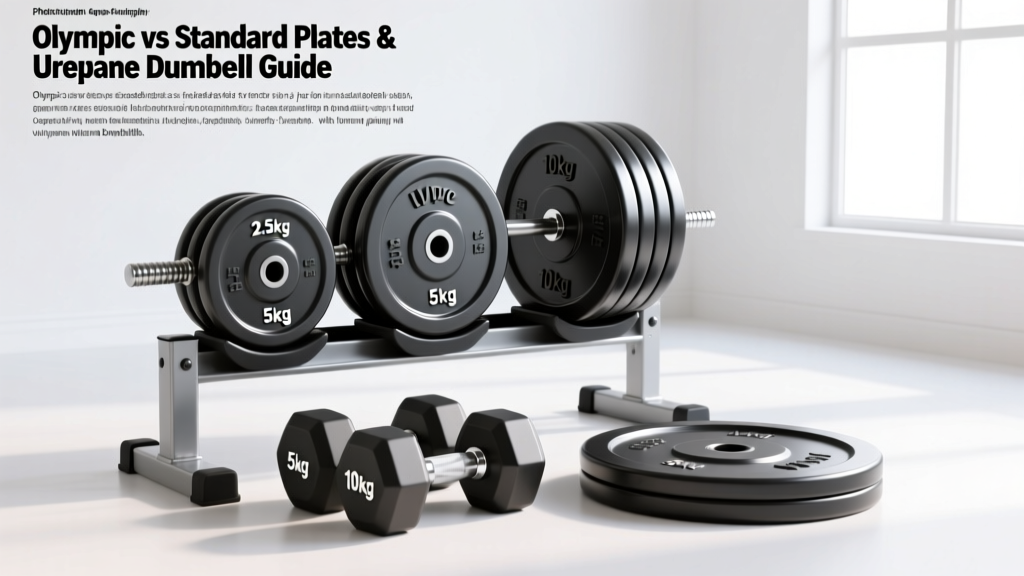
Olympic vs Standard Plates & Urethane Dumbbell Guide
Compare Olympic vs standard weight plates for your home gym. Learn sleeve specs, load limits, and how to pair them with a premium urethane dumbbell set.

When building a comprehensive free weight ecosystem in 2026, the foundational decision always begins at the sleeve of the barbell. The split between Olympic and standard weight plates dictates not only your barbell choices but also your storage solutions, rack compatibility, and even your secondary implements, such as a premium urethane dumbbell set. While standard plates offer an accessible entry point for casual lifters, Olympic plates represent the undisputed gold standard for serious strength training, commercial facilities, and high-end home gyms.
In this in-depth buying guide, we will dissect the metallurgical, dimensional, and practical differences between Olympic (50mm) and standard (25mm) weight plates. Furthermore, we will explore how your plate choice influences the integration of high-density free weights, specifically focusing on why pairing Olympic plates with a commercial-grade urethane dumbbell collection is the ultimate blueprint for a future-proof home gym.
The Dimensional Divide: 50mm vs 25mm Sleeves
The most obvious distinction between the two plate categories is the center hole diameter, which corresponds directly to the barbell sleeve size.
- Standard Plates (1-inch / 25mm): These plates feature a 1-inch center hole designed to fit standard solid steel or hollow-core barbells. They are typically found in big-box sporting goods stores and budget-friendly home gym starter kits.
- Olympic Plates (2-inch / 50mm): Featuring a 50mm (approx. 1.97-inch) center hole, these plates are engineered for Olympic barbells. The actual hole tolerance on high-quality Olympic plates is often machined to 50.4mm to 50.8mm to allow for smooth rotation over the barbell's bronze bushings or needle bearings without excessive friction.
Comparison Matrix: Olympic vs Standard Weight Plates
To visualize the stark differences in performance, durability, and cost, review the 2026 comparison matrix below:
| Feature | Standard Plates (25mm) | Olympic Plates (50mm) |
|---|---|---|
| Hole Diameter | 1 inch (25.4mm) | 2 inches (50mm) |
| Max Load Capacity | 200 - 300 lbs (bar dependent) | 500 - 1,500+ lbs |
| Common Materials | Cast Iron, Vinyl-Encased Concrete | Cast Iron, Rubber, Urethane, Bumper |
| Avg. Price Per Pound | $0.80 - $1.20 / lb | $1.50 - $3.50 / lb |
| Calibration Accuracy | +/- 5% variance | +/- 1% to 2% variance |
| Resale Value | Low (Hard to sell used) | High (Holds 70%+ value) |
Material Science: Iron, Rubber, and the Urethane Standard
While standard plates are almost exclusively made from cheap cast iron or concrete encased in vinyl, the Olympic ecosystem opens the door to advanced material science. This is where the concept of the urethane dumbbell and urethane-coated plates becomes highly relevant.
The Problem with Rubber and Vinyl
Virgin and recycled rubber plates are popular for their noise-dampening qualities. However, rubber is highly susceptible to UV degradation, meaning plates left near a garage window will eventually chalk, crack, and emit a permanent, noxious off-gassing odor. Vinyl-encased standard plates are even worse; the plastic shells crack under minor impacts, exposing the fragile concrete or sand fillings inside to moisture.
The Urethane Advantage
Urethane (specifically high-grade polyurethane) is a premium elastomer that bridges the gap between the durability of steel and the floor-protecting qualities of rubber. A high-quality urethane dumbbell or urethane-coated Olympic plate features a Shore hardness rating between 85A and 90A. This makes the equipment virtually odorless, highly resistant to UV fading, and impervious to the sweat and chalk acids that degrade standard rubber over time.
If you are investing in a premium Olympic plate set, pairing it with a top-tier urethane dumbbell rack ensures your entire free weight ecosystem shares the same commercial-grade lifespan. According to industry testing, urethane coatings can withstand thousands of drops from waist height without delaminating from the steel core, a feat standard rubber simply cannot match.
Load Capacity and the 'Standard Bar Bend' Failure Mode
One of the most critical, yet frequently overlooked, aspects of the standard vs. Olympic debate is the yield strength of the accompanying barbells. Standard 1-inch barbells are typically constructed from basic solid steel or hollow tubing.
Warning: Plastic DeformationWhen a standard barbell is loaded beyond 200 to 250 lbs, the steel often exceeds its yield point. This results in 'plastic deformation'—meaning the bar will permanently bend and will not spring back to its original straight position. Once a standard bar bends, the sleeves warp, making it nearly impossible to load or unload standard plates safely.
Olympic barbells, conversely, are forged from high-tensile spring steel (often rated between 190,000 and 215,000 PSI). They are designed to flex under heavy loads (like a 400-lb squat) and aggressively whip back to center. Because Olympic plates are designed to be loaded onto these high-capacity bars, you can safely stack 45-lb iron plates up to the collar without fearing catastrophic equipment failure.
Ecosystem Integration: Racks, Storage, and Dumbbells
Your choice of plates dictates your storage footprint. Standard plates require compact, often flimsy A-frame racks or small peg trees. Olympic plates require heavy-duty vertical trees or horizontal cradles welded to the base of a power rack.
Furthermore, integrating a urethane dumbbell set into this ecosystem requires careful spatial planning. Urethane dumbbells are typically manufactured with a hexagonal or 12-sided (dodecagonal) head to prevent rolling. A 5-to-50 lb urethane dumbbell set requires a robust 3-tier steel rack. By standardizing your gym with Olympic plates and urethane free weights, you can purchase unified storage solutions—such as a power rack with integrated lat-pulldown weight stacks and rear-mounted Olympic plate storage—keeping your gym floor clear and safe.
Decision Framework: Which Path Should You Take?
Use this practical framework to determine which plate type aligns with your 2026 fitness goals:
- Choose Standard Plates If: You are strictly performing light isolation exercises, rehab work, or outfitting a temporary space with a strict budget under $300. Expect to outgrow this setup within 6 to 12 months.
- Choose Olympic Cast Iron If: You are focused on powerlifting, barbell cycling, or general strength, and want a traditional, no-nonsense setup with high resale value.
- Choose Olympic Urethane/Rubber If: You are building a premium home gym, commercial studio, or CrossFit box where noise reduction, floor protection, and aesthetic uniformity with your urethane dumbbell rack are paramount.
Frequently Asked Questions
Can I use standard plates on an Olympic barbell?
Yes, but only with a specialized sleeve adapter that converts the 50mm sleeve down to 25mm. However, this is highly discouraged for heavy lifting. The adapters add unnecessary length to the sleeve, altering the bar's center of gravity and whip characteristics, and they can scratch the barbell's zinc or chrome finish.
Why do urethane dumbbells cost significantly more than rubber?
The raw material cost of polyurethane is higher than recycled rubber, and the manufacturing process requires precision molding to ensure the urethane permanently bonds to the steel core without the use of toxic chemical adhesives. The result is a product that will easily last 15+ years in a home gym environment without degrading, making the upfront cost-per-year significantly lower than replacing cracked rubber sets.
Do Olympic plates fit all power racks?
Not inherently. While the plates themselves do not interact with the rack, the Olympic barbell you use to lift them requires a rack with standard 50mm J-cups. Always verify that your power rack features Westside hole spacing and 50mm J-cup dimensions before purchasing your barbell and plate ecosystem.
More gear to consider
All reviews
Neoprene Dumbbells for Home Use: Incline Dumbbell Fly Press Guide

Olympic Barbell Guide: Upgrading Your Weekly Dumbbell Workout Routine
Cast Iron vs Competition Kettlebells & Dumbbell Bent Rows Value

Power Rack vs Squat Rack: All Body Exercises with Dumbbells & More
Loadable Dumbbells for Upright Rows: 2026 Value Breakdown