Olympic vs Standard Plates & the Standing Dumbbell Fly Exercise
Compare Olympic vs standard weight plates for your home gym, then master the standing dumbbell fly exercise with our beginner-friendly step-by-step guide.

The Foundation of Free Weights: Gear and Gravity
Building a home gym in 2026 requires navigating a maze of equipment specifications, especially when transitioning from machines to free weights. Two of the most common hurdles for beginners are choosing the right weight plate ecosystem for your barbell and mastering foundational isolation movements that don't require a bench. In this comprehensive guide, we will break down the critical differences between Olympic and standard weight plates, helping you avoid costly purchasing mistakes. Then, we will transition to the floor to master the standing dumbbell fly exercise, revealing a biomechanical secret that most beginners get entirely wrong.
The Great Plate Debate: Standard vs. Olympic
When shopping for weight plates, you will immediately encounter two distinct categories based on the center hole diameter: Standard (1-inch) and Olympic (2-inch). While they may look similar to the untrained eye, their performance, durability, and compatibility with gym equipment are worlds apart.
Standard Plates (1-Inch Bore): The Budget Trap
Standard plates feature a 1-inch center hole and are designed for lightweight, entry-level barbells and dumbbell handles. While the initial cost is low, they come with severe limitations. Most standard bars are made from lower-grade steel and will begin to permanently bend (plastic deformation) when loaded past 200 pounds. Furthermore, many budget standard plates are 'cement-filled' plastic shells. These are notorious failure points: they crack when dropped, leak sand, and are often wildly miscalibrated—a plate stamped '45 lbs' might actually weigh 38 lbs, ruining your progressive overload tracking.
Olympic Plates (2-Inch Bore): The Lifetime Investment
Olympic plates feature a 2-inch center hole and pair with Olympic barbells, which utilize high-tensile steel sleeves and bushings or bearings. An entry-level Olympic bar can safely handle 700+ pounds without bending. For home gyms, rubber-coated Olympic plates or bumper plates are the gold standard. According to current market pricing, reliable cast-iron Olympic plates cost around $1.50 to $2.00 per pound, while high-quality Rogue Echo Bumper Plates hover around $3.25 per pound. They offer precise calibration (within 1% of stated weight) and dead-bounce rubber that protects your flooring.
| Feature | Standard (1-Inch) | Olympic (2-Inch) |
|---|---|---|
| Center Hole | 1 Inch | 2 Inches (50mm) |
| Barbell Yield Strength | Bends at ~200 lbs | Handles 700 - 1,500+ lbs |
| Weight Accuracy | Poor (especially cement) | Excellent (within 1-2%) |
| Average Cost (per lb) | $0.50 (cement) to $1.50 (iron) | $1.80 (iron) to $4.50 (urethane) |
| Gym Compatibility | Home-only, cheap Amazon kits | Universal standard in all commercial gyms |
The Standing Dumbbell Fly Exercise: A Biomechanical Reality Check
Now that your gear is sorted, let's address a fundamental movement pattern. The chest fly is a staple for pectoral hypertrophy, but performing it while standing upright is one of the most misunderstood exercises in fitness. To understand why, we must look at gravity vectors. For a detailed breakdown of muscle mechanics and gravity resistance, resources like ExRx.net's kinesiology directory are invaluable.
The Gravity Vector Problem
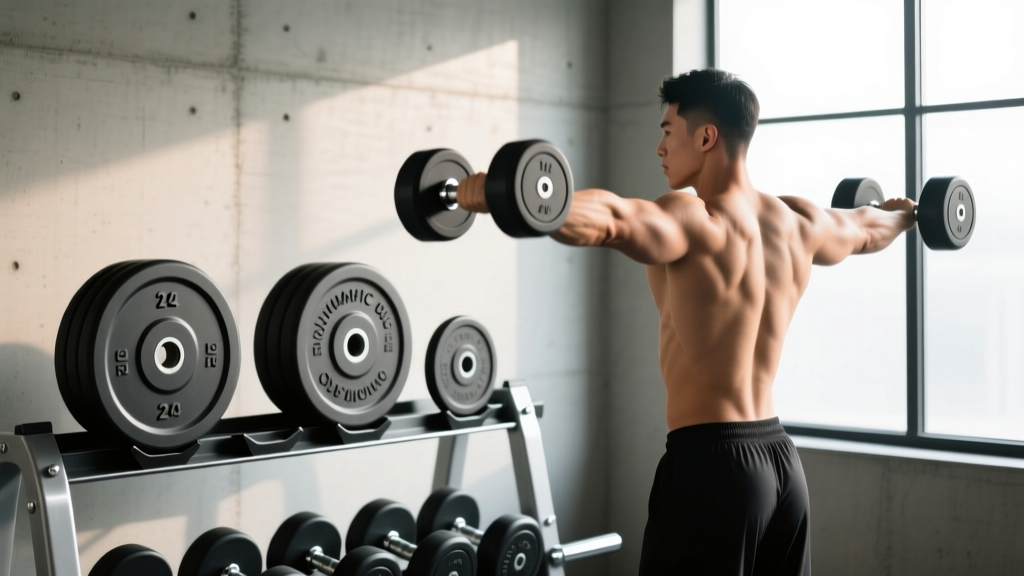
Your pectoralis major fibers run horizontally across your chest. To train them effectively, you must move your arms horizontally against resistance. When you lie on a flat bench, gravity pulls the dumbbells straight down, creating maximum horizontal resistance on the chest. However, when you stand perfectly upright holding dumbbells, gravity still pulls them straight down toward the floor. An upright 'standing fly' is biomechanically a straight-arm front raise. The anterior deltoids (front shoulders) do 90% of the dynamic work, while the chest merely acts as a static stabilizer.
Step-by-Step Guide: The Hinged Standing Dumbbell Fly
To properly target the chest while standing, you must change your body's angle relative to gravity by using a hip hinge. This mimics the angle of a flat or incline bench without requiring the equipment.
- The Setup: Grab a pair of light adjustable dumbbells (10 to 20 lbs is plenty for beginners). Stand with feet shoulder-width apart, knees slightly bent.
- The Hinge: Push your hips backward and hinge your torso forward until your chest is nearly parallel to the floor. Keep your spine completely neutral—do not round your lower back.
- The Starting Position: Let your arms hang straight down toward the floor, palms facing each other. Maintain a slight, 'soft' bend in your elbows (about 10 to 15 degrees). Lock this elbow angle in place.
- The Concentric Phase: Exhale and sweep the dumbbells out to the sides and upward, as if you are hugging a massive barrel. Focus on squeezing the pectoral muscles to pull the weight, not the biceps or shoulders.
- The Peak Contraction: Stop when the dumbbells are level with your torso. Do not let them touch or clink together at the top, as this removes tension from the chest.
- The Eccentric Phase: Inhale and slowly lower the weights back to the starting position over a full 3-second count, feeling a deep stretch across the chest.
Common Failure Modes and Corrections
- Flaring the Elbows: Bending the elbows too much turns the movement into a triceps extension or a weird press. Keep the elbow angle locked and rigid.
- Using Momentum: Swinging the torso to heave the weights up removes the chest from the equation. Brace your core as if preparing for a punch to stabilize the spine.
- Overstretching at the Bottom: Lowering the dumbbells too far past the torso places extreme shear stress on the anterior shoulder capsule. Stop the descent when your hands are in line with your chest.
Putting It Together: Your First Free-Weight Push Day
Integrating your new Olympic plates and your mastery of the standing fly into a cohesive routine is the final step. Here is a beginner-friendly push workout that utilizes both barbell plates and dumbbells:
| Exercise | Sets | Reps | Equipment Needed |
|---|---|---|---|
| Barbell Floor Press | 3 | 8-10 | Olympic Barbell & Plates |
| Standing Overhead Press | 3 | 8-12 | Olympic Barbell & Plates |
| Hinged Standing Dumbbell Fly | 3 | 12-15 | Adjustable Dumbbells |
| Dumbbell Lateral Raises | 3 | 15-20 | Adjustable Dumbbells |
Final Thoughts on Building Your Arsenal
Investing in Olympic weight plates ensures your home gym can grow with your strength for decades, avoiding the frustrating limitations and safety hazards of standard 1-inch gear. Pairing that smart equipment investment with a deep, biomechanical understanding of movements like the standing dumbbell fly exercise guarantees that your hard work in the gym actually translates to muscle growth. Train smart, respect the gravity vectors, and enjoy the journey of free-weight mastery.
More gear to consider
All reviews
Quad Exercises With Dumbbells: Rubber Hex vs Urethane 2026
Troubleshooting the Reverse Dumbbell Press with Neoprene Dumbbells

Olympic Barbell Knurling: Fixing Grip From Cable Dumbbell Curls
Fixing Plate Mistakes in Dumbbell Workouts for Biceps and Chest

Dumbbells vs Barbells: Rubber Hex vs Urethane Dumbbell Care