
Olympic vs Standard Plates Setup & Rear Delt Pulls Dumbbell Guide
Master your home gym setup with our Olympic vs standard plates installation walkthrough, plus spatial tips for rear delt pulls dumbbell exercises.

The 2-Inch vs. 1-Inch Divide: Ecosystem Fundamentals
When designing a comprehensive free weight zone in 2026, the most critical foundational decision you will make is choosing between Olympic and standard weight plate ecosystems. This choice dictates not only the barbells you purchase but also the structural requirements of your plate storage, rack compatibility, and long-term budget. The primary differentiator is the center hole diameter: standard plates feature a 1-inch center hole, while Olympic plates utilize a 2-inch center hole designed to fit over the thick, rotating sleeves of Olympic barbells.
Standard plates are typically cast from lower-grade iron and paired with lightweight, often threaded, 1-inch bars. While they serve as an accessible entry point, standard bars generally max out at a safe load capacity of 200 to 300 pounds before the sleeves begin to bend or the collar threading strips under heavy stress. Conversely, Olympic plates—ranging from bare cast iron to virgin rubber bumpers—are engineered for high-load compound lifting. A standard 7-foot Olympic barbell can safely support 1,000 to 1,500 pounds, making it the mandatory choice for serious lifters.
Step-by-Step Installation: Securing Heavy Plate Storage
Setting up your plate storage is not merely about assembly; it is an exercise in structural load management. A fully loaded Olympic plate tree can easily exceed 800 pounds, concentrating immense point-load stress on your flooring. Below is the complete installation walkthrough for securing a heavy-duty A-Frame plate tree and wall-mounted standard racks.
Phase 1: Floor Joist Mapping and Preparation
- Locate the Joists: Use a stud finder to map the floor joists beneath your intended setup area. Standard residential flooring is rated for 40-50 pounds per square foot (psf) live load. An 800-pound plate tree occupying a 4-square-foot footprint exerts 200 psf, which will cause floor deflection if not placed directly over structural supports.
- Positioning: Align the base of the plate tree so that it spans perpendicular across at least three floor joists to distribute the weight.
- Subfloor Protection: Lay down a 3/8-inch thick vulcanized rubber mat (such as those from Horse Stall Mats) cut to a 4x4 foot square. This prevents the steel base from micro-shifting and dampens acoustic vibrations when loading plates.
Phase 2: Assembling the A-Frame Tree
For Olympic setups, we recommend heavy-gauge steel trees like the Titan Fitness A-Frame or the Rogue A-Frame Plate Tree. During assembly, apply a medium-strength threadlocker (e.g., Loctite Blue 242) to all structural hex bolts. The repeated vibration of dropping iron plates onto the barbell can slowly back out untreated hardware over time. Torque the base gusset bolts to 60 ft-lbs to ensure the vertical horns remain perfectly plumb.
⚠️ Critical Warning for Wall-Mounted Standard Racks:If you are installing wall-mounted pegs for 1-inch standard plates, you must anchor directly into the center of 16-inch on-center wood studs or solid concrete. Never use drywall toggle bolts for weight storage. Use 3/8-inch x 3-inch structural lag bolts driven at least 2 inches into the stud core to prevent catastrophic pull-out under sheer stress.
Comparison Matrix: Standard vs. Olympic Specifications
To visualize the engineering and market differences in the current 2026 landscape, review the data matrix below compiled from leading strength equipment manufacturers and the National Strength and Conditioning Association (NSCA).
| Feature | Standard Plates (1-Inch) | Olympic Plates (2-Inch) |
|---|---|---|
| Center Hole Diameter | 1.00 inch | 2.00 inches (50mm) |
| 45lb Plate Diameter | 14.0 - 15.5 inches | 17.7 inches (450mm IWF Standard) |
| Average Cost per Pound | $1.20 - $1.80 | $2.00 - $4.50 |
| Barbell Sleeve Type | Smooth or Threaded (Fixed) | Rotating (Bushings or Bearings) |
| Max Safe Load (Bar Dependent) | 200 - 300 lbs | 1,000 - 1,500+ lbs |
Spatial Integration: Dumbbell Zones & Clearance Metrics
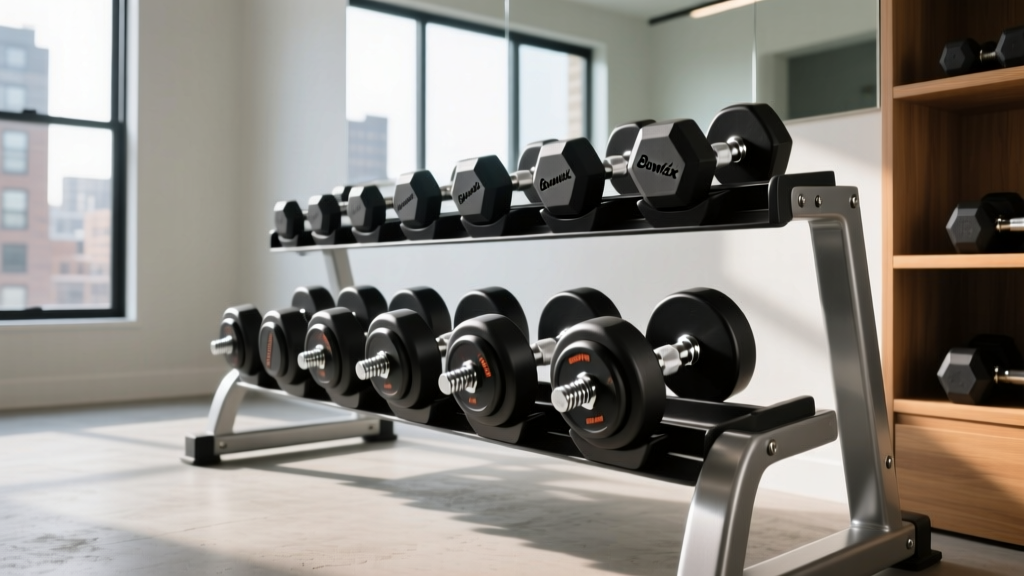
A well-designed home gym requires seamless flow between heavy barbell zones and isolation dumbbell areas. When placing your adjustable dumbbell rack or tiered dumbbell stand adjacent to your plate storage, spatial planning is paramount to prevent injury and equipment damage.
For example, if your programming includes high-volume rear delt pulls dumbbell variations, you need a minimum of 42 inches of lateral clearance between the loaded plate tree and the edge of the dumbbell rack. The bent-over hinge position required for the rear delt pulls dumbbell exercise demands significant posterior and lateral space. Failing to account for this clearance often results in lifters striking their elbows or knuckles against the steel horns of the plate tree during the eccentric phase of the movement. Always measure the full wingspan of the user plus the length of the dumbbell handle (typically 5.5 to 6.5 inches per side) to establish your safety perimeter.
Biomechanical Application: Execution Focus
According to the American Council on Exercise (ACE) Exercise Library, proper spinal alignment during bent-over isolation work is critical. When performing your rear delt pulls dumbbell routine near your storage zone, maintain a neutral spine hinged at 45 to 60 degrees. Squeeze the scapulae together at the apex of the pull, ensuring the dumbbell paths track toward your hips rather than your chest, which shifts the load away from the posterior deltoids and onto the latissimus dorsi.
Real-World Failure Modes & 2026 Market Pricing
As you finalize your setup, be aware of the common failure modes associated with both plate ecosystems:
- Standard Plate Rust and Flaking: Budget standard plates often feature thin enamel paint that chips upon impact, exposing bare iron to humidity. In 2026, we recommend spending an extra $0.20 per pound for rubber-encased standard plates if your gym lacks climate control.
- Olympic Sleeve Friction: Cheap Olympic bars use low-grade bushings that seize up when exposed to chalk dust and iron oxide. If you buy bare cast iron Olympic plates, you must routinely wire-brush the inner rings and wipe the barbell sleeves with 3-in-One oil to maintain smooth rotation during Olympic lifts.
- Bumper Plate Degradation: While urethane Olympic bumpers are highly durable, cheaper crumb-rubber bumpers can develop "mushrooming" around the 2-inch steel insert hub if dropped repeatedly on uneven flooring. Always ensure your lifting platform is perfectly level.
Pro-Tip for 2026 Buyers: If you are on a strict budget, purchase a high-quality Olympic barbell and a basic set of bare cast-iron Olympic plates first. You can upgrade to calibrated competition plates or urethane bumpers later, but a bent 1-inch standard barbell is a total loss that cannot be salvaged or safely used.
By meticulously planning your floor load distribution, anchoring your storage hardware with structural-grade fasteners, and respecting the spatial clearance required for isolation movements, your free weight zone will remain safe, functional, and primed for progressive overload for decades to come.
More gear to consider
All reviews
Best Storage for 1-Inch Dumbbell Sets: 2026 Budget Guide

Bumper vs Iron Plates: Value for Spin Lock Dumbbell & Bar Rigs

Loadable Dumbbell Care for the Standing Dumbbell Reverse Fly
Bowflex Dumbbells Jammed? Best Storage Racks to Prevent It

Collar Types & Rotator Cuff Exercises with Dumbbells: Safety Guide
