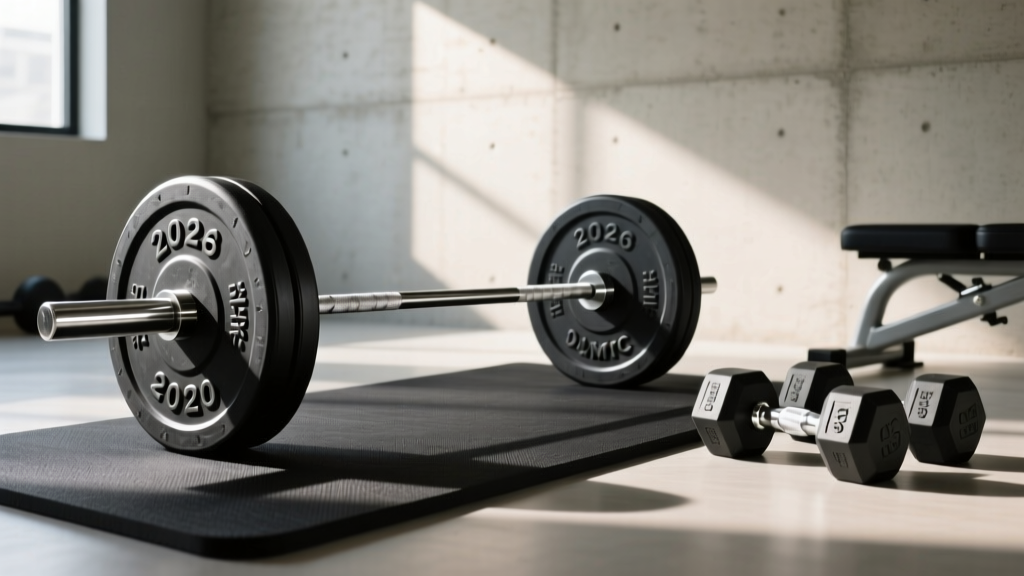
Olympic vs Standard: Which Muscle Must Contract to Lift the Dumbbell?
Compare Olympic vs standard weight plates and explore how handle thickness and rotational inertia affect which muscle must contract to lift the dumbbell.

The Home Gym Dilemma: 2-Inch vs. 1-Inch Plate Architecture
Building a free-weight sanctuary in 2026 requires navigating a fork in the road that has defined home gyms for decades: the choice between Olympic (2-inch hub) and Standard (1-inch hub) weight plates. While casual lifters often default to standard plates due to their lower upfront cost and availability at big-box retailers, serious strength athletes almost universally gravitate toward Olympic gear. But this decision extends far beyond mere compatibility with power racks and barbells. The physical dimensions of your plates dictate the handles you must use, which in turn subtly alters the biomechanics of every isolation and compound movement you perform.
When studying exercise kinesiology, a common textbook question asks which muscle must contract to lift the dumbbell during a standard bicep curl. The fundamental answer points to the biceps brachii as the primary agonist, assisted by the brachialis and brachioradialis (ExRx.net). However, in a real-world training environment, the equipment you load onto that dumbbell handle—specifically whether you are using bulky Olympic plates or compact standard plates—fundamentally alters grip demands, rotational inertia, and stabilizer recruitment. Let us break down this head-to-head comparison.
Core Specifications: Olympic vs. Standard Weight Plates
Before analyzing the biomechanical impact, we must establish the physical and economic differences between the two ecosystems. The table below outlines the baseline specifications for cast iron and bumper plates across both categories in the current market.
| Feature | Olympic Plates (2-Inch) | Standard Plates (1-Inch) |
|---|---|---|
| Hub Diameter | 50mm (Fits 2-inch sleeves) | 25mm (Fits 1-inch sleeves) |
| Plate Diameter (45lb/20kg) | 450mm (Standardized) | ~350mm - 380mm (Varies by brand) |
| Lighter Plate Diameters | 450mm (Bumpers) or Scaled (Iron) | Drastically decreases (e.g., 10lb is tiny) |
| Average Cost Per Pound | $1.50 - $3.50 / lb | $0.80 - $1.50 / lb |
| Max Load per Dumbbell Handle | 150+ lbs (Heavy-duty steel sleeves) | 40 - 60 lbs (Threaded collars limit space) |
Biomechanics & Grip: How Plate Size Alters Muscle Activation
The most profound difference between these two systems lies in the dumbbell handles they require. Standard dumbbell handles typically feature a 25mm to 28mm grip diameter. Olympic dumbbell handles, designed to slide over 2-inch barbell sleeves, often feature grip thicknesses ranging from 35mm to over 50mm (such as the Rogue Olympic Dumbbell Handles).
The Grip Fatigue Factor
Returning to our earlier kinesiology question: which muscle must contract to lift the dumbbell? If you are using a standard 1-inch handle, the biceps brachii easily takes over as the primary mover. However, when you switch to a thick-grip Olympic dumbbell handle loaded with 2-inch plates, the biomechanical hierarchy shifts. The forearm flexors—specifically the flexor digitorum superficialis and flexor carpi radialis—must contract isometrically with significantly greater force just to maintain grip integrity.
This premature forearm fatigue often becomes the limiting factor in pulling movements like dumbbell rows or Romanian deadlifts, forcing the lifter to terminate the set before the target muscles (the latissimus dorsi or hamstrings) reach true muscular failure. According to the American Council on Exercise (ACE), grip thickness directly correlates with increased electromyographic (EMG) activity in the forearm musculature, proving that your plate choice indirectly dictates your isolation exercise outcomes.
Rotational Inertia and Stabilizer Recruitment
Beyond grip thickness, the physical footprint of the plates changes the physics of the lift. Standard plates scale down in diameter as they get lighter. A 5-pound standard plate is barely larger than the handle itself. Conversely, Olympic bumper plates maintain a uniform 450mm diameter regardless of weight.
Expert Insight: When performing a dumbbell chest press with Olympic bumper plates, the massive 450mm diameter places the weight's center of mass further away from the wrist joint. This increases the rotational inertia, demanding higher stabilization torque from the anterior deltoid and the rotator cuff to prevent the dumbbell from tilting laterally at the bottom of the press.
For hypertrophy-focused lifters, this increased stabilization requirement can be a double-edged sword. It builds incredible joint resilience and functional strength, but it may detract from pure pectoral isolation. If your goal is strict chest isolation, standard iron plates (which sit closer to the handle) offer a more stable, predictable lever arm.
Head-to-Head: Real-World Failure Modes and Edge Cases
When investing in free weights, understanding how equipment fails under stress is just as important as how it performs. Here is a breakdown of the mechanical limitations inherent to both systems.
⚠️ Warning: The Standard Handle Bending Point
Standard 1-inch dumbbell handles are typically constructed from lower-grade steel or hollow tubing to keep costs down. Once you exceed 80 pounds of total loaded weight per hand, the 1-inch sleeve is highly susceptible to bending under the lateral torque of heavy presses. Furthermore, the threaded collars used to secure standard plates frequently strip or warp, leading to dangerous plate slippage mid-set. Olympic handles utilize solid steel sleeves with snap-ring or bolt-on retention, safely supporting loads well over 150 pounds per hand.
Standard Plates: The Casting Porosity Issue
- Inaccurate Weights: Budget standard plates are often sand-cast with low quality control. A 25lb standard plate can easily weigh 23.5lbs or 26.5lbs, ruining progressive overload tracking.
- Hub Stretching: The 1-inch hole in cheap cast iron plates can deform over time, especially when dropped, making them difficult to slide onto handles.
- Space Inefficiency: Because standard plates are thicker and lack precision machining, loading heavy dumbbells requires massive sleeve space, which standard handles simply do not have.
Olympic Plates: The Calibration Advantage
- Precision Machining: High-quality Olympic plates (like those from Titan Fitness or Rogue) are machined to within 1-2% of their stated weight.
- Drop Safety: Olympic bumper plates feature a stainless steel insert that grips the 50mm sleeve tightly, absorbing drops without damaging the floor or the plate hub.
- Resale Value: The 2-inch Olympic standard is universal. Upgrading or selling your gear in the secondary market is vastly easier than trying to offload niche 1-inch standard sets.
The 2026 Verdict: Building Your Free Weight Arsenal
So, which system wins the head-to-head battle? The answer depends entirely on your training age, budget, and spatial constraints.
Choose Standard (1-Inch) If: You are outfitting a budget-friendly apartment gym, your maximum dumbbell pressing weight is under 50 lbs per hand, and you primarily focus on high-rep isolation work where handle thickness and rotational inertia are negligible factors. Standard plates remain a viable, space-saving entry point for casual fitness.
Choose Olympic (2-Inch) If: You are a serious strength athlete, CrossFit competitor, or bodybuilder who plans to progressively overload for years. The ability to load heavy, accurate weight onto robust handles ensures that when you ask yourself which muscle must contract to lift the dumbbell, the answer is always your target muscle group—not your failing grip or a bending steel sleeve.
Frequently Asked Questions
Can I use Olympic plates on a standard barbell?
No. Olympic plates feature a 50mm (2-inch) hole, while standard barbells have 25mm (1-inch) sleeves. Attempting to mix these systems without a specialized, heavy-duty adapter sleeve is dangerous and will result in the plate sliding off the bar during movement.
Do Olympic dumbbell handles take up too much space?
Yes, the sleeves on Olympic dumbbell handles are significantly longer and thicker than standard handles. This can limit the range of motion on exercises like dumbbell flies or close-grip presses if you are using large diameter 45lb bumper plates. For these specific movements, many lifters prefer loading smaller-diameter Olympic iron plates or fractional change plates.
Are standard weight plates completely obsolete?
While commercial gyms and serious home gyms have universally adopted the Olympic standard, 1-inch standard plates are still heavily manufactured for budget retail markets, school physical education programs, and lightweight aerobic pump sets where extreme durability and precise calibration are not required.
More gear to consider
All reviews
Top Picks for Wrist Workouts With Dumbbells: Rubber Hex vs Urethane

How to Get Bigger Arms with Dumbbells vs. Olympic Barbells

EZ Bar vs Straight Bar: Gold's Gym Dumbbell Value Comparison

Best Neoprene Dumbbells for Dumbbell Exercises (No Bench) 2026

Rubber Hex vs Urethane: Gear for a Chest Workout With One Dumbbell