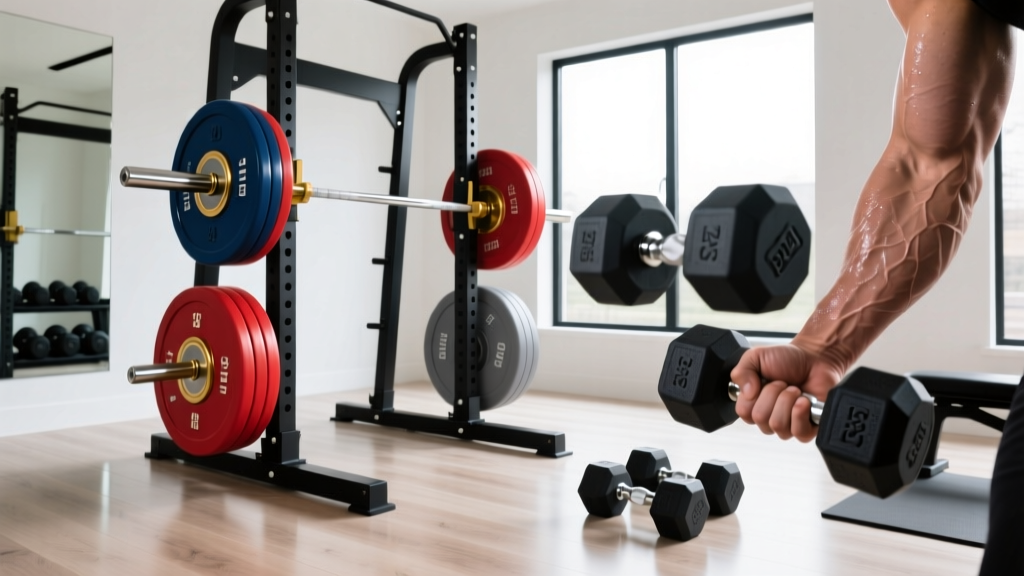
Olympic vs Standard Plates Setup & Forearm Curls Dumbbell Guide
Master your home gym setup with our 2026 walkthrough of Olympic vs standard plates, rack installation, and forearm curls dumbbell integration.

The Core Dilemma: 1-Inch Standard vs. 2-Inch Olympic Ecosystems
When engineering a comprehensive home gym in 2026, the foundational decision isn't which power rack to buy, but which weight plate ecosystem to commit to. The divide between Olympic (2-inch / 50mm) and Standard (1-inch / 25mm) plates dictates your equipment's lifespan, safety margins, and exercise versatility. According to BarBend's comprehensive breakdown of Olympic vs standard weight plates, the primary difference extends far beyond the center hole diameter; it encompasses barbell whip, sleeve rotation mechanics, and ultimate tensile strength.
Quick Spec Matrix:- Olympic Hole: 50.4mm (fits 50mm barbell sleeves)
- Standard Hole: 25.4mm (fits 25mm barbell sleeves)
- Max Load Tolerance: Olympic bars routinely handle 1,000–1,500 lbs; Standard bars often yield or bend at 200–250 lbs.
- Sleeve Rotation: Olympic sleeves utilize bronze bushings or needle bearings to reduce torque during dynamic lifts.
Complete Rack and Plate Installation Walkthrough
Setting up your free weight station requires methodical assembly to ensure safety under heavy axial loading. Below is a step-by-step installation guide for a standard 4-post power rack and plate storage system.
Step 1: Rack Anchoring and Footprint Clearance
Before unboxing your plates, secure the rack. If you are using a rack like the Rogue SML-2C or Fitness Reality 8000XL, bolt it to your platform or use heavy-duty rear weight storage pegs to counterbalance front-loaded squats. Ensure you have a minimum of 24 inches of clearance on all sides for plate loading. For 45lb Olympic bumper plates (which measure 17.7 inches in diameter), verify that your J-cups are set at a height that allows the barbell to clear the rack's crossmembers during unracking.
Step 2: Sleeve Loading and Collar Sequencing
When installing Olympic plates onto the barbell sleeve, always follow the 'Heavy-to-Light' sequencing rule. Load the 45lb plates first, followed by 35s, 25s, and 10s. This ensures the plates with the smallest surface area are pushed flush against the inner sleeve collar, minimizing lateral shift. Secure the setup with OSO Pro aluminum clamps or heavy-duty spring collars. Never rely on friction alone; a 45lb plate sliding off a 50mm sleeve during a bench press creates a catastrophic seesaw effect.
Step 3: Integrating Plate Storage Trees
Install your weight storage tree at least 18 inches away from the rack's uprights to prevent knuckle scraping during heavy deadlifts or barbell rows. Organize plates by denomination, keeping fractional plates (2.5lb and 5lb) at eye level to encourage micro-loading.
Integrating Isolation: The Forearm Curls Dumbbell Protocol
While Olympic plates dominate the squat rack and deadlift platform, standard 1-inch plates possess a hidden, highly specific advantage for micro-loading isolation movements. When executing the forearm curls dumbbell movement, progressive overload is notoriously difficult. The brachioradialis and flexor carpi radialis muscles fatigue quickly, and jumping from a 15lb to a 20lb fixed hex dumbbell (a 33% increase) often leads to tendon strain or compromised form.
This is where 1-inch standard plate-loaded dumbbell handles (such as the CAP Barbell 14-inch solid steel handles) paired with standard cast-iron plates become a secret weapon. By utilizing standard 1.25lb and 2.5lb plates, you can increase the load on your forearm curls dumbbell exercise by mere ounces, perfectly matching the strength curve of the forearm flexors. Furthermore, the longer 14-inch standard handles allow for a wider grip, shifting the leverage and heavily recruiting the brachialis muscle for thicker arm development.
2026 Cost Analysis & Space Footprint
As of 2026, global supply chains for cast iron and polyurethane have stabilized, but the price gap between ecosystems remains significant. Below is a realistic cost breakdown for outfitting a home gym with 300 lbs of working weight.
| Ecosystem | Material | Avg. Cost Per Pound | Total 300lb Cost | Space Footprint |
|---|---|---|---|---|
| Standard (1-inch) | Cast Iron | $1.50 - $2.00 | $450 - $600 | Compact (smaller diameter) |
| Olympic (2-inch) | Cast Iron | $2.00 - $2.80 | $600 - $840 | Standard (17.7" diameter for 45s) |
| Olympic (2-inch) | Virgin Rubber | $3.00 - $4.50 | $900 - $1,350 | Standard (low bounce) |
| Olympic (2-inch) | Premium Urethane | $4.50 - $6.00 | $1,350 - $1,800 | Standard (ultra-durable, odorless) |
Common Failure Modes & Edge Cases
Understanding how equipment fails is critical for long-term setup safety. Here are the most frequent edge cases encountered in mixed-equipment home gyms:
- The 'Standard Bar Whip' Failure: Standard 1-inch bars lack the tensile strength of 190k PSI Olympic steel. Loading a standard bar past 200 lbs for heavy Romanian Deadlifts will cause permanent plastic deformation (bending). Once a standard bar bends, it will no longer roll smoothly in the J-cups, creating a severe safety hazard.
- Hub Cracking in Cheap Bumpers: When dropping low-quality Olympic rubber plates from overhead, the steel insert hub can separate from the rubber matrix. Always inspect the Rogue Fitness Echo Bumper specifications or similar high-durometer (85A-90A) plates to ensure the steel hub is fully encapsulated and reinforced.
- Calibration Inaccuracies: Budget standard plates often suffer from severe weight variances (up to 10% off stated weight). For compound lifts, this causes unilateral imbalances. Always use calibrated Olympic plates for heavy bilateral movements.
FAQ: Plate Maintenance and Storage
How do I prevent cast iron plates from rusting in a garage gym?
Garage environments introduce severe humidity fluctuations. To protect cast iron standard and Olympic plates, wire-brush any existing oxidation, wipe down with mineral spirits, and apply a thin coat of 3-in-One oil or paste wax. Avoid painting the inner hubs, as the friction from the barbell sleeve will quickly chip the paint and create debris.
Can I use Olympic plates on a standard bar with an adapter?
While 2-inch to 1-inch sleeve adapters exist, they are strongly discouraged for any lift where the bar leaves the rack. Adapters introduce lateral slop, alter the bar's center of gravity, and create a shear point that can snap under heavy loads. Keep your ecosystems strictly separated: Olympic for the rack, Standard for micro-loaded dumbbell handles and isolation accessories.
More gear to consider
All reviews
2026 Dumbbell Racks for the Best Hamstring Exercise with Dumbbells
Power Rack vs Squat Rack vs Stand for HIIT Training with Dumbbells

Olympic vs Standard Plates for Your Dumbbell Triceps Press

Olympic vs Standard Plates: What Fits Your Dumbbell Hand & Bar?

Bumper vs Iron Plates: Budgeting for Dumbbell Chest Press Variations
